
How to Grow and Care for Prickly goldenfleece
Urospermum picroides
Written by Emilio Marruso · last checked
At a glance
Prickly golden fleece is a wild edible plant whose leaves are used in traditional cooking. This annual grows from seed, and in one trial, seeds sown in early October gave two leaf harvests, in November and December. Cut the leaves, let them grow back and pick again. Just keep an eye on it, because it can spread outside its home range.
- Harvest
Eat the leaves: cut them, let them regrow and cut again for a second harvest
What the sources say (3)
How to harvest: Cut the leaves and let them grow again; two harvests optimize yield (leafy-vegetable trial)
Two harvests were made, cutting the leaves and allowing them to grow again, so as to optimize yield
— agriculture [5] Harvest: 11 November and 16 December (two cuttings of the leaves, floating hydroponic system, sown 7 October)
Bari, Italy (floating hydroponic system): The first harvests were on 11 and 20 November for U. picroides and U. dalechampii, respectively; the second on 16 December and 13 January, respectively.
— agriculture [5] The first harvests were on 11 and 20 November for U. picroides and U. dalechampii, respectively; the second on 16 December and 13 January, respectively.
— agriculture [5] - Watch out
Outside its home range it can spread and form dense patches
- Propagation
An annual that grows from seed
What the sources say (2)
Propagation: Seed
On 7 October, seeds were sown in cells containing a peat-based commercial substrate
— agriculture [5] Life cycle: annual
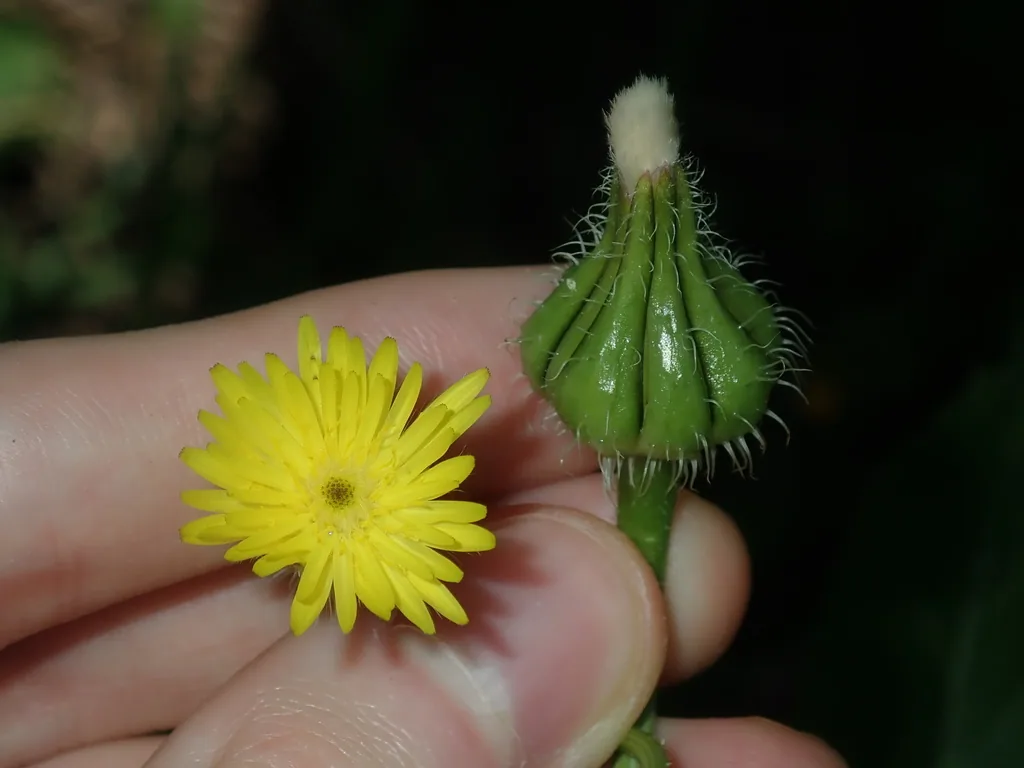
Species Urospermum picroides is clearly distinct from Urospermum dalechampii as it is an annual, not a perennial, and because it is covered with rigid hairs
— Urospermum picroides (L.) Scop. ex F.W. Schmidt - Herbari Virtual del Mediterrani Occidental [4] - Sowing
Sow seeds in cells in early October
What the sources say (2)
Sowing: 7 October (seeds sown in cells, then grown in a floating hydroponic system)
Bari, Italy (floating hydroponic system): On 7 October, seeds were sown in cells containing a peat-based commercial substrate
— agriculture [5] On 7 October, seeds were sown in cells containing a peat-based commercial substrate
— agriculture [5]
Overview
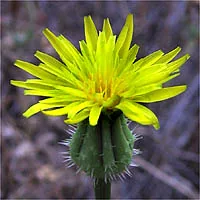
Prickly goldenfleece is an annual plant with a taproot and stiff hairs, spreading as a weed outside the Mediterranean region. [2][3] It is a wild edible plant used in traditional cuisine and folk medicine, and it has been tested as a vegetable for the ready-to-eat chain. [5] In a floating-system trial seeds were sown in October and the leaves were cut twice, in November and December. [5]
This record is incomplete: the sources we read do not cover every field yet.
Not yet covered by our sources: Watering, Light, Spacing
Prickly goldenfleece care
How to water Prickly goldenfleece
Not stated in the sources we read.
How much light Prickly goldenfleece needs
Not stated in the sources we read.
Where to grow Prickly goldenfleece
Not stated in the sources we read.
How to propagate Prickly goldenfleece
Seed
What the sources say (1)
On 7 October, seeds were sown in cells containing a peat-based commercial substrateHow to grow Prickly goldenfleece
The plant
Life cycle
annual
What the sources say (1)
Species Urospermum picroides is clearly distinct from Urospermum dalechampii as it is an annual, not a perennial, and because it is covered with rigid hairsFamily
Asteraceae (Compositae)
What the sources say (1)
Family:
COMPOSITAE (ASTERACEAE)
Genus:Harvest and storage
How to harvest
Cut the leaves and let them grow again; two harvests optimize yield (leafy-vegetable trial)
What the sources say (1)
Two harvests were made, cutting the leaves and allowing them to grow again, so as to optimize yieldFertilizing
Mineral fertilizers
The sources give different values depending on region, zone or growing conditions.
What each source says
floating hydroponic system (research trial): Nutrient solution with 140 mg/L nitrate, 300 mg/L potassium, 60 mg/L phosphate, 40 mg/L magnesium, 150 mg/L calcium and 130 mg/L sulfate
What the sources say (1)
floating hydroponic system (research trial): grown in a floating hydroponic system using a nutrient solution composed of 140, 300, 60, 40, 150, 130 mg/L NO3−, K+, H2PO4−, Mg2+, Ca2+ , SO4 2-, respectively.Avoid
The sources give different values depending on region, zone or growing conditions.
What each source says
floating hydroponic system (research trial): A nitrate-only nutrient solution up to harvest: removing part or all nitrate nitrogen a few days before harvest, or adding ammonium nitrogen, lowers leaf nitrate
What the sources say (1)
floating hydroponic system (research trial): removing part or all nitrate nitrogen from the nutrient solution a few days before harvesting; using nutrient solutions with NO3-N and NH4-N rather than nitrate nitrogen alone [43] could therefore be used to reduce nitrate content in cultivated U. delechampii and U. picroidesPrickly goldenfleece pests and problems
Invasive behavior outside its native range
Symptom: In California the species is reported as spreading and forming dense patches in some locations.
What the sources say (1)
In California, the species has recently been reported to be spreading in Santa Barbara county and the San Francisco Bay Area, forming dense patches in some locations.
— Urospermum picroides Risk – California Invasive Plant Council [3]
Remedies
The sources we checked give no remedies for this plant.
Calendar
7 October (seeds sown in cells, then grown in a floating hydroponic system)
What each source says
Bari, Italy (floating hydroponic system): 7 October
11 November and 16 December (two cuttings of the leaves, floating hydroponic system, sown 7 October)
What each source says
Bari, Italy (floating hydroponic system): First harvest 11 November, second 16 December
What the sources say (2)
Bari, Italy (floating hydroponic system): The first harvests were on 11 and 20 November for U. picroides and U. dalechampii, respectively; the second on 16 December and 13 January, respectively.The first harvests were on 11 and 20 November for U. picroides and U. dalechampii, respectively; the second on 16 December and 13 January, respectively.Months as given by the sources, which are mostly from the United States (northern hemisphere). In the southern hemisphere they shift by about six months.
Edibility
Reported by the source, quoted verbatim. Do not eat a plant on the basis of this page alone: identification mistakes can be dangerous.
Smooth golden fleece (Urospermum dalechampii (L.) F.W. Schmidt) and prickly golden fleece (Urospermum picroides (L.) Scop. ex F.W. Schmid) are two wild edible plants used in traditional cuisine and folk medicine.
[5]
Similar plants
- Urospermum dalechampii Urospermum dalechampii
- Abraham Trachystemon orientalis
- Abyssinian banana Ensete ventricosum
- Acacia longifolia Acacia longifolia
- African Blue Lily Agapanthus praecox
- African lily Dietes bicolor
- African lovegrass Eragrostis curvula
- African tuliptree Spathodea campanulata
Sources
Every value above is quoted from these documents. Links lead to the original publisher.
- VicFlora: Urospermum picroides · vicflora.rbg.vic.gov.au, consulted
- Urospermum picroides (L.) F. W. Schmidt, PRICKLY GOLDENFLEECE. Annual, taprooted, · smmflowers.org, consulted
- Urospermum picroides Risk – California Invasive Plant Council · cal-ipc.org, consulted
- Urospermum picroides (L.) Scop. ex F.W. Schmidt - Herbari Virtual del Mediterrani Occidental · herbarivirtual.uib.cat, consulted
- agriculture · ricerca.uniba.it, consulted
Written by Emilio Marruso · last checked