
How to Grow and Care for Vanilla
Vanilla planifolia
Written by Emilio Marruso · last checked
At a glance
Natural vanilla extract comes from the seed pods of this orchid, so growing it means growing your own vanilla beans. It is a perennial with modest needs: give it bright, mottled shade, and once rooted it wants very little water and very little feeding. Eight to nine months after the flowers are pollinated, the pods are ready to harvest and cure.
- Sun
Bright, mottled shade
What the sources say (1)
Light: Bright, mottled shade
Like many orchids, vanilla prefers areas with good air flow and bright, mottled shade.
— Vanilla – Gardening Solutions [4] - Water
Very little water once it has rooted
What the sources say (1)
Watering: Very little watering once rooted
Once rooted, these lovely orchids are low maintenance, requiring very little watering, pruning or fertilizing.
— Vanilla – Gardening Solutions [4] - Cold
Survives winters down to 30 °F (−1.1 °C)
Half hardy: mild winters or an unheated greenhouse · USDA 10a · RHS H3 · Z10
What the sources say (2)
Hardiness, coldest zone: 10a [winter low −1.1 to 1.7 °C (30 to 35 °F)]
This vining orchid grows in South Florida (zones 10a to 11a), climbing up host trees and flowering in the branches.
— Vanilla – Gardening Solutions [4] Hardiness, warmest zone: 11a [winter low 4.4 to 7.2 °C (40 to 45 °F)]
This vining orchid grows in South Florida (zones 10a to 11a), climbing up host trees and flowering in the branches.
— Vanilla – Gardening Solutions [4] - Feeding
Very little feeding once it has rooted
What the sources say (1)
How often: Very little once rooted
Once rooted, these lovely orchids are low maintenance, requiring very little watering, pruning or fertilizing.
— Vanilla – Gardening Solutions [4] - Harvest
Cut the pods 8–9 months after pollination; once cured, they become vanilla beans
What the sources say (3)
How to harvest: Capsules are harvested 8-9 months after pollination, either as the whole cluster cut from its base (more common commercially) or as individual capsules
Las cápsulas de vainilla alcanzan su estado óptimo de cosecha entre ocho y nueve meses después de la polinización (Van Dek et al., 2014).
— ENH1392s/EP661: Producción natural del extracto de vainilla [1] La vainilla es cosechada ya sea por el racimo completo o por cápsulas individuales (Figura 2).
— ENH1392s/EP661: Producción natural del extracto de vainilla [1] Cosechar el racimo entero, cortándolo desde su base, es más común en la producción comercial.
— ENH1392s/EP661: Producción natural del extracto de vainilla [1] - Propagation
Grow new plants from cuttings
What the sources say (1)
Propagation: Cuttings
Large cuttings (24 to 36 inches) can root and flower in two to three years, while smaller cuttings will take longer, likely three to four years.
— Vanilla – Gardening Solutions [4]
Overview
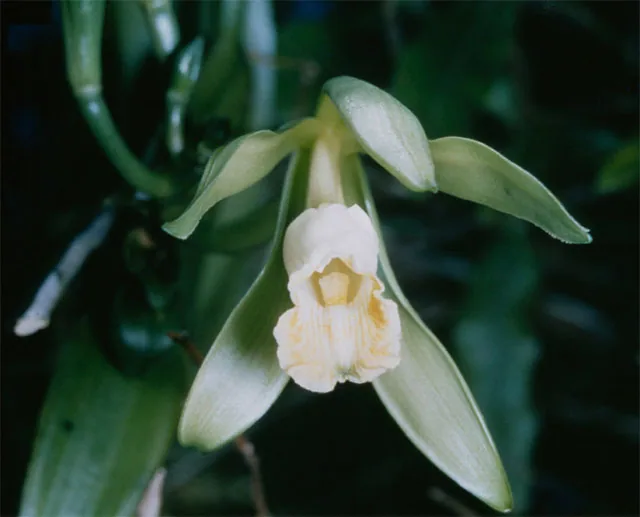
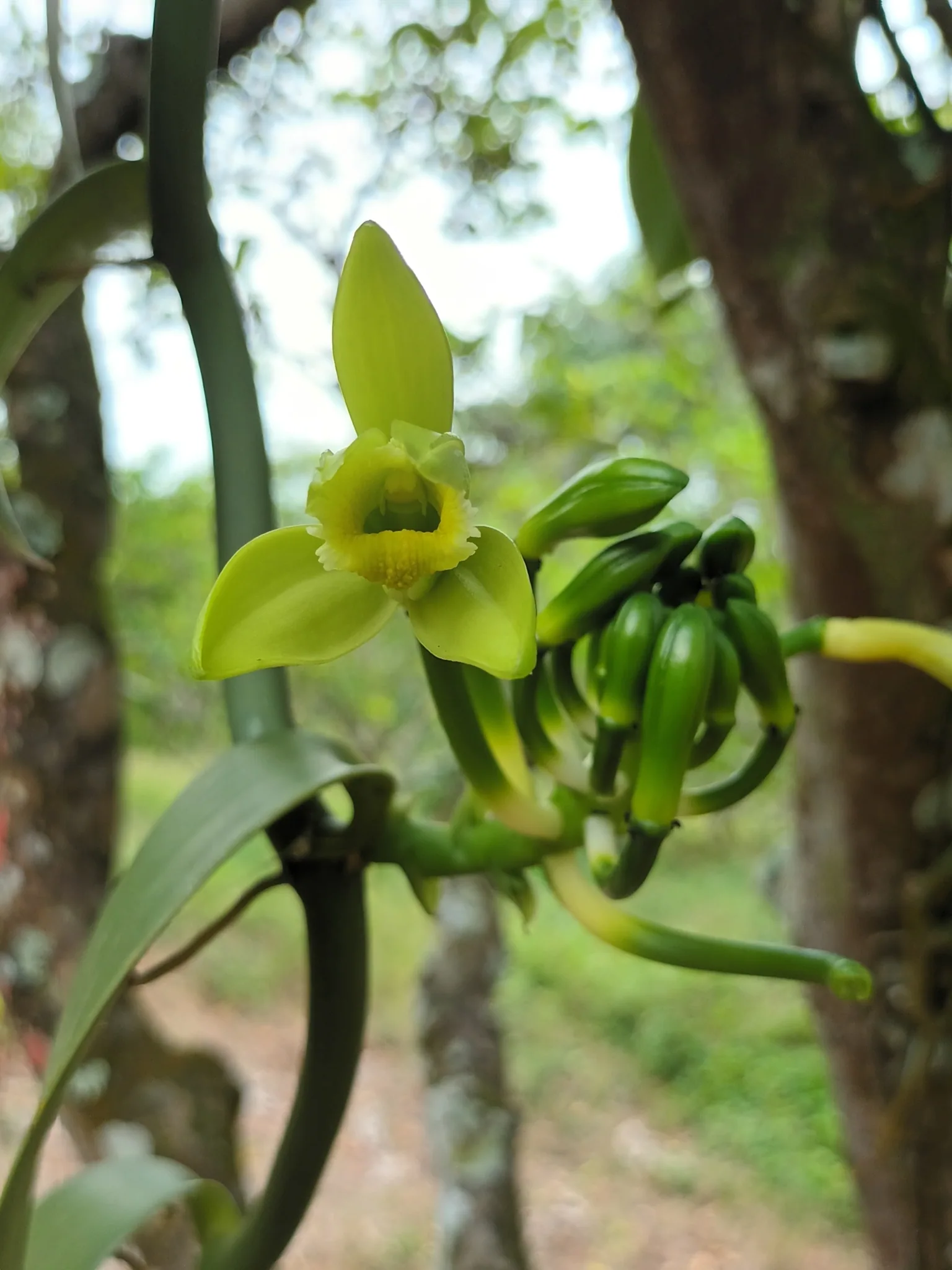
Vanilla planifolia is a vining, semi-epiphytic orchid whose seed pods are the source of natural vanilla. [4] Grown in Florida in zones 10a to 11a, it prefers good air flow and bright, mottled shade and needs very little watering once rooted. [4] Flowers must be pollinated by hand and the pods are harvested months later. [1]
This record is incomplete: the sources we read do not cover every field yet.
Not yet covered by our sources: Sowing / Planting, Harvest
Vanilla care
How to water Vanilla
Very little watering once rooted
What the sources say (1)
Once rooted, these lovely orchids are low maintenance, requiring very little watering, pruning or fertilizing.How much light Vanilla needs
Bright, mottled shade
What the sources say (1)
Like many orchids, vanilla prefers areas with good air flow and bright, mottled shade.How much cold Vanilla can take
Hardiness, coldest zone
10a [winter low −1.1 to 1.7 °C (30 to 35 °F)]
What the sources say (1)
This vining orchid grows in South Florida (zones 10a to 11a), climbing up host trees and flowering in the branches.Hardiness, warmest zone
11a [winter low 4.4 to 7.2 °C (40 to 45 °F)]
What the sources say (1)
This vining orchid grows in South Florida (zones 10a to 11a), climbing up host trees and flowering in the branches.How to propagate Vanilla
Cuttings
What the sources say (1)
Large cuttings (24 to 36 inches) can root and flower in two to three years, while smaller cuttings will take longer, likely three to four years.How to grow Vanilla
The plant
Life cycle
perennial
What the sources say (1)
The vine is perennial and can reach a length of over 200 feet.Harvest and storage
How to harvest
Capsules are harvested 8-9 months after pollination, either as the whole cluster cut from its base (more common commercially) or as individual capsules
What the sources say (3)
Las cápsulas de vainilla alcanzan su estado óptimo de cosecha entre ocho y nueve meses después de la polinización (Van Dek et al., 2014).La vainilla es cosechada ya sea por el racimo completo o por cápsulas individuales (Figura 2).Cosechar el racimo entero, cortándolo desde su base, es más común en la producción comercial.Fertilizing
How often
Very little once rooted
What the sources say (1)
Once rooted, these lovely orchids are low maintenance, requiring very little watering, pruning or fertilizing.Remedies
Each remedy shows what official sources say about it; traditional remedies without an official source are marked as such. Harmful ones are listed so you know to avoid them.
Treating the plant
root rot
removing and destroying diseased plants with roots Not verified
Traditional remedy, not verified by an official source.
How: Remove & destroy dead & diseased plants along with roots.
trichoderma and pseudomonas at planting Not verified
Traditional remedy, not verified by an official source.
How: Apply native isolates of Trichoderma harzanium and Pseudomonas fluroscens at time of planting and in main field
Calendar
Sowing
Not stated in the sources we read.
Planting
Not stated in the sources we read.
Harvest
Not stated in the sources we read.
Months as given by the sources, which are mostly from the United States (northern hemisphere). In the southern hemisphere they shift by about six months.
Edibility
Reported by the source, quoted verbatim. Do not eat a plant on the basis of this page alone: identification mistakes can be dangerous.
Natural vanilla extract comes from the seed pods of the orchid.
[4]
Indicative values
Values from a secondary source, not checked word for word like the rest of this page. Use them as a starting point.
- Mature height
- 243.8-304.8 cm (8-10 ft)Indicative value, adapt it to your climate · Secondary source
- Hours of sun
- 8-10 hoursIndicative value, adapt it to your climate · Secondary source
- Soil pH
- 6-7Indicative value, adapt it to your climate · Secondary source
- Care level
- MediumIndicative value, adapt it to your climate · Secondary source
- Growth rate
- HighIndicative value, adapt it to your climate · Secondary source
- Pruning
- March, April, March, April, May, June, July, August, SeptemberIndicative value, adapt it to your climate · Secondary source
Similar plants
- Aji Capsicum chinense
- Alexanders Smyrnium olusatrum
- American pepper Schinus molle
- Angelica Angelica archangelica
- Anise burnet saxifrage Pimpinella anisum
- Bayrumtree Pimenta racemosa
- Bitter orange Citrus × aurantium
- Black caraway Nigella sativa
Sources
Every value above is quoted from these documents. Links lead to the original publisher.
- ENH1392s/EP661: Producción natural del extracto de vainilla · edis.ifas.ufl.edu, consulted
- ENH1392s · edis.ifas.ufl.edu, consulted
- Vanilla: A Tropical Treat | University of Vermont Extension · uvm.edu, consulted
- Vanilla – Gardening Solutions · gardeningsolutions.ifas.ufl.edu, consulted
Written by Emilio Marruso · last checked