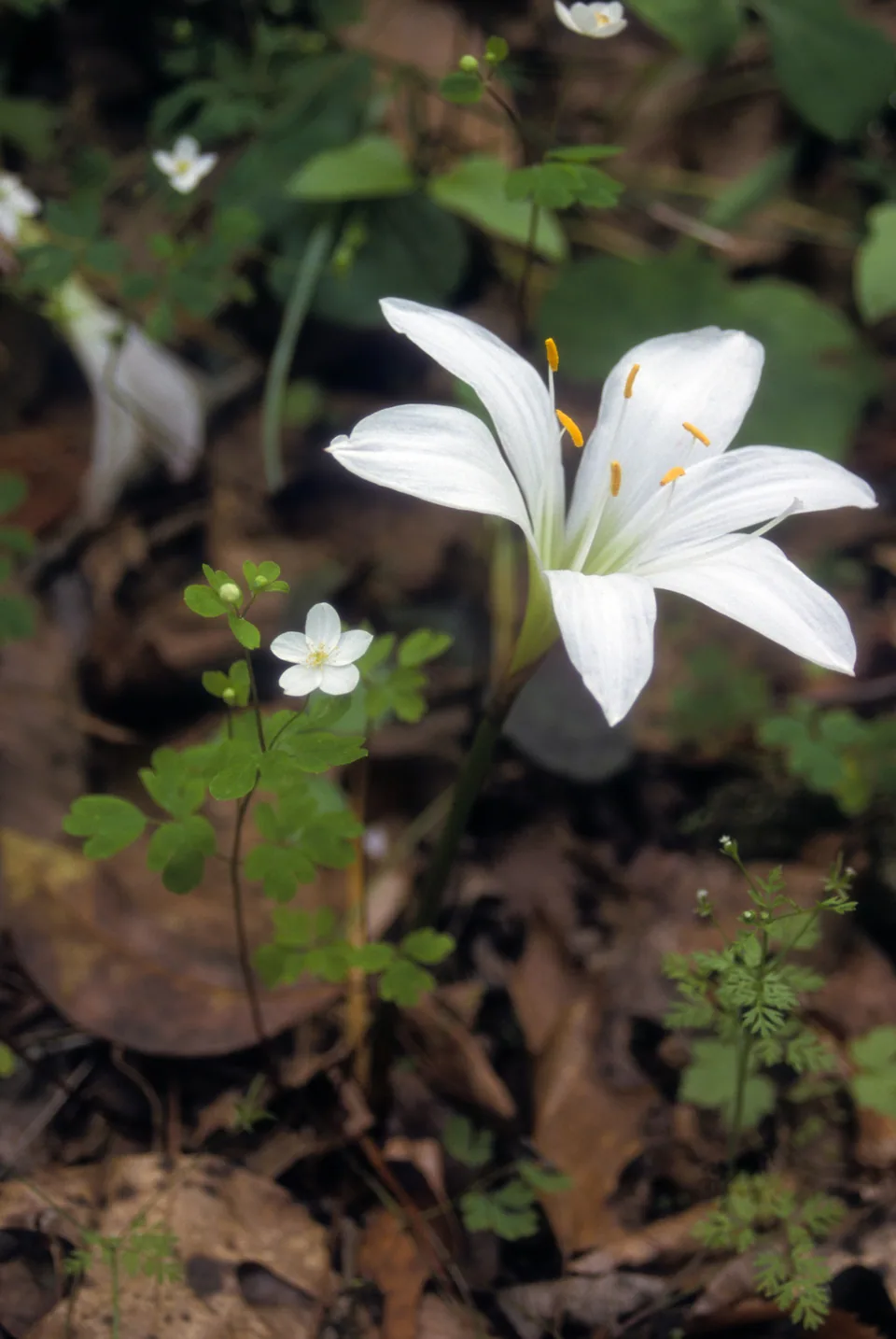


How to Grow and Care for Rain Lily
Zephyranthes atamasco
Written by Emilio Marruso · last checked
Toxic to: Cats, Dogs, Horses, People · Why
At a glance
The atamasco lily is happy where many plants struggle: it loves moist to wet, rich soil and even handles seasonal flooding. Give it full sun or partial shade, with at least 2 hours of direct sun a day for the best blooms. It grows 1–2 ft tall, comes back year after year and does well in containers too.
- Sun
Full sun to partial shade; at least 2 hours of direct sun a day for the best blooms
What the sources say (2)
Light: Full sun to partial shade; blooms best with at least 2 hours of direct sunlight a day
Plant in full sun to partial shade in moist to wet organically rich soils. Occasionally add some leaf mold to the soil.
— Zephyranthes atamasco (Atamasca Lily, Common Atamasco-lily, Fairy Lily, Rain Lily, Zephyr Lily) | North Carolina Extension Gardener Plant Toolbox [1] It will tolerate seasonal flooding and will bloom best if it receives at least 2 hours of direct sunlight a day.
— Zephyranthes atamasco (Atamasca Lily, Common Atamasco-lily, Fairy Lily, Rain Lily, Zephyr Lily) | North Carolina Extension Gardener Plant Toolbox [1] - Water
Keep the soil moist to wet; it handles seasonal flooding and rests in summer
What the sources say (3)
Watering: Moist to wet, organically rich soils
Plant in full sun to partial shade in moist to wet organically rich soils. Occasionally add some leaf mold to the soil.
— Zephyranthes atamasco (Atamasca Lily, Common Atamasco-lily, Fairy Lily, Rain Lily, Zephyr Lily) | North Carolina Extension Gardener Plant Toolbox [1] Watering notes: Tolerates seasonal flooding; goes dormant in summer
It will tolerate seasonal flooding and will bloom best if it receives at least 2 hours of direct sunlight a day.
— Zephyranthes atamasco (Atamasca Lily, Common Atamasco-lily, Fairy Lily, Rain Lily, Zephyr Lily) | North Carolina Extension Gardener Plant Toolbox [1] It can spread from bulb offsets to form colonies. The plant goes dormant in summer
— Zephyranthes atamasco (Atamasca Lily, Common Atamasco-lily, Fairy Lily, Rain Lily, Zephyr Lily) | North Carolina Extension Gardener Plant Toolbox [1] - Cold
Survives winters down to 0 °F (−17.8 °C)
Hardy in very cold winters · USDA 7a · RHS H6 · Z7
What the sources say (2)
Hardiness, coldest zone: 7a [winter low −17.8 to −15 °C (0 to 5 °F)]
USDA Plant Hardiness Zone: 7a, 7b, 8a, 8b, 9a, 9b, 10a, 10b
— Zephyranthes atamasco (Atamasca Lily, Common Atamasco-lily, Fairy Lily, Rain Lily, Zephyr Lily) | North Carolina Extension Gardener Plant Toolbox [1] Hardiness, warmest zone: 10b [winter low 1.7 to 4.4 °C (35 to 40 °F)]
USDA Plant Hardiness Zone: 7a, 7b, 8a, 8b, 9a, 9b, 10a, 10b
— Zephyranthes atamasco (Atamasca Lily, Common Atamasco-lily, Fairy Lily, Rain Lily, Zephyr Lily) | North Carolina Extension Gardener Plant Toolbox [1] - Soil
Soil rich in organic matter
What the sources say (1)
Watering: Moist to wet, organically rich soils
Plant in full sun to partial shade in moist to wet organically rich soils. Occasionally add some leaf mold to the soil.
— Zephyranthes atamasco (Atamasca Lily, Common Atamasco-lily, Fairy Lily, Rain Lily, Zephyr Lily) | North Carolina Extension Gardener Plant Toolbox [1] - Size
1–2 ft tall and 6–12 in wide
What the sources say (2)
Mature height: 30.48-60.96 cm (1-2 ft)
Dimensions: Height: 1 ft. 0 in. - 2 ft. 0 in. Width: 0 ft. 6 in. - 1 ft. 0 in.
— Zephyranthes atamasco (Atamasca Lily, Common Atamasco-lily, Fairy Lily, Rain Lily, Zephyr Lily) | North Carolina Extension Gardener Plant Toolbox [1] Mature width: 15.24-30.48 cm (0.5-1 ft)
Dimensions: Height: 1 ft. 0 in. - 2 ft. 0 in. Width: 0 ft. 6 in. - 1 ft. 0 in.
— Zephyranthes atamasco (Atamasca Lily, Common Atamasco-lily, Fairy Lily, Rain Lily, Zephyr Lily) | North Carolina Extension Gardener Plant Toolbox [1] - Propagation
Divide the clumps, sow seeds or replant the small side bulbs
What the sources say (2)
Propagation: Division; seed; bulb offsets
Life Cycle: Bulb Perennial Recommended Propagation Strategy: Division Seed
— Zephyranthes atamasco (Atamasca Lily, Common Atamasco-lily, Fairy Lily, Rain Lily, Zephyr Lily) | North Carolina Extension Gardener Plant Toolbox [1] It can spread from bulb offsets to form colonies.
— Zephyranthes atamasco (Atamasca Lily, Common Atamasco-lily, Fairy Lily, Rain Lily, Zephyr Lily) | North Carolina Extension Gardener Plant Toolbox [1] - Containers
Grows in containers too
What the sources say (1)
In containers: Yes
Landscape Location: Coastal Container Meadow Naturalized Area Near Septic
— Zephyranthes atamasco (Atamasca Lily, Common Atamasco-lily, Fairy Lily, Rain Lily, Zephyr Lily) | North Carolina Extension Gardener Plant Toolbox [1] - Safety
Poisonous, can be fatal if eaten; also harmful to cats, dogs and horses
Overview
Atamasco lily is an onion-like perennial bulb native to the southeastern USA. [1] It grows in full sun to partial shade in moist to wet organically rich soils and tolerates seasonal flooding. [1] All parts are listed as highly poisonous to humans. [1]
This record is incomplete: the sources we read do not cover every field yet.
Not yet covered by our sources: Pruning
Rain Lily care
How to water Rain Lily
Watering
Moist to wet, organically rich soils
What the sources say (1)
Plant in full sun to partial shade in moist to wet organically rich soils. Occasionally add some leaf mold to the soil.Watering notes
Tolerates seasonal flooding; goes dormant in summer
What the sources say (2)
It will tolerate seasonal flooding and will bloom best if it receives at least 2 hours of direct sunlight a day.It can spread from bulb offsets to form colonies. The plant goes dormant in summerHow much light Rain Lily needs
Full sun to partial shade; blooms best with at least 2 hours of direct sunlight a day
What the sources say (2)
Plant in full sun to partial shade in moist to wet organically rich soils. Occasionally add some leaf mold to the soil.It will tolerate seasonal flooding and will bloom best if it receives at least 2 hours of direct sunlight a day.How much cold Rain Lily can take
Hardiness, coldest zone
7a [winter low −17.8 to −15 °C (0 to 5 °F)]
What the sources say (1)
USDA Plant Hardiness Zone:
7a, 7b, 8a, 8b, 9a, 9b, 10a, 10bHardiness, warmest zone
10b [winter low 1.7 to 4.4 °C (35 to 40 °F)]
What the sources say (1)
USDA Plant Hardiness Zone:
7a, 7b, 8a, 8b, 9a, 9b, 10a, 10bWhere to grow Rain Lily
Yes
What the sources say (1)
Landscape Location:
Coastal
Container
Meadow
Naturalized Area
Near SepticHow to propagate Rain Lily
Division; seed; bulb offsets
What the sources say (2)
Life Cycle:
Bulb
Perennial
Recommended Propagation Strategy:
Division
SeedIt can spread from bulb offsets to form colonies.How to grow Rain Lily
The plant
Life cycle
perennial
What the sources say (1)
Family:
Amaryllidaceae
Life Cycle:
Bulb
Perennial
Recommended Propagation Strategy:Family
Amaryllidaceae
What the sources say (1)
Rain lily is an onion-like perennial bulb in the amaryllis family (Amaryllidaceae) that is native to SE USA and NC, mainly in the coastal and Piedmont areas.Mature height
30.48-60.96 cm (1-2 ft)
What the sources say (1)
Dimensions:
Height: 1 ft. 0 in. - 2 ft. 0 in.
Width: 0 ft. 6 in. - 1 ft. 0 in.Mature width
15.24-30.48 cm (0.5-1 ft)
What the sources say (1)
Dimensions:
Height: 1 ft. 0 in. - 2 ft. 0 in.
Width: 0 ft. 6 in. - 1 ft. 0 in.Remedies
Each remedy shows what official sources say about it; traditional remedies without an official source are marked as such. Harmful ones are listed so you know to avoid them.
First aid
First aid: not a substitute for a doctor
ingestion of toxic parts
wipe out the mouth and rinse it with water Official source, not independently tested
Do not induce vomiting and do not give them anything to drink.
— missouripoisoncenter.org [5] If the person is awake and alert, call the Missouri Poison Center at 1-800-222-1222 for further treatment advice.
— missouripoisoncenter.org [5] How: Wipe out the mouth with a damp cloth and/or let the person rinse the mouth out with water, then call the poison center.
Wipe out their mouth with a damp cloth and or let them rinse their mouth out with water.
— missouripoisoncenter.org [5]
Treating the plant
slugs and snails
beer trap Works
Set the traps in the early evening in the beds where snails and slugs have been causing damage.
— lsuagcenter.com [6] How: Sink a small plastic bowl up to its rim in the ground and fill it half full of beer; empty and replenish the traps daily until you stop catching many snails or slugs.
To make a beer trap, sink a small plastic bowl up to its rim in the ground and fill it half full of beer.
— lsuagcenter.com [6] What the evidence says All snails and slugs are very attracted to the yeasty smell of beer and will gladly crawl into it if given a chance.
— lsuagcenter.com [6] hand picking Partly works
How: Hand picking is done at night with a flashlight; put the snails and slugs in a plastic bag and throw them away.
Hand picking is done at night with a flashlight and is not for the squeamish.
— lsuagcenter.com [6] What the evidence says The main strategies for their control involve baits, traps, hand picking and encouraging predators that eat them.
— lsuagcenter.com [6] copper barrier Works
Make sure an area is free of snails and slugs before you enclose it inside a copper barrier.
— lsuagcenter.com [6] How: Barriers made with copper flashing and screen, at least 4 inches tall and buried an inch or two below the soil.
The easiest to maintain are those made with copper flashing and screen.
— lsuagcenter.com [6] What the evidence says It is believed that copper barriers are effective because the copper reacts with the slime that snails and slugs secrete
— lsuagcenter.com [6] salt Harmful
How: Salt sprinkled around plants against snails and slugs.
Avoid using salt to control snails and slugs.
— lsuagcenter.com [6] What the evidence says Using salt around your plants can damage them. Salts in the soil can burn plant roots.
— lsuagcenter.com [6]
Is Rain Lily toxic to pets?
Reported by the source, quoted verbatim. This is not medical or veterinary advice: if a person or an animal may have eaten this plant, contact a poison control centre or a veterinarian.
Animals
#problem for cats #problem for dogs #problem for horses
[1]The source flags the risk for this animal but does not explain why.
People
Poison Severity: High Poison Symptoms: May be fatal if eaten though it is so bitter it I difficult to ingest enough. Nausea, vomiting, and diarrhea.
[1]- Poisonous parts
Causes Contact Dermatitis: No Poison Part: Flowers Fruits Leaves Roots Stems
[1]- Toxic principle
Poison Toxic Principle: Alkaloids lycorine and others Causes Contact Dermatitis: No Poison Part:
[1]- Symptoms
Poison Symptoms: May be fatal if eaten though it is so bitter it I difficult to ingest enough. Nausea, vomiting, and diarrhea.
[1]- Severity
Poison Severity: High Poison Symptoms: May be fatal if eaten
[1]
Calendar
Pruning
Not stated in the sources we read.
Months as given by the sources, which are mostly from the United States (northern hemisphere). In the southern hemisphere they shift by about six months.
Similar plants
- Aztec Lily Zephyranthes formosissima
- Rain Lily Zephyranthes candida
- Rain Lily Zephyranthes drummondii
- African Blood Lily Scadoxus multiflorus
- African Blue Lily Agapanthus praecox
- Allium triquetrum Allium triquetrum
- Amazon Lily Urceolina amazonica
- Blue Globe Onion Allium caeruleum
Sources
Every value above is quoted from these documents. Links lead to the original publisher.
- Zephyranthes atamasco (Atamasca Lily, Common Atamasco-lily, Fairy Lily, Rain Lily, Zephyr Lily) | North Carolina Extension Gardener Plant Toolbox · plants.ces.ncsu.edu, consulted
- Zephyranthes (Atamasco Lily, Fairy Lily, Rainflower, Rain Lily, Zephyr Lily) | North Carolina Extension Gardener Plant Toolbox · plants.ces.ncsu.edu, consulted
- Fairy Lily - Zephyranthes atamasco | North Carolina Extension Gardener Plant Toolbox · plants.ces.ncsu.edu, consulted
- Atamasca Lily - Zephyranthes atamasco | North Carolina Extension Gardener Plant Toolbox · plants.ces.ncsu.edu, consulted
- missouripoisoncenter.org · missouripoisoncenter.org
- lsuagcenter.com · lsuagcenter.com
Written by Emilio Marruso · last checked