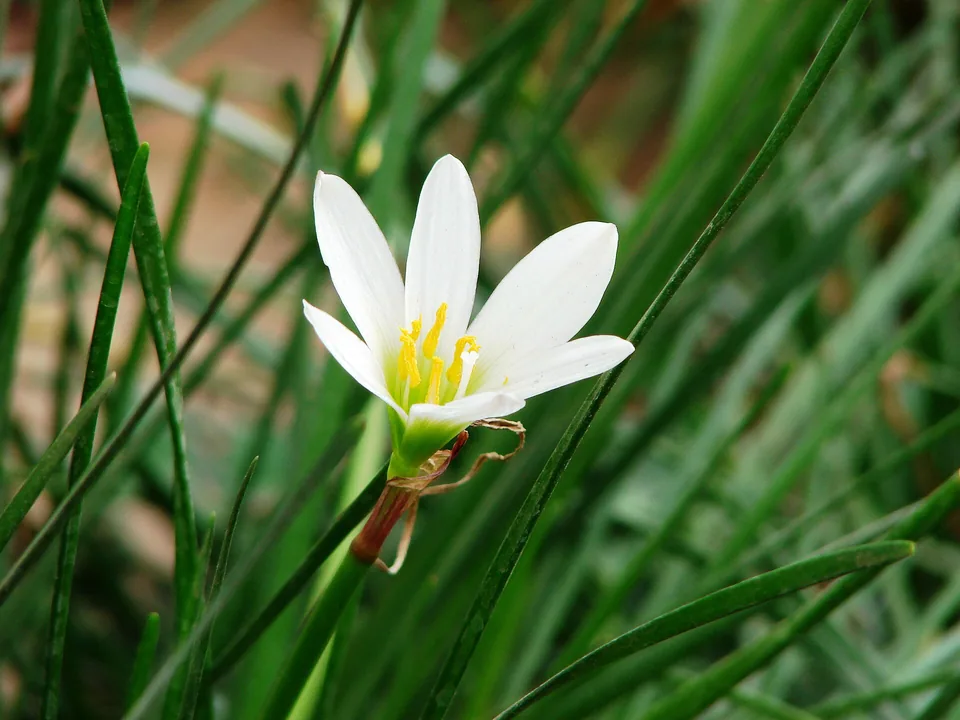


How to Grow and Care for Rain Lily
Zephyranthes candida
Written by Emilio Marruso · last checked
At a glance
This little rain lily is easygoing: it handles full sun or partial shade and tolerates both dry spells and wet soil. Staying just 6 inches to 1 foot tall and wide, it fits in garden beds, in pots or even indoors. In cooler climates, simply keep the bulbs cool and dry indoors through winter, and they're ready to bloom again.
- Sun
Full sun to partial shade
What the sources say (2)
Light: Full sun to partial shade
Although they can be grown in part shade, full sun will provide the best performance.
— Zephyranthes candida (Autumn Rain-lily, Fairy Lily, Peruvian Swamp-lily, Rain Lily, Zephyr Flower) | North Carolina Extension Gardener Plant Toolbox [1] Light: Full sun (6 or more hours of direct sunlight a day) Partial Shade (Direct sunlight only part of the day, 2-6 hours)
— Zephyranthes candida (Autumn Rain-lily, Fairy Lily, Peruvian Swamp-lily, Rain Lily, Zephyr Flower) | North Carolina Extension Gardener Plant Toolbox [1] - Water
Handles dry spells and wet soil; potted bulbs indoors in winter need just enough water
What the sources say (4)
Watering: Drought tolerant; also tolerates wet soils
Resistance To Challenges: Diseases Drought Insect Pests Poor Soil Wet Soil
— Zephyranthes candida (Autumn Rain-lily, Fairy Lily, Peruvian Swamp-lily, Rain Lily, Zephyr Flower) | North Carolina Extension Gardener Plant Toolbox [1] #clumping #wet soils tolerant #drought tolerant #perennial #patio
— Zephyranthes candida (Autumn Rain-lily, Fairy Lily, Peruvian Swamp-lily, Rain Lily, Zephyr Flower) | North Carolina Extension Gardener Plant Toolbox [1] Watering notes: Potted bulbs kept indoors over winter need just enough moisture to keep the soil from drying out totally; soil drainage good to moist
If planting in containers, they should be moved indoors to a cool but frost-free area and provided with just enough moisture to keep the soil from drying out totally.
— Zephyranthes candida (Autumn Rain-lily, Fairy Lily, Peruvian Swamp-lily, Rain Lily, Zephyr Flower) | North Carolina Extension Gardener Plant Toolbox [1] Soil Drainage: Good Drainage Moist Available Space To Plant:
— Zephyranthes candida (Autumn Rain-lily, Fairy Lily, Peruvian Swamp-lily, Rain Lily, Zephyr Flower) | North Carolina Extension Gardener Plant Toolbox [1] - Cold
Survives winters down to 0 °F (−17.8 °C)
Hardy in very cold winters · USDA 7a · RHS H6 · Z7
What the sources say (2)
Hardiness, coldest zone: 7a [winter low −17.8 to −15 °C (0 to 5 °F)]
USDA Plant Hardiness Zone: 7a, 7b, 8a, 8b, 9a, 9b, 10a, 10b
— Zephyranthes candida (Autumn Rain-lily, Fairy Lily, Peruvian Swamp-lily, Rain Lily, Zephyr Flower) | North Carolina Extension Gardener Plant Toolbox [1] Hardiness, warmest zone: 10b [winter low 1.7 to 4.4 °C (35 to 40 °F)]
USDA Plant Hardiness Zone: 7a, 7b, 8a, 8b, 9a, 9b, 10a, 10b
— Zephyranthes candida (Autumn Rain-lily, Fairy Lily, Peruvian Swamp-lily, Rain Lily, Zephyr Flower) | North Carolina Extension Gardener Plant Toolbox [1] - Pruning
Once flowers fade, cut them off at the base so it doesn't reseed
What the sources say (1)
Pruning: After the flowers have bloomed and faded (cut flowers back at the base to prevent reseeding)
To prevent reseeding, cut the flowers back at the base after they have bloomed and faded.
— Zephyranthes candida (Autumn Rain-lily, Fairy Lily, Peruvian Swamp-lily, Rain Lily, Zephyr Flower) | North Carolina Extension Gardener Plant Toolbox [1] - Pests
Watch for slugs, snails and spider mites
What the sources say (1)
Pests: slugs, snails, spider mites
No serious issues; however, watch for slugs and snails. Spider mites may also affect this plant.
— Zephyranthes candida (Autumn Rain-lily, Fairy Lily, Peruvian Swamp-lily, Rain Lily, Zephyr Flower) | North Carolina Extension Gardener Plant Toolbox [1] - Watch out
In extreme heat leaves die back and blooms suffer: shade it from afternoon sun
- Size
6 inches to 1 foot tall and wide
What the sources say (2)
Mature height: 15.24-30.48 cm (6 in-1 ft)
Dimensions: Height: 0 ft. 6 in. - 1 ft. 0 in. Width: 0 ft. 6 in. - 1 ft. 0 in.
— Zephyranthes candida (Autumn Rain-lily, Fairy Lily, Peruvian Swamp-lily, Rain Lily, Zephyr Flower) | North Carolina Extension Gardener Plant Toolbox [1] Mature width: 15.24-30.48 cm (6 in-1 ft)
Dimensions: Height: 0 ft. 6 in. - 1 ft. 0 in. Width: 0 ft. 6 in. - 1 ft. 0 in.
— Zephyranthes candida (Autumn Rain-lily, Fairy Lily, Peruvian Swamp-lily, Rain Lily, Zephyr Flower) | North Carolina Extension Gardener Plant Toolbox [1] - Propagation
Separate the small side bulbs in spring, or collect seed from the flower center after petals drop
What the sources say (2)
Propagation: Offsets (separated in spring), seed
Offsets can be separated in the spring. To prevent reseeding, cut the flowers back at the base after they have bloomed and faded. Seed can be collected from the center of the flower after the petals drop.
— Zephyranthes candida (Autumn Rain-lily, Fairy Lily, Peruvian Swamp-lily, Rain Lily, Zephyr Flower) | North Carolina Extension Gardener Plant Toolbox [1] Saving seeds: Collect seed from the center of the flower after the petals drop.
Seed can be collected from the center of the flower after the petals drop.
— Zephyranthes candida (Autumn Rain-lily, Fairy Lily, Peruvian Swamp-lily, Rain Lily, Zephyr Flower) | North Carolina Extension Gardener Plant Toolbox [1] - Containers
Grows in pots and indoors; in cool climates keep bulbs cool and dry inside in winter
What the sources say (3)
In containers: Yes
It also works well in containers on a patio or as a houseplant.
— Zephyranthes candida (Autumn Rain-lily, Fairy Lily, Peruvian Swamp-lily, Rain Lily, Zephyr Flower) | North Carolina Extension Gardener Plant Toolbox [1] Indoors: Yes
It also works well in containers on a patio or as a houseplant.
— Zephyranthes candida (Autumn Rain-lily, Fairy Lily, Peruvian Swamp-lily, Rain Lily, Zephyr Flower) | North Carolina Extension Gardener Plant Toolbox [1] Storage: Keep the bulbs cool and dry in an indoor location through the winter months (cooler climates).
In cooler climates, it must be dug up before the first frost and stored in an indoor location through the winter months. It should be kept cool and dry while stored.
— Zephyranthes candida (Autumn Rain-lily, Fairy Lily, Peruvian Swamp-lily, Rain Lily, Zephyr Flower) | North Carolina Extension Gardener Plant Toolbox [1]
Overview
Rain lily is a flowering bulb native to South America that is grown as a perennial in zones 7 through 10. [1] Full sun gives the best performance, though it can be grown in part shade. [1] It is used in specimen clumps, rock gardens and borders, and in containers or as a houseplant. [1]
Rain Lily care
How to water Rain Lily
Watering
Drought tolerant; also tolerates wet soils
What the sources say (2)
Resistance To Challenges:
Diseases
Drought
Insect Pests
Poor Soil
Wet Soil#clumping #wet soils tolerant #drought tolerant #perennial #patioWatering notes
Potted bulbs kept indoors over winter need just enough moisture to keep the soil from drying out totally; soil drainage good to moist
What the sources say (2)
If planting in containers, they should be moved indoors to a cool but frost-free area and provided with just enough moisture to keep the soil from drying out totally.Soil Drainage:
Good Drainage
Moist
Available Space To Plant:How much light Rain Lily needs
Full sun to partial shade
What the sources say (2)
Although they can be grown in part shade, full sun will provide the best performance.Light:
Full sun (6 or more hours of direct sunlight a day)
Partial Shade (Direct sunlight only part of the day, 2-6 hours)How much cold Rain Lily can take
Hardiness, coldest zone
7a [winter low −17.8 to −15 °C (0 to 5 °F)]
What the sources say (1)
USDA Plant Hardiness Zone:
7a, 7b, 8a, 8b, 9a, 9b, 10a, 10bHardiness, warmest zone
10b [winter low 1.7 to 4.4 °C (35 to 40 °F)]
What the sources say (1)
USDA Plant Hardiness Zone:
7a, 7b, 8a, 8b, 9a, 9b, 10a, 10bWhere to grow Rain Lily
Indoors
Yes
What the sources say (1)
It also works well in containers on a patio or as a houseplant.In containers
Yes
What the sources say (1)
It also works well in containers on a patio or as a houseplant.How to propagate Rain Lily
Offsets (separated in spring), seed
What the sources say (1)
Offsets can be separated in the spring. To prevent reseeding, cut the flowers back at the base after they have bloomed and faded. Seed can be collected from the center of the flower after the petals drop.How to grow Rain Lily
The plant
Life cycle
perennial
What the sources say (1)
It is grown as a perennial in Zones 7 through 10 and may remain in the landscape as an evergreen.Family
Amaryllidaceae
What the sources say (1)
It is a member of the amaryllis family (Amaryllidaceae).Mature height
15.24-30.48 cm (6 in-1 ft)
What the sources say (1)
Dimensions:
Height: 0 ft. 6 in. - 1 ft. 0 in.
Width: 0 ft. 6 in. - 1 ft. 0 in.Mature width
15.24-30.48 cm (6 in-1 ft)
What the sources say (1)
Dimensions:
Height: 0 ft. 6 in. - 1 ft. 0 in.
Width: 0 ft. 6 in. - 1 ft. 0 in.Harvest and storage
Storage
Keep the bulbs cool and dry in an indoor location through the winter months (cooler climates).
What the sources say (1)
In cooler climates, it must be dug up before the first frost and stored in an indoor location through the winter months. It should be kept cool and dry while stored.Saving seeds
Collect seed from the center of the flower after the petals drop.
What the sources say (1)
Seed can be collected from the center of the flower after the petals drop.Pests and diseases
Pests
slugs, snails, spider mites
What the sources say (1)
No serious issues; however, watch for slugs and snails. Spider mites may also affect this plant.Rain Lily pests and problems
Slugs, snails and spider mites
Symptom: Slugs and snails may be a problem, and spider mites may also affect the plant.
What to do: Watch for these pests.
What the sources say (1)
No serious issues; however, watch for slugs and snails. Spider mites may also affect this plant.
— Zephyranthes candida (Autumn Rain-lily, Fairy Lily, Peruvian Swamp-lily, Rain Lily, Zephyr Flower) | North Carolina Extension Gardener Plant Toolbox [1] Heat dieback
Symptom: In extreme heat the foliage can die back and the floral display is hampered.
What to do: Protect from afternoon sun in locations that experience extreme heat.
What the sources say (1)
In locations that experience extreme heat, protection from afternoon sun will help avoid dieback of the foliage and hampered floral displays.
— Zephyranthes candida (Autumn Rain-lily, Fairy Lily, Peruvian Swamp-lily, Rain Lily, Zephyr Flower) | North Carolina Extension Gardener Plant Toolbox [1]
Remedies
Each remedy shows what official sources say about it; traditional remedies without an official source are marked as such. Harmful ones are listed so you know to avoid them.
Treating the plant
slugs and snails
sunken beer trap Works
Beer as an attractant is definitely not recommended, as the very intense smell merely attracts more snails from the surrounding area.
— plantura.garden [5] How: Trap snails and slugs in shallow pans of stale beer sunken so that the lip of the container is even with the soil surface.
Trap snails and slugs in shallow pans of stale beer sunken so that the lip of the container is even with the soil surface.
— hgic.clemson.edu [4] What the evidence says When found, these pests can be removed by handpicking or by making simple, effective traps. Trap snails and slugs in shallow pans of stale beer sunken so that the lip of the container is even with the soil surface.
— hgic.clemson.edu [4] handpicking Works
How: When found, these pests can be removed by handpicking.
When found, these pests can be removed by handpicking or by making simple, effective traps.
— hgic.clemson.edu [4] What the evidence says When found, these pests can be removed by handpicking or by making simple, effective traps.
— hgic.clemson.edu [4] diatomaceous earth Works
How: Protect young seedlings by sprinkling diatomaceous earth around the plants. It must be reapplied after rain or watering.
Protect young seedlings by sprinkling diatomaceous earth around the plants. Diatomaceous earth is very sharp and scratches the skin of these soft-bodied critters, resulting in dehydration and death. It must be reapplied after rain or watering.
— hgic.clemson.edu [4] What the evidence says Diatomaceous earth is very sharp and scratches the skin of these soft-bodied critters, resulting in dehydration and death.
— hgic.clemson.edu [4]
Calendar
Pruning
After the flowers have bloomed and faded (cut flowers back at the base to prevent reseeding)
What the sources say (1)
To prevent reseeding, cut the flowers back at the base after they have bloomed and faded.Months as given by the sources, which are mostly from the United States (northern hemisphere). In the southern hemisphere they shift by about six months.
Indicative values
Values from a secondary source, not checked word for word like the rest of this page. Use them as a starting point.
- Hours of sun
- 10-12 hoursIndicative value, adapt it to your climate · Secondary source
- Drought tolerant
- yesIndicative value, adapt it to your climate · Secondary source
- Soil pH
- 6-7Indicative value, adapt it to your climate · Secondary source
- Care level
- MediumIndicative value, adapt it to your climate · Secondary source
- Growth rate
- LowIndicative value, adapt it to your climate · Secondary source
Similar plants
- Aztec Lily Zephyranthes formosissima
- Rain Lily Zephyranthes atamasco
- Rain Lily Zephyranthes drummondii
- African Blood Lily Scadoxus multiflorus
- African Blue Lily Agapanthus praecox
- Allium triquetrum Allium triquetrum
- Amazon Lily Urceolina amazonica
- Blue Globe Onion Allium caeruleum
Sources
Every value above is quoted from these documents. Links lead to the original publisher.
- Zephyranthes candida (Autumn Rain-lily, Fairy Lily, Peruvian Swamp-lily, Rain Lily, Zephyr Flower) | North Carolina Extension Gardener Plant Toolbox · plants.ces.ncsu.edu, consulted
- Zephyr Flower - Zephyranthes candida | North Carolina Extension Gardener Plant Toolbox · plants.ces.ncsu.edu, consulted
- Zephyranthes (Atamasco Lily, Fairy Lily, Rainflower, Rain Lily, Zephyr Lily) | North Carolina Extension Gardener Plant Toolbox · plants.ces.ncsu.edu, consulted
- hgic.clemson.edu · hgic.clemson.edu
- plantura.garden · plantura.garden
Written by Emilio Marruso · last checked