

How to Grow and Care for Sunset Huskmallow
Abelmoschus manihot
Written by Emilio Marruso · last checked
At a glance
This okra relative is a garden plant you can eat: its young leaves are tasty raw or cooked and a good source of vitamins and iron. Give it full sun and evenly moist, well-drained soil, and it grows 4–6 feet tall. Cut it to the ground in winter, and this perennial will keep you company year after year, even in a pot.
- Sun
Full sun: 6 or more hours a day
What the sources say (1)
Light: Full sun (6 or more hours of direct sunlight a day)
Light: Full sun (6 or more hours of direct sunlight a day)
— Abelmoschus manihot (Hibiscus Manihot, Muskmallow, Sunset Huskmallow, Tropic Jewel Hibiscus) | North Carolina Extension Gardener Plant Toolbox [1] - Water
Keep the soil evenly moist, but make sure it drains well
What the sources say (1)
Watering: Well-drained, evenly moist soil
This plant grows easily and quickly in well-drained, evenly moist, loamy soils in the full sun and prefers humid conditions.
— Abelmoschus manihot (Hibiscus Manihot, Muskmallow, Sunset Huskmallow, Tropic Jewel Hibiscus) | North Carolina Extension Gardener Plant Toolbox [1] - Cold
Survives winters down to 10 °F (−12.2 °C)
Hardy in cold winters · USDA 8a · RHS H5 · Z8
What the sources say (2)
Hardiness, coldest zone: 8a [winter low −12.2 to −9.4 °C (10 to 15 °F)]
USDA Plant Hardiness Zone: 8a, 8b, 9a, 9b, 10a, 10b
— Abelmoschus manihot (Hibiscus Manihot, Muskmallow, Sunset Huskmallow, Tropic Jewel Hibiscus) | North Carolina Extension Gardener Plant Toolbox [1] Hardiness, warmest zone: 10b [winter low 1.7 to 4.4 °C (35 to 40 °F)]
USDA Plant Hardiness Zone: 8a, 8b, 9a, 9b, 10a, 10b
— Abelmoschus manihot (Hibiscus Manihot, Muskmallow, Sunset Huskmallow, Tropic Jewel Hibiscus) | North Carolina Extension Gardener Plant Toolbox [1] - Soil
Well-drained soil, from slightly acidic to alkaline: pH 6.0–8.0
What the sources say (2)
Soil pH, minimum: 6.0
Soil pH: Neutral (6.0-8.0)
— Abelmoschus manihot (Hibiscus Manihot, Muskmallow, Sunset Huskmallow, Tropic Jewel Hibiscus) | North Carolina Extension Gardener Plant Toolbox [1] Soil pH, maximum: 8.0
Soil pH: Neutral (6.0-8.0)
— Abelmoschus manihot (Hibiscus Manihot, Muskmallow, Sunset Huskmallow, Tropic Jewel Hibiscus) | North Carolina Extension Gardener Plant Toolbox [1] - Pruning
In winter, cut it down to the ground
What the sources say (1)
Pruning: Winter (cut to the ground)
Prune it to the ground in winter to rejuvenate growth in the spring.
— Abelmoschus manihot (Hibiscus Manihot, Muskmallow, Sunset Huskmallow, Tropic Jewel Hibiscus) | North Carolina Extension Gardener Plant Toolbox [1] - Harvest
Eat the young leaves raw or cooked; the seed pods are not edible
- Pests
Watch for aphids, slugs, whiteflies and root nematodes
What the sources say (1)
Pests: aphids, slugs, whiteflies, root nematodes
Insects, Diseases, and Other Plant Problems: Aphids, slugs, and whiteflies can be problems. Root nematodes.
— Abelmoschus manihot (Hibiscus Manihot, Muskmallow, Sunset Huskmallow, Tropic Jewel Hibiscus) | North Carolina Extension Gardener Plant Toolbox [1] - Size
4–6 ft tall and 2–3 ft wide
What the sources say (2)
Mature height: 121.92-182.88 cm (4-6 ft)
It will reach 4-6 feet tall with a 2-3 feet spread.
— Abelmoschus manihot (Hibiscus Manihot, Muskmallow, Sunset Huskmallow, Tropic Jewel Hibiscus) | North Carolina Extension Gardener Plant Toolbox [1] Mature width: 60.96-91.44 cm (2-3 ft)
It will reach 4-6 feet tall with a 2-3 feet spread.
— Abelmoschus manihot (Hibiscus Manihot, Muskmallow, Sunset Huskmallow, Tropic Jewel Hibiscus) | North Carolina Extension Gardener Plant Toolbox [1] - Propagation
Grow new plants from seed or stem cuttings
What the sources say (1)
Propagation: Seed, stem cutting
Recommended Propagation Strategy: Seed Stem Cutting
— Abelmoschus manihot (Hibiscus Manihot, Muskmallow, Sunset Huskmallow, Tropic Jewel Hibiscus) | North Carolina Extension Gardener Plant Toolbox [1] - Containers
Grows in containers too
What the sources say (1)
In containers: Yes
In cooler climates use it as an annual or in a container.
— Abelmoschus manihot (Hibiscus Manihot, Muskmallow, Sunset Huskmallow, Tropic Jewel Hibiscus) | North Carolina Extension Gardener Plant Toolbox [1]
Overview
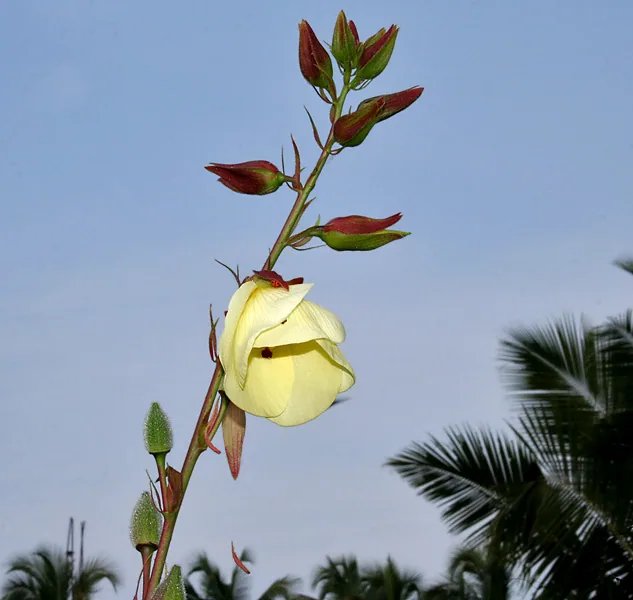
Abelmoschus manihot is a perennial shrubby mallow with large lemon-yellow flowers that last one day. [1] It grows in full sun in well-drained, evenly moist, loamy soils. [1] Its young leaves are edible raw or cooked, while the seed pods are not. [1]
Sunset Huskmallow care
How to water Sunset Huskmallow
Well-drained, evenly moist soil
What the sources say (1)
This plant grows easily and quickly in well-drained, evenly moist, loamy soils in the full sun and prefers humid conditions.How much light Sunset Huskmallow needs
Full sun (6 or more hours of direct sunlight a day)
What the sources say (1)
Light:
Full sun (6 or more hours of direct sunlight a day)How much cold Sunset Huskmallow can take
Hardiness, coldest zone
8a [winter low −12.2 to −9.4 °C (10 to 15 °F)]
What the sources say (1)
USDA Plant Hardiness Zone:
8a, 8b, 9a, 9b, 10a, 10bHardiness, warmest zone
10b [winter low 1.7 to 4.4 °C (35 to 40 °F)]
What the sources say (1)
USDA Plant Hardiness Zone:
8a, 8b, 9a, 9b, 10a, 10bBest soil for Sunset Huskmallow
Soil pH, minimum
6.0
What the sources say (1)
Soil pH:
Neutral (6.0-8.0)Soil pH, maximum
8.0
What the sources say (1)
Soil pH:
Neutral (6.0-8.0)Where to grow Sunset Huskmallow
Yes
What the sources say (1)
In cooler climates use it as an annual or in a container.How to propagate Sunset Huskmallow
Seed, stem cutting
What the sources say (1)
Recommended Propagation Strategy:
Seed
Stem CuttingHow to grow Sunset Huskmallow
The plant
Life cycle
perennial
What the sources say (1)
Sunset huskmallow is a perennial shrubby plant in the mallow family (Malvaceae).Family
Malvaceae
What the sources say (1)
Sunset huskmallow is a perennial shrubby plant in the mallow family (Malvaceae).Mature height
121.92-182.88 cm (4-6 ft)
What the sources say (1)
It will reach 4-6 feet tall with a 2-3 feet spread.Mature width
60.96-91.44 cm (2-3 ft)
What the sources say (1)
It will reach 4-6 feet tall with a 2-3 feet spread.Pests and diseases
Pests
aphids, slugs, whiteflies, root nematodes
What the sources say (1)
Insects, Diseases, and Other Plant Problems: Aphids, slugs, and whiteflies can be problems. Root nematodes.Sunset Huskmallow pests and problems
Aphids, slugs, whiteflies and root nematodes
Symptom: Listed as possible plant problems.
What the sources say (1)
Insects, Diseases, and Other Plant Problems: Aphids, slugs, and whiteflies can be problems. Root nematodes.
— Abelmoschus manihot (Hibiscus Manihot, Muskmallow, Sunset Huskmallow, Tropic Jewel Hibiscus) | North Carolina Extension Gardener Plant Toolbox [1]
Remedies
Each remedy shows what official sources say about it; traditional remedies without an official source are marked as such. Harmful ones are listed so you know to avoid them.
Treating the plant
aphids
soapy water spray Partly works
Regardless of what product is used, be sure to test soap sprays for plant toxicity on a small area of the plant for a couple days prior to widespread use.
— site.extension.uga.edu [3] How: 1 to 2 teaspoons of dish soap in 1 pint of water, sprayed to coat the insects, also under the leaves.
If you are in the latter group, aim for a 1 to 2% soap solution: add 1 to 2 teaspoons of dish soap to 1 pint of water.
— site.extension.uga.edu [3] What the evidence says Because soapy water only works by direct contact to the insects, sprays need to be made whenever new insect populations appear and start to increase.
— site.extension.uga.edu [3]
whiteflies
soapy water spray Partly works
Regardless of what product is used, be sure to test soap sprays for plant toxicity on a small area of the plant for a couple days prior to widespread use.
— site.extension.uga.edu [3] How: 1 to 2 teaspoons of dish soap in 1 pint of water, sprayed to coat the insects, also under the leaves.
If you are in the latter group, aim for a 1 to 2% soap solution: add 1 to 2 teaspoons of dish soap to 1 pint of water.
— site.extension.uga.edu [3] What the evidence says Because soapy water only works by direct contact to the insects, sprays need to be made whenever new insect populations appear and start to increase.
— site.extension.uga.edu [3]
slugs
cardboard or plastic trap Official source, not independently tested
How: Lay plastic or cardboard on the ground overnight and handpick the slugs under it in the morning.
You can lay down pieces of plastic or cardboard, just lay them down on the ground, and overnight the slugs will crawl under there, and you can lift up the plastic in the morning and handpick them off.
— extension.oregonstate.edu [4] beer trap Official source, not independently tested
How: A trap baited with beer, or with water, granulated sugar and yeast.
The common trap is a beer trap, and the slugs are really attracted to the yeast and the sugar.
— extension.oregonstate.edu [4]
leafminer
squashing mines by hand Not verified
Traditional remedy, not verified by an official source.
How: Squash the mines by hand if few; if numerous remove and burn affected leaves.
leaf blotch
removing infected leaves Not verified
Traditional remedy, not verified by an official source.
How: Remove older infected leaves and burn them when harvesting.
Calendar
Pruning
Winter (cut to the ground)
What the sources say (1)
Prune it to the ground in winter to rejuvenate growth in the spring.Months as given by the sources, which are mostly from the United States (northern hemisphere). In the southern hemisphere they shift by about six months.
Edibility
Reported by the source, quoted verbatim. Do not eat a plant on the basis of this page alone: identification mistakes can be dangerous.
Indicative values
Values from a secondary source, not checked word for word like the rest of this page. Use them as a starting point.
- Hours of sun
- 7-8 hoursIndicative value, adapt it to your climate · Secondary source
- Drought tolerant
- yesIndicative value, adapt it to your climate · Secondary source
- Care level
- MediumIndicative value, adapt it to your climate · Secondary source
- Growth rate
- LowIndicative value, adapt it to your climate · Secondary source
Similar plants
- Okra Abelmoschus esculentus
- Musk okra Abelmoschus moschatus
- African Baobab Adansonia digitata
- Bastardcedar Guazuma ulmifolia
- Bigleaf Linden Tilia platyphyllos
- Brazilian Bellflower Callianthe megapotamica
- Cape Mallow Anisodontea capensis
- Chinese Hibiscus Hibiscus × rosa-sinensis
Sources
Every value above is quoted from these documents. Links lead to the original publisher.
- Abelmoschus manihot (Hibiscus Manihot, Muskmallow, Sunset Huskmallow, Tropic Jewel Hibiscus) | North Carolina Extension Gardener Plant Toolbox · plants.ces.ncsu.edu, consulted
- Hibiscus Manihot - Abelmoschus manihot | North Carolina Extension Gardener Plant Toolbox · plants.ces.ncsu.edu, consulted
- site.extension.uga.edu · site.extension.uga.edu
- extension.oregonstate.edu · extension.oregonstate.edu
Written by Emilio Marruso · last checked