

How to Grow and Care for Small-leaf White Snakeroot
Ageratina aromatica
Written by Emilio Marruso · last checked
Toxic to: People · Why
At a glance
This tough perennial from the daisy family comes back year after year and is happy anywhere from full sun to light shade. Once it settles in, it handles drought, so it asks for little watering, and it grows 2–3 feet tall. You can start it from seed. Just remember never to eat any part of it: it is highly toxic and can be fatal.
- Sun
Full sun to light shade
What the sources say (1)
Light: Full sun to light shade
It tolerates drought once established and prefers full sun to light shade.
— Ageratina aromatica (Lesser Snakeroot, Small-leaf White Snakeroot, Wild Hoarhound) | North Carolina Extension Gardener Plant Toolbox [1] - Water
Once settled in, it handles drought
What the sources say (1)
Watering: Tolerates drought once established
It tolerates drought once established and prefers full sun to light shade.
— Ageratina aromatica (Lesser Snakeroot, Small-leaf White Snakeroot, Wild Hoarhound) | North Carolina Extension Gardener Plant Toolbox [1] - Cold
Survives winters down to −20 °F (−28.9 °C)
Very hardy · USDA 5a · RHS H7 · Z5
What the sources say (2)
Hardiness, coldest zone: 5a [winter low −28.9 to −26.1 °C (−20 to −15 °F)]
USDA Plant Hardiness Zone: 5a, 5b, 6a, 6b, 7a, 7b, 8a, 8b, 9a, 9b
— Ageratina aromatica (Lesser Snakeroot, Small-leaf White Snakeroot, Wild Hoarhound) | North Carolina Extension Gardener Plant Toolbox [1] Hardiness, warmest zone: 9b [winter low −3.9 to −1.1 °C (25 to 30 °F)]
USDA Plant Hardiness Zone: 5a, 5b, 6a, 6b, 7a, 7b, 8a, 8b, 9a, 9b
— Ageratina aromatica (Lesser Snakeroot, Small-leaf White Snakeroot, Wild Hoarhound) | North Carolina Extension Gardener Plant Toolbox [1] - Size
2–3 ft tall and 1–3 ft wide
What the sources say (2)
Mature height: 60.96-91.44 cm (2-3 ft)
Small-leaf white snakeroot grows 2-3 feet tall and 1-3 feet wide.
— Ageratina aromatica (Lesser Snakeroot, Small-leaf White Snakeroot, Wild Hoarhound) | North Carolina Extension Gardener Plant Toolbox [1] Mature width: 30.48-91.44 cm (1-3 ft)
Small-leaf white snakeroot grows 2-3 feet tall and 1-3 feet wide.
— Ageratina aromatica (Lesser Snakeroot, Small-leaf White Snakeroot, Wild Hoarhound) | North Carolina Extension Gardener Plant Toolbox [1] - Propagation
Grow new plants from seed
What the sources say (1)
Propagation: Seed
Recommended Propagation Strategy: Seed
— Ageratina aromatica (Lesser Snakeroot, Small-leaf White Snakeroot, Wild Hoarhound) | North Carolina Extension Gardener Plant Toolbox [1] - Safety
Highly toxic if eaten and can be fatal: never eat any part
Overview
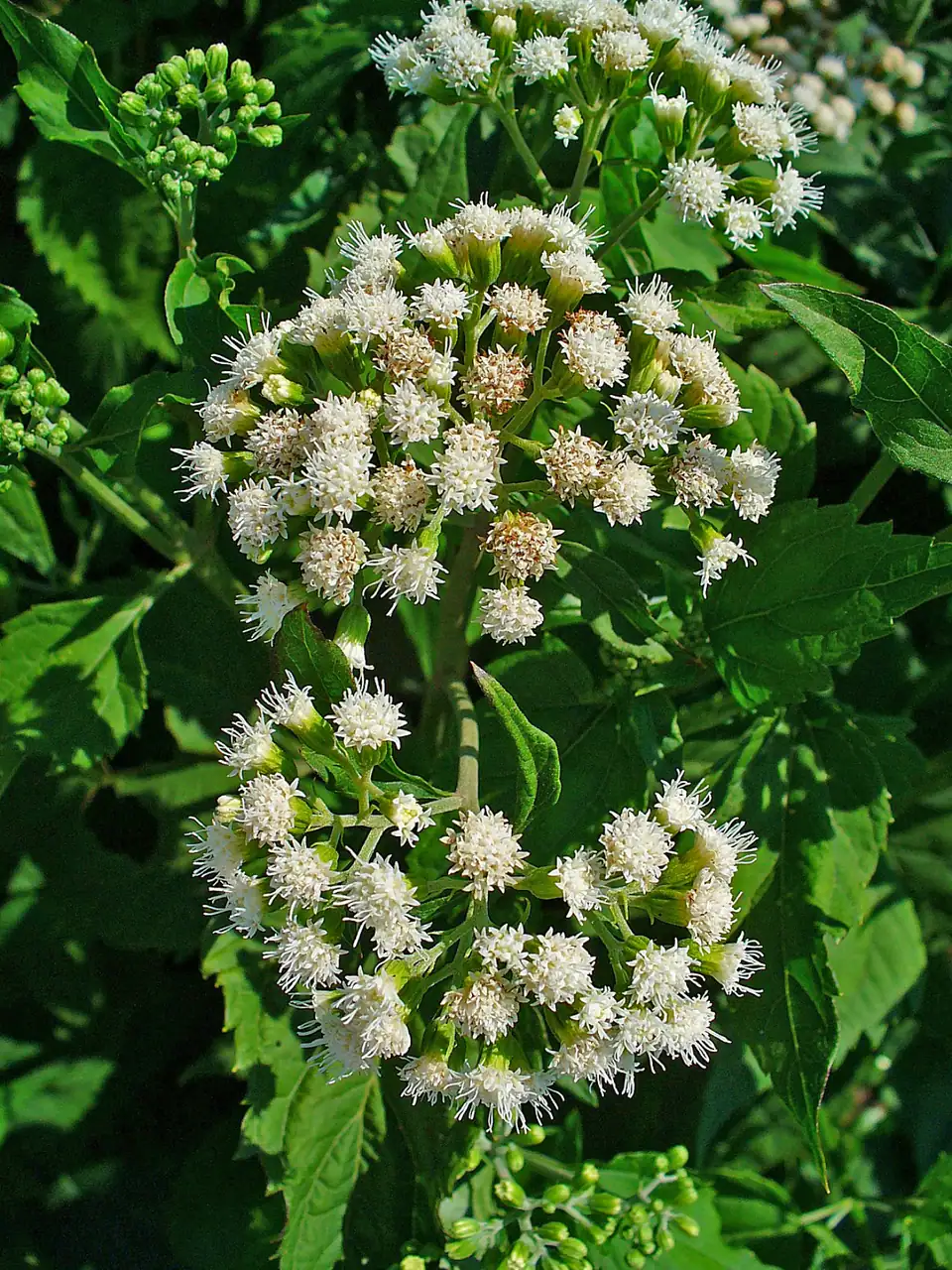
Ageratina aromatica is a native perennial of the aster family that grows 2-3 feet [61–91 cm] tall with white flowers from August into fall. [1] It tolerates drought once established and prefers full sun to light shade. [1] The source rates the plant as highly toxic to humans if eaten. [1]
This record is incomplete: the sources we read do not cover every field yet.
Not yet covered by our sources: Pruning
Small-leaf White Snakeroot care
Measurements in square brackets are our conversion into the other unit system; the quoted text is unchanged.
How to water Small-leaf White Snakeroot
Tolerates drought once established
What the sources say (1)
It tolerates drought once established and prefers full sun to light shade.How much light Small-leaf White Snakeroot needs
Full sun to light shade
What the sources say (1)
It tolerates drought once established and prefers full sun to light shade.How much cold Small-leaf White Snakeroot can take
Hardiness, coldest zone
5a [winter low −28.9 to −26.1 °C (−20 to −15 °F)]
What the sources say (1)
USDA Plant Hardiness Zone:
5a, 5b, 6a, 6b, 7a, 7b, 8a, 8b, 9a, 9bHardiness, warmest zone
9b [winter low −3.9 to −1.1 °C (25 to 30 °F)]
What the sources say (1)
USDA Plant Hardiness Zone:
5a, 5b, 6a, 6b, 7a, 7b, 8a, 8b, 9a, 9bHow to propagate Small-leaf White Snakeroot
Seed
What the sources say (1)
Recommended Propagation Strategy:
SeedHow to grow Small-leaf White Snakeroot
The plant
Life cycle
perennial
What the sources say (1)
Small-leaf white snakeroot is a native perennial in the aster (Asteraceae) family.Family
Asteraceae
What the sources say (1)
Small-leaf white snakeroot is a native perennial in the aster (Asteraceae) family.Mature height
60.96-91.44 cm (2-3 ft)
What the sources say (1)
Small-leaf white snakeroot grows 2-3 feet tall and 1-3 feet wide.Mature width
30.48-91.44 cm (1-3 ft)
What the sources say (1)
Small-leaf white snakeroot grows 2-3 feet tall and 1-3 feet wide.Remedies
Each remedy shows what official sources say about it; traditional remedies without an official source are marked as such. Harmful ones are listed so you know to avoid them.
First aid
First aid: not a substitute for a doctor
swallowed plant material
wipe out the mouth and rinse with water Official source, not independently tested
Do not induce vomiting and do not give them anything to drink.
— missouripoisoncenter.org [3] If the person is awake and alert, call the Missouri Poison Center at 1-800-222-1222 for further treatment advice.
— missouripoisoncenter.org [3] How: Wipe out the mouth with a damp cloth and or let the person rinse the mouth out with water.
Wipe out their mouth with a damp cloth and or let them rinse their mouth out with water.
— missouripoisoncenter.org [3]
Getting rid of it
aggressive self-seeding
select plant removal and deadheading Not verified
Traditional remedy, not verified by an official source.
How: Control plant spreading by removing selected plants and deadheading to prevent aggressive self-seeding.
unwanted white snakeroot
pulling plants up by the roots Not verified
Traditional remedy, not verified by an official source.
How: The plants are shallow-rooted and fairly easy to pull up; pull the entire plant out by the roots.
Is Small-leaf White Snakeroot poisonous?
Reported by the source, quoted verbatim. This is not medical or veterinary advice: if a person or an animal may have eaten this plant, contact a poison control centre or a veterinarian.
The plant is highly toxic if eaten and may be fatal if eaten.
[1]- Poisonous parts
Poison Part: Flowers Leaves Sap/Juice Stems
[1]- Toxic principle
Poison Toxic Principle: Tremetone, a ketone, and glycosides
[1]- Symptoms
Toxicity is characterized by weakness, nausea, abdominal pain, vomiting, delirium, cardiac damage, prostration and eventually, coma.
[1]- Severity
Poison Severity: High
[1]
Calendar
Pruning
Not stated in the sources we read.
Months as given by the sources, which are mostly from the United States (northern hemisphere). In the southern hemisphere they shift by about six months.
Similar plants
- White Snakeroot Ageratina altissima
- African Daisy Dimorphotheca pluvialis
- African Marigold Tagetes erecta
- Ageratum Ageratum houstonianum
- Alpine aster Aster alpinus
- Appalachian Blazing Star Liatris squarrulosa
- Appalachian Ironweed Vernonia glauca
- Appalachian Sunflower Helianthus atrorubens
Sources
Every value above is quoted from these documents. Links lead to the original publisher.
- Ageratina aromatica (Lesser Snakeroot, Small-leaf White Snakeroot, Wild Hoarhound) | North Carolina Extension Gardener Plant Toolbox · plants.ces.ncsu.edu, consulted
- Garden Extravaganza 2025 - Haywood County Center | N.C. Cooperative Extension · haywood.ces.ncsu.edu, consulted
- missouripoisoncenter.org · missouripoisoncenter.org
Written by Emilio Marruso · last checked