

How to Grow and Care for Leopard's-Bane
Arnica montana
Written by Emilio Marruso · last checked
Toxic to: People · Why
At a glance
Arnica is a cheerful perennial for sunny or partly shaded spots, happy in well-drained, sandy soil. It comes from poor grasslands, so it asks for no fertilizer at all. Trim the stems before it flowers and you'll get shorter stems and a second round of blooms. Wild plants are endangered in many places, so growing your own is a lovely choice.
- Sun
Full sun to partial shade
What the sources say (1)
Light: Full sun to partial shade
It tolerates most soils if they are lime free, and a well-drained location in full sun to partial shade, but prefers slightly alkaline moist sandy loam.
— Arnica montana (Arnica Root, Leopard's-Bane, Mountain arnica, Mountain Snuff, Mountain Tobacco, Wolfbane) | North Carolina Extension Gardener Plant Toolbox [1] - Water
Likes moist soil that drains well
What the sources say (1)
Watering notes: Well-drained location; prefers slightly alkaline moist sandy loam
It tolerates most soils if they are lime free, and a well-drained location in full sun to partial shade, but prefers slightly alkaline moist sandy loam.
— Arnica montana (Arnica Root, Leopard's-Bane, Mountain arnica, Mountain Snuff, Mountain Tobacco, Wolfbane) | North Carolina Extension Gardener Plant Toolbox [1] - Cold
Survives winters down to −30 °F (−34.4 °C)
Very hardy · USDA 4a · RHS H7 · Z4
What the sources say (2)
Hardiness, coldest zone: 4a [winter low −34.4 to −31.7 °C (−30 to −25 °F)]
4a, 4b, 5a, 5b, 6a, 6b, 7a, 7b, 8a, 8b, 9a, 9b
— Arnica montana (Arnica Root, Leopard's-Bane, Mountain arnica, Mountain Snuff, Mountain Tobacco, Wolfbane) | North Carolina Extension Gardener Plant Toolbox [1] Hardiness, warmest zone: 9b [winter low −3.9 to −1.1 °C (25 to 30 °F)]
4a, 4b, 5a, 5b, 6a, 6b, 7a, 7b, 8a, 8b, 9a, 9b
— Arnica montana (Arnica Root, Leopard's-Bane, Mountain arnica, Mountain Snuff, Mountain Tobacco, Wolfbane) | North Carolina Extension Gardener Plant Toolbox [1] - Soil
Sandy, well-drained soil, slightly alkaline
What the sources say (1)
Watering notes: Well-drained location; prefers slightly alkaline moist sandy loam
It tolerates most soils if they are lime free, and a well-drained location in full sun to partial shade, but prefers slightly alkaline moist sandy loam.
— Arnica montana (Arnica Root, Leopard's-Bane, Mountain arnica, Mountain Snuff, Mountain Tobacco, Wolfbane) | North Carolina Extension Gardener Plant Toolbox [1] - Feeding
Don't feed it: it loves poor soil, and fertilizer means fewer new seedlings
What the sources say (2)
Avoid: Fertilizing where it grows among grasses: arnica belongs to nutrient-poor grasslands and fertilization sharply cuts seedling numbers
While the unfertilized trays displayed only a slight decrease from no to high competition, fertilization led to a substantial drop in the proportion of seedlings
— [4] montana is inferior when growing in grass-dominated vegetation, especially with fertilization.
— [4] - Pruning
Cut stems back before it flowers for shorter stems and a second bloom
What the sources say (1)
Pruning: Before the plant flowers: cut the stem back to keep stems short and produce a secondary bloom
Cutting the stem back before the plant flowers will keep the stems short, as well as produce a secondary bloom.
— Arnica montana (Arnica Root, Leopard's-Bane, Mountain arnica, Mountain Snuff, Mountain Tobacco, Wolfbane) | North Carolina Extension Gardener Plant Toolbox [1] - Watch out
Roots spread and can take over the garden; in windy spots, stake the stems
- Size
6 in to 2 ft tall
What the sources say (1)
Mature height: 15.2-61 cm (0.5 to 2 ft)
It grows .5 to 2 feet tall with basal downy leaves and flowers that occur May to August.
— Arnica montana (Arnica Root, Leopard's-Bane, Mountain arnica, Mountain Snuff, Mountain Tobacco, Wolfbane) | North Carolina Extension Gardener Plant Toolbox [1] - Propagation
From seed, or by dividing the plant in spring or fall
What the sources say (2)
Propagation: Seed; division in spring or fall
Life Cycle: Perennial Recommended Propagation Strategy: Seed Country Or Region Of Origin:
— Arnica montana (Arnica Root, Leopard's-Bane, Mountain arnica, Mountain Snuff, Mountain Tobacco, Wolfbane) | North Carolina Extension Gardener Plant Toolbox [1] Divide during the spring or fall every few years to keep this plant at its best.
— Arnica montana (Arnica Root, Leopard's-Bane, Mountain arnica, Mountain Snuff, Mountain Tobacco, Wolfbane) | North Carolina Extension Gardener Plant Toolbox [1] - Safety
Poisonous: irritates skin and, if eaten, causes vomiting and heart palpitations
Overview
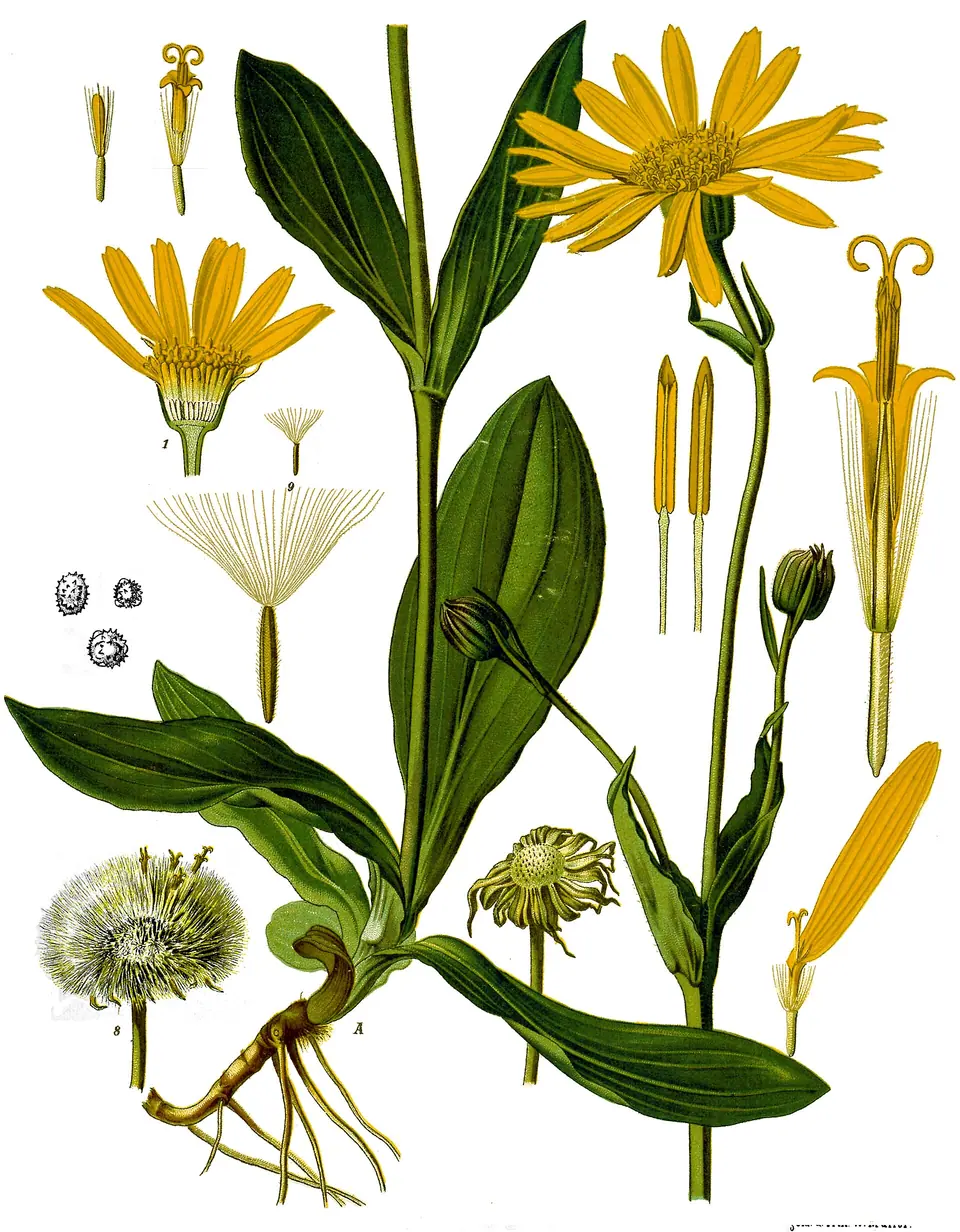
Arnica is a perennial herb in the daisy family native to Europe, growing 0.5 to 2 feet [15–61 cm] tall with flowers from May to August. [1] It grows in full sun to partial shade in well-drained soil. [1] The plant is toxic and has been listed as endangered in many locations due to collection for medicinal uses. [1]
This record is incomplete: the sources we read do not cover every field yet.
Not yet covered by our sources: Watering
Leopard's-Bane care
Measurements in square brackets are our conversion into the other unit system; the quoted text is unchanged.
How to water Leopard's-Bane
Watering
Not stated in the sources we read.
Watering notes
Well-drained location; prefers slightly alkaline moist sandy loam
What the sources say (1)
It tolerates most soils if they are lime free, and a well-drained location in full sun to partial shade, but prefers slightly alkaline moist sandy loam.How much light Leopard's-Bane needs
Full sun to partial shade
What the sources say (1)
It tolerates most soils if they are lime free, and a well-drained location in full sun to partial shade, but prefers slightly alkaline moist sandy loam.How much cold Leopard's-Bane can take
Hardiness, coldest zone
4a [winter low −34.4 to −31.7 °C (−30 to −25 °F)]
What the sources say (1)
4a, 4b, 5a, 5b, 6a, 6b, 7a, 7b, 8a, 8b, 9a, 9bHardiness, warmest zone
9b [winter low −3.9 to −1.1 °C (25 to 30 °F)]
What the sources say (1)
4a, 4b, 5a, 5b, 6a, 6b, 7a, 7b, 8a, 8b, 9a, 9bHow to propagate Leopard's-Bane
Seed; division in spring or fall
What the sources say (2)
Life Cycle:
Perennial
Recommended Propagation Strategy:
Seed
Country Or Region Of Origin:Divide during the spring or fall every few years to keep this plant at its best.How to grow Leopard's-Bane
The plant
Life cycle
perennial
What the sources say (1)
Leopard's-bane is a perennial herb in the Asteraceae (daisy) family native to Europe.Family
Asteraceae
What the sources say (1)
Leopard's-bane is a perennial herb in the Asteraceae (daisy) family native to Europe.Mature height
15.2-61 cm (0.5 to 2 ft)
What the sources say (1)
It grows .5 to 2 feet tall with basal downy leaves and flowers that occur May to August.Fertilizing
When
The sources give different values depending on region, zone or growing conditions.
What each source says
field cultivation for flower heads: Nitrogen at the start of spring growth and when flowering shoots form
field cultivation for flower heads: Phosphorus and potassium in autumn
What the sources say (2)
field cultivation for flower heads: Nitrogen in the form of 34% ammonium nitrate was used in two doses: after the beginning of plant vegetation in spring and in the phase of inflorescence shoot formation.field cultivation for flower heads: The same fertilization with phosphorus (single superphosphate 80 kg P ha −1 ) and potassium (potassium salt 120 kg K ha −1 ) was applied in autumn.How often
The sources give different values depending on region, zone or growing conditions.
What each source says
field cultivation for flower heads: Nitrogen in two doses
What the sources say (1)
field cultivation for flower heads: Nitrogen in the form of 34% ammonium nitrate was used in two doses: after the beginning of plant vegetation in spring and in the phase of inflorescence shoot formation.Mineral fertilizers
The sources give different values depending on region, zone or growing conditions.
What each source says
field cultivation for flower heads: Up to 60 kg [132.3 lb] N/ha as ammonium nitrate raised the content of active compounds
field cultivation for flower heads: Superphosphate at 80 kg [176.4 lb] P/ha and potassium salt at 120 kg [264.6 lb] K/ha
What the sources say (2)
field cultivation for flower heads: The content of sesquiterpene lactones, flavonoids, and essential oil increased with the increase in the nitrogen doses to 60 kg N ha −1 by 0.66%, 1.45%, and 0.27%, respectively.field cultivation for flower heads: The same fertilization with phosphorus (single superphosphate 80 kg P ha −1 ) and potassium (potassium salt 120 kg K ha −1 ) was applied in autumn.Micronutrients
The sources give different values depending on region, zone or growing conditions.
What each source says
field cultivation for flower heads: Foliar boron, the only nutrient with a demonstrated effect
What the sources say (1)
field cultivation for flower heads: Among the macro- and micronutrients analyzed individually as a factor in different experiments on sustainable production of arnica raw material in field conditions, only the impact of foliar boron fertilization has been demonstratedAvoid
Fertilizing where it grows among grasses: arnica belongs to nutrient-poor grasslands and fertilization sharply cuts seedling numbers
What the sources say (2)
While the unfertilized trays displayed only a slight decrease from no to high competition, fertilization led to a substantial drop in the proportion of seedlingsmontana is inferior when growing in grass-dominated vegetation, especially with fertilization.Signs of excess
The sources give different values depending on region, zone or growing conditions.
What each source says
field cultivation for flower heads, above 60 kg N/ha: Lower content of active compounds in the flower heads
What the sources say (1)
field cultivation for flower heads, above 60 kg N/ha: A further increase in the nitrogen dose resulted in a decrease in the content of the analyzed secondary metabolites.Leopard's-Bane pests and problems
Spreading roots and weedy tendencies
Symptom: Roots spread and take over more space than intended
What to do: Maintain the plant to avoid invading other portions of the garden
What the sources say (1)
Their roots can spread, taking over more space than intended. Maintain this plant to avoid invading other portions of your garden.
— Arnica montana (Arnica Root, Leopard's-Bane, Mountain arnica, Mountain Snuff, Mountain Tobacco, Wolfbane) | North Carolina Extension Gardener Plant Toolbox [1] Wind damage
Symptom: Stems may need support in windy locations
What to do: Stake for additional support
What the sources say (1)
In windy locations, they may need to be staked for additional support.
— Arnica montana (Arnica Root, Leopard's-Bane, Mountain arnica, Mountain Snuff, Mountain Tobacco, Wolfbane) | North Carolina Extension Gardener Plant Toolbox [1]
Remedies
Each remedy shows what official sources say about it; traditional remedies without an official source are marked as such. Harmful ones are listed so you know to avoid them.
First aid
First aid: not a substitute for a doctor
arnica ingestion by a child
contact poison control Official source, not independently tested
If you discover that your kid’s gotten into an arnica product, you should contact poison control immediately.
— health.clevelandclinic.org [5] While arnica is sometimes used to flavor food, its cytotoxic properties render it poisonous in large amounts.
— health.clevelandclinic.org [5] How: if a child has got into an arnica product, contact poison control immediately
If you discover that your kid’s gotten into an arnica product, you should contact poison control immediately.
— health.clevelandclinic.org [5]
allergic skin reaction to arnica
stop contact and call a doctor Official source, not independently tested
If you experience any of the following symptoms of an allergic reaction after using arnica topically, you should stop using it and contact your doctor.
— health.clevelandclinic.org [5] How: after skin contact, if redness, itching, irritation, worsened bruising or increased pain appear, stop using it and contact a doctor
If you experience any of the following symptoms of an allergic reaction after using arnica topically, you should stop using it and contact your doctor.
— health.clevelandclinic.org [5]
Treating the plant
snails
hand-picking Works
How: check for snails daily, hunting them with a flashlight in the dark and wearing gloves if squeamish; weekly hand-picking is enough once numbers fall
Check for snails daily, and be thorough – they’ll likely be hiding in the arnica plants! When you start to notice fewer snails, weekly hand-picking should be enough to manage them.
— gardenerspath.com [6] What the evidence says Many insect and disease issues can be solved in the home garden by hand-picking insects or clipping and disposing of diseased plant parts.
— extension.unh.edu [7] beer trap Not verified
Traditional remedy, not verified by an official source.
How: place beer, or sugar water with yeast, in a bowl the snails cannot crawl out of, buried level with the soil; traps work within a few feet; empty and refill every few days
copper barrier Not verified
Traditional remedy, not verified by an official source.
How: wrap copper foil or tape around the planting box; when it tarnishes, clean it with vinegar
aphids
strong water jet Not verified
Traditional remedy, not verified by an official source.
How: spray plants with a firm stream of water to dislodge colonies, repeating every few days as needed
insecticidal soap Works
When “oils and soaps” are mentioned in UC IPM publications, we are referring to commercially available oils and soaps that are formulated specifically for use as pesticides- not household oils and soaps meant for cooking, cleaning, or other purposes.
— ucanr.edu [10] How: for persistent infestations, treat tender growth with insecticidal soap, coating leaf undersides thoroughly in the cool parts of the day
For persistent infestations, treat tender growth with insecticidal soap or a ready-to-use horticultural oil, coating leaf undersides thoroughly and applying in cool parts of the day.
— botanapp.com [8] What the evidence says For example, insecticidal soap is a safe, effective organic insecticide with minimal environmental impact.
— extension.psu.edu [9]
spider mites
water rinse Not verified
Traditional remedy, not verified by an official source.
How: rinse foliage thoroughly with water, including the undersides of leaves, on a regular schedule
powdery mildew
removing diseased leaves Works
How: remove and discard heavily infected leaves, thin surrounding vegetation for air movement, water at soil level in the morning
Remove and discard heavily infected leaves to reduce spore load, and thin surrounding vegetation or competing groundcover to improve air movement around the plants.
— botanapp.com [8] What the evidence says Many insect and disease issues can be solved in the home garden by hand-picking insects or clipping and disposing of diseased plant parts.
— extension.unh.edu [7]
leaf spot
removing diseased leaves Works
How: cut off and dispose of affected leaves, especially at the end of the season; water at the base of the plant and keep spacing generous
Cut off and dispose of affected leaves, especially at the end of the season, to remove sources of infection.
— botanapp.com [8] What the evidence says Many insect and disease issues can be solved in the home garden by hand-picking insects or clipping and disposing of diseased plant parts.
— extension.unh.edu [7]
Is Leopard's-Bane poisonous?
Reported by the source, quoted verbatim. This is not medical or veterinary advice: if a person or an animal may have eaten this plant, contact a poison control centre or a veterinarian.
Poison Severity: High Poison Symptoms: Poisonous through dermatitis and ingestion. Skin irritation upon contact; after ingestion, heart palpitation, vomiting, drowsiness, shortness of breath, and coma in children. Poison Toxic Principle: Helenalin and its esters
[1]- Poisonous parts
Poison Part: Flowers Roots Download Print-Friendly QR Code
[1]- Toxic principle
Poison Toxic Principle: Helenalin and its esters Causes
[1]- Symptoms
Skin irritation upon contact; after ingestion, heart palpitation, vomiting, drowsiness, shortness of breath, and coma in children.
[1]- Severity
Poison Severity: High Poison Symptoms: Poisonous through dermatitis
[1]
This plant is toxic, however, has been listed as endangered in many locations due to its collection for medicinal uses.
[1]- Poisonous parts
Poison Part: Flowers Roots Download Print-Friendly QR Code
[1]- Toxic principle
Poison Toxic Principle: Helenalin and its esters Causes
[1]- Symptoms
Skin irritation upon contact; after ingestion, heart palpitation, vomiting, drowsiness, shortness of breath, and coma in children.
[1]- Severity
Poison Severity: High Poison Symptoms: Poisonous through dermatitis
[1]
Skin irritation upon contact; after ingestion, heart palpitation, vomiting, drowsiness, shortness of breath, and coma in children.
[1]
Calendar
Pruning
Before the plant flowers: cut the stem back to keep stems short and produce a secondary bloom
What the sources say (1)
Cutting the stem back before the plant flowers will keep the stems short, as well as produce a secondary bloom.Months as given by the sources, which are mostly from the United States (northern hemisphere). In the southern hemisphere they shift by about six months.
Similar plants
- Heart-leaf Arnica Arnica cordifolia
- African Daisy Dimorphotheca pluvialis
- African Marigold Tagetes erecta
- Ageratum Ageratum houstonianum
- Alpine aster Aster alpinus
- Appalachian Blazing Star Liatris squarrulosa
- Appalachian Ironweed Vernonia glauca
- Appalachian Sunflower Helianthus atrorubens
Sources
Every value above is quoted from these documents. Links lead to the original publisher.
- Arnica montana (Arnica Root, Leopard's-Bane, Mountain arnica, Mountain Snuff, Mountain Tobacco, Wolfbane) | North Carolina Extension Gardener Plant Toolbox · plants.ces.ncsu.edu, consulted
- Arnica Root - Arnica montana | North Carolina Extension Gardener Plant Toolbox · plants.ces.ncsu.edu, consulted
- pmc.ncbi.nlm.nih.gov · pmc.ncbi.nlm.nih.gov
- pmc.ncbi.nlm.nih.gov · pmc.ncbi.nlm.nih.gov
- health.clevelandclinic.org · health.clevelandclinic.org
- gardenerspath.com · gardenerspath.com
- extension.unh.edu · extension.unh.edu
- botanapp.com · botanapp.com
- extension.psu.edu · extension.psu.edu
- ucanr.edu · ucanr.edu
Written by Emilio Marruso · last checked