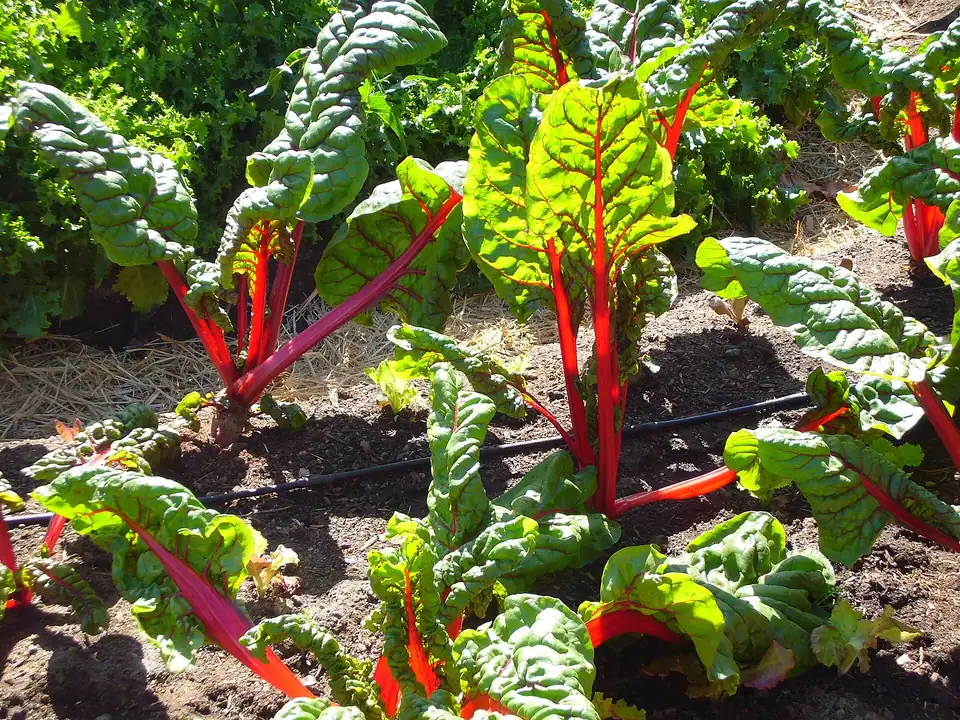

How to Grow and Care for Common beet
Beta vulgaris
Written by Emilio Marruso · last checked
At a glance
Beets give you two harvests in one: leafy tops to cook or eat fresh as greens, and roots to pickle or cook whole. Sow the seeds 1/2 inch deep in a sunny spot, water evenly, and in 6–8 weeks you can dig roots the size of a golf ball. They grow happily in containers too.
- Sun
A sunny spot
What the sources say (1)
Light: Sunny locations
Beets are cool season vegetables that prefer sunny locations and fertile, deep, well-drained soils. Incorporate plenty of organic matter and
— How to Grow Beets in Your Garden | USU [3] - Water
Water regularly and evenly; ups and downs in moisture crack the roots. Mulch helps
What the sources say (4)
Watering: Water regularly and uniformly; well irrigated but with good drainage
Water beets regularly. Water requirements depend on soil type. Mulching around the plants helps to conserve soil moisture. Use drip
— How to Grow Beets in Your Garden | USU [3] - Beets need to be well-irrigated for best quality, but they should also have good drainage.
— Beets: How to Grow It [2] Watering notes: Avoid moisture fluctuations, which cause root cracking and low yields; mulch to conserve moisture
Moisture fluctuations cause root cracking, slow leaf development, and contribute to low yields. Water stress during the first 6 weeks
— How to Grow Beets in Your Garden | USU [3] Water beets regularly. Water requirements depend on soil type. Mulching around the plants helps to conserve soil moisture. Use drip
— How to Grow Beets in Your Garden | USU [3] - Soil
Well-drained soil with plenty of compost worked in
What the sources say (5)
Watering: Water regularly and uniformly; well irrigated but with good drainage
Water beets regularly. Water requirements depend on soil type. Mulching around the plants helps to conserve soil moisture. Use drip
— How to Grow Beets in Your Garden | USU [3] - Beets need to be well-irrigated for best quality, but they should also have good drainage.
— Beets: How to Grow It [2] Natural fertilizers: Plenty of organic matter or compost worked in before planting, especially in heavy clay soils; with compost, a layer of no more than 2.54 cm [1 in] of well-composted organic matter
Heavy clay soil should be amended with compost or other organic matter.
— Beets: How to Grow It [2] Incorporate plenty of organic matter and a complete fertilizer into the area before planting.
— How to Grow Beets in Your Garden | USU [3] If you fertilize with compost, apply no more than 1 inch of well-composted organic matter per 100 square feet of garden area.
— How to Grow Beets in Your Garden | USU [3] - Spacing
12–18 in between rows
What the sources say (1)
Row spacing: 30.5-45.7 cm (12-18 in)
Seeded beets should be spaced 3-4 inches between plants in the row with rows 12-18 inches apart.
— How to Grow Beets in Your Garden | USU [3] - Feeding
Compost before planting, nitrogen 6 weeks after sprouting; too much gives leaves, not roots
What the sources say (6)
When: Before planting, then a nitrogen side-dressing 6 weeks after emergence
Incorporate plenty of organic matter and a complete fertilizer into the area before planting.
— How to Grow Beets in Your Garden | USU [3] Apply ¼ cup per 10 foot of row of a nitrogen-based fertilizer (21-0-0) 6 weeks after emergence to encourage rapid plant growth.
— How to Grow Beets in Your Garden | USU [3] Natural fertilizers: Plenty of organic matter or compost worked in before planting, especially in heavy clay soils; with compost, a layer of no more than 2.54 cm [1 in] of well-composted organic matter
Heavy clay soil should be amended with compost or other organic matter.
— Beets: How to Grow It [2] Incorporate plenty of organic matter and a complete fertilizer into the area before planting.
— How to Grow Beets in Your Garden | USU [3] If you fertilize with compost, apply no more than 1 inch of well-composted organic matter per 100 square feet of garden area.
— How to Grow Beets in Your Garden | USU [3] Signs of excess: Extensive top growth at the expense of root growth (excess nitrogen)
Excessive nitrogen fertilization can also contribute to extensive top growth at the expense of root growth.
— Beets: How to Grow It [2] - Harvest
Dig roots at golf-ball size, 6–8 weeks after planting; the leaves are good to eat too
What the sources say (1)
How to harvest: dig roots with a potato fork or similar tool when about golf-ball size, 6-8 weeks after planting
Mature roots are generally ready to harvest 6-to-8 weeks after planting, when they have reached the size of a golf ball. They can be dug with a potato fork or similar tool.
— Beets: How to Grow It [2] - Pests
Flea beetles, leaf miners and leaf spot; don't plant in the same spot two years in a row
What the sources say (6)
Pests: flea beetles, leaf miners, leafhoppers
Flea Beetles: Flea beetles chew small, round holes in leaves (Figure 4-A). They can heavily damage the crop, especially when the plants are very young.
— Beets: How to Grow It [2] Small white maggots that burrow and feed in the leaves. Leave a lacy trail.
— How to Grow Beets in Your Garden | USU [3] Carried by leafhoppers. Cover plants with fabric mulch. No known control.
— How to Grow Beets in Your Garden | USU [3] Diseases: cercospora leaf spot, leaf spots, root rots
Cercospora Leaf Spot: Avoid this disease by not planting beets in the same spot two years in a row and by removing any remaining plant debris after harvest.
— Beets: How to Grow It [2] Fungal diseases that cause circular spotting on infected leaves.
— How to Grow Beets in Your Garden | USU [3] Fungal diseases that cause decay and rotting of the root. May affect plant stands
— How to Grow Beets in Your Garden | USU [3] - Propagation
Grown from seed
What the sources say (1)
Propagation: Seed
Beets are always grown from seed. Beets can be sown after soils reach 40°F. Seeds germinate best at 55-75°F and require 7-14 days to emerge.
— How to Grow Beets in Your Garden | USU [3] - Sowing
Sow 1/2 inch deep; seeds sprout in 7–14 days
What the sources say (3)
Sowing depth: 1.3 cm (1/2 in)
Plant seeds about 1/2 inch deep and one inch apart.
— Beet | Home Vegetable Gardening | Illinois Extension | Illinois [4] Plant seeds ½ inch deep and one inch apart. Each beet seed will produce 2-to-6 plants, which will need to be thinned.
— Beets: How to Grow It [2] Days to germination: 7-14 days
Seeds germinate best at 55-75°F and require 7-14 days to emerge.
— How to Grow Beets in Your Garden | USU [3] - Containers
Grows in containers too
What the sources say (1)
In containers: Yes
In gardens, beet roots can grow 3-to-4 feet deep in good soil. However, because of their small size, beets can easily be grown in containers or raised beds.
— Beets: How to Grow It [2]
Overview
Beets are biennial herbs usually grown as annuals for their swollen taproot, and the tops can also be eaten as greens. [1] They are cool-season, sun-loving vegetables that need regular, uniform watering and well-drained soil. [3]
Common beet care
Measurements in square brackets are our conversion into the other unit system; the quoted text is unchanged.
How to water Common beet
Watering
Water regularly and uniformly; well irrigated but with good drainage
What the sources say (2)
Water beets regularly. Water requirements depend on soil type. Mulching around the plants helps to conserve soil moisture. Use drip- Beets need to be well-irrigated for best quality, but they should also have good drainage.Watering notes
Avoid moisture fluctuations, which cause root cracking and low yields; mulch to conserve moisture
What the sources say (2)
Moisture fluctuations cause root cracking, slow leaf development, and contribute to low yields. Water stress during the first 6 weeksWater beets regularly. Water requirements depend on soil type. Mulching around the plants helps to conserve soil moisture. Use dripHow much light Common beet needs
Sunny locations
What the sources say (1)
Beets are cool season vegetables that prefer sunny locations and fertile, deep, well-drained soils. Incorporate plenty of organic matter andWhere to grow Common beet
In containers
Yes
What the sources say (1)
In gardens, beet roots can grow 3-to-4 feet deep in good soil. However, because of their small size, beets can easily be grown in containers or raised beds.Spacing
The sources give different values depending on region, zone or growing conditions.
What each source says
According to SDSU Extension: 5.1-7.6 cm (2-3 in)
According to USU Extension: 7.6-10.2 cm (3-4 in)
According to Illinois Extension: 2.5-7.6 cm (1-3 in)
What the sources say (3)
According to SDSU Extension: The plants should be thinned to 2-to-3 inches apart.According to USU Extension: Seeded beets should be spaced 3-4 inches between plants in the row with rows 12-18 inches apart.According to Illinois Extension: The seedlings should be thinned to 1 to 3 inches apart. If thinning is delayed until the plants are 3How to propagate Common beet
Seed
What the sources say (1)
Beets are always grown from seed. Beets can be sown after soils reach 40°F. Seeds germinate best at 55-75°F and require 7-14 days to emerge.How to grow Common beet
The plant
Life cycle
biennial (usually grown as an annual)
What the sources say (1)
Beet plants are biennial herbs that are usually grown as annuals. They form a large
inflated tap root and leafy rosette of leaves that bolt in the early summer of the
second seasonFamily
amaranth family (formerly placed in the chenopod family)
What the sources say (1)
The plant has long been classified
as belonging to the chenopod family, the same family to which spinach belongs, but
new classification schemes using DNA data have moved this whole family into the amaranth
family.Sowing and growth
Days to germination
7-14 days
What the sources say (1)
Seeds germinate best at 55-75°F and require 7-14 days to emerge.Sowing depth
1.3 cm (1/2 in)
Row spacing
30.5-45.7 cm (12-18 in)
What the sources say (1)
Seeded beets should be spaced 3-4 inches between plants in the row with rows 12-18 inches apart.Harvest and storage
How to harvest
dig roots with a potato fork or similar tool when about golf-ball size, 6-8 weeks after planting
What the sources say (1)
Mature roots are generally ready to harvest 6-to-8 weeks after planting, when they have reached the size of a golf ball. They can be dug with a potato fork or similar tool.Storage
cool, humid place at 0-4.4 °C (32-40 °F) with tops cut off; do not allow to freeze
What the sources say (1)
Cut off tops and store beets in a cool, humid place with temperatures ranging from 32°to 40° Farenheit. Do not allow them to freeze.Pests and diseases
Pests
flea beetles, leaf miners, leafhoppers
What the sources say (3)
Flea Beetles: Flea beetles chew small, round holes in leaves (Figure 4-A). They can heavily damage the crop, especially when the plants are very young.Small white maggots that burrow and feed in the leaves. Leave a lacy trail.Carried by leafhoppers. Cover plants with fabric mulch. No known control.Diseases
cercospora leaf spot, leaf spots, root rots
What the sources say (3)
Cercospora Leaf Spot: Avoid this disease by not planting beets in the same spot two years in a row and by removing any remaining plant debris after harvest.Fungal diseases that cause circular spotting on infected leaves.Fungal diseases that cause decay and rotting of the root. May affect plant standsFertilizing
When
Before planting, then a nitrogen side-dressing 6 weeks after emergence
What the sources say (2)
Incorporate plenty of organic matter and a complete fertilizer into the area before planting.Apply ¼ cup per 10 foot of row of a nitrogen-based fertilizer (21-0-0) 6 weeks after emergence to encourage rapid plant growth.Natural fertilizers
Plenty of organic matter or compost worked in before planting, especially in heavy clay soils; with compost, a layer of no more than 2.54 cm [1 in] of well-composted organic matter
What the sources say (3)
Heavy clay soil should be amended with compost or other organic matter.Incorporate plenty of organic matter and a complete fertilizer into the area before planting.If you fertilize with compost, apply no more than 1 inch of well-composted organic matter per 100 square feet of garden area.Mineral fertilizers
Complete fertilizer worked into the top 15.2 cm [6 in] of soil before planting, following the soil test; nitrogen as urea, 19.1–25.5 mL/m², or as a 21-0-0 fertilizer, 59.3 mL per 3.05 m [10 ft] of row, placed beside the plants and watered in; phosphorus and potassium by soil test, in a soil high in potassium
What the sources say (6)
If fertilizer applications are warranted, work the fertilizer into the top 6 inches of soil.Nitrogen: Apply ¾ to 1 cup of urea per 100 square-feet.Apply ¼ cup per 10 foot of row of a nitrogen-based fertilizer (21-0-0) 6 weeks after emergence to encourage rapid plant growth.Place the fertilizer to the side of the plants and irrigate it into the soil.Phosphorus and Potassium: Apply according to soil test recommendations.Like most root crops, beets need a fertile soil (especially high in potassium) for vigorous growth.Micronutrients
Boron: adequate amounts are needed for proper root development
What the sources say (1)
Beets require adequate amounts of boron to develop properly. Black, sunken spots on or in the root generally indicate low boron levels in the soil.Avoid
Excess nitrogen; water or fertilizer stress during growth
What the sources say (2)
Excessive nitrogen fertilization can also contribute to extensive top growth at the expense of root growth.Avoid water or fertilizer stress during growth. Irrigation should be frequent and uniform to ensure good growth.Signs of deficiency
Low boron: black, sunken spots on or in the root; boron-deficient plants are more susceptible to common root diseases
What the sources say (2)
Beets require adequate amounts of boron to develop properly. Black, sunken spots on or in the root generally indicate low boron levels in the soil.Boron deficient plants are more susceptible to many of the more common root diseases.Signs of excess
Extensive top growth at the expense of root growth (excess nitrogen)
What the sources say (1)
Excessive nitrogen fertilization can also contribute to extensive top growth at the expense of root growth.Common beet pests and problems
Flea beetles
Symptom: Flea beetles chew small, round holes in leaves.
What to do: Planting mustard greens, such as arugula or radishes near the beets can sometimes act as a trap crop.
What the sources say (1)
- Flea Beetles: Flea beetles chew small, round holes in leaves (Figure 4-A). They can heavily damage the crop, especially when the plants are very young. Planting mustard greens, such as arugula or radishes near the beets can sometimes act
— Beets: How to Grow It [2] Cercospora leaf spot
Symptom: Cercospora Leaf Spot is a major disease of beets.
What to do: Avoid this disease by not planting beets in the same spot two years in a row and by removing any remaining plant debris after harvest.
What the sources say (1)
- Cercospora Leaf Spot: Avoid this disease by not planting beets in the same spot two years in a row and by removing any remaining plant debris after harvest.
— Beets: How to Grow It [2]
Remedies
Each remedy shows what official sources say about it; traditional remedies without an official source are marked as such. Harmful ones are listed so you know to avoid them.
Treating the plant
beet leafminer
pinching infested leaves Official source, not independently tested
How: Pinch leaves to kill larvae inside, and pick out infested leaves when noticed.
Pinch leaves to kill larvae inside. - Pick out infested leaves when noticed. Discard leaves in garbage.
— hortsense.cahnrs.wsu.edu [5] floating row cover Official source, not independently tested
Do not cover crops in fields where susceptible crops were grown previously, as adult flies may emerge from the soil underneath the cover.
— umass.edu [6] How: Screen plants with a floating row cover prior to emergence of flies in spring.
Screen plants with a floating row cover prior to emergence of flies in spring (April-May).
— hortsense.cahnrs.wsu.edu [5] weed control around the beds Official source, not independently tested
How: Control weeds which can serve as hosts of spinach and beet leafminers.
Control weeds which can serve as hosts of spinach and beet leafminers. These include chickweed, lambquarters, and nightshades.
— umass.edu [6]
flea beetles
trap crop of mustard greens or radishes Partly works
How: Plant mustard greens, such as arugula or radishes, near the beets.
Planting mustard greens, such as arugula or radishes near the beets can sometimes act as a trap crop.
— Beets: How to Grow It [2] What the evidence says Planting mustard greens, such as arugula or radishes near the beets can sometimes act as a trap crop.
— Beets: How to Grow It [2]
cercospora leaf spot
crop rotation and removing plant debris Official source, not independently tested
How: Do not plant beets in the same spot two years in a row and remove remaining plant debris after harvest.
Cercospora Leaf Spot: Avoid this disease by not planting beets in the same spot two years in a row and by removing any remaining plant debris after harvest.
— Beets: How to Grow It [2] deep burial of plant debris Official source, not independently tested
How: Bury plant debris using deep tillage and rotate with non-host crops for at least 3 years.
Rotate with non-host crops for at least 3 years. - Bury plant debris using deep tillage.
— vegetables.cornell.edu [7]
Calendar
Sowing
The sources give different values depending on region, zone or growing conditions.
What each source says
According to SDSU Extension: Once soil temperature reaches 45 F; again in mid- to late August for a fall harvest
According to USU Extension: 2-3 weeks before the last frost
According to Illinois Extension: 30 days before the frost-free date
What the sources say (3)
According to SDSU Extension: Plant beet seed directly into the soil once soil temperatures have reached 45° Fahrenheit. Light or loamy soil is preferred.According to USU Extension: Plant 2-3 weeks before the last frost. Beets taste best when plants have been exposed to several weeks of coolAccording to Illinois Extension: Beets are fairly frost hardy and can be planted in the garden 30 days before the frost-free date for your area. Although beets grow wellPlanting
Not stated in the sources we read.
Harvest
The sources give different values depending on region, zone or growing conditions.
What each source says
According to SDSU Extension: 6-8 weeks after planting
According to USU Extension: 60-80 days from seeding
According to Illinois Extension: About 60 days to reach 1 1/2 inches [3.8 cm] in diameter
What the sources say (3)
According to SDSU Extension: Mature roots are generally ready to harvest 6-to-8 weeks after planting, when they have reached the size of a golfAccording to USU Extension: Generally roots are mature 60-80 days from seeding, depending on variety. As the roots get larger they tend to getAccording to Illinois Extension: About 60 days are required for beets to reach 1 1/2 inches in diameter, the size often used for cooking, pickling or canning as wholeMonths as given by the sources, which are mostly from the United States (northern hemisphere). In the southern hemisphere they shift by about six months.
Relative to frost
Less precise estimate: there is no weather station within 300 km.
Find frost dates by ZIP code or city
Sow outdoors: 2 to 3 weeks before the last frost
Plant seeds ¼-½ inch deep. Thin seedling beets to 3 inches apart in the row with rows 12-18 inches apart. Plant 2-3 weeks before the last frost.
— How to Grow Beets in Your Garden | USU [3]
Count from the average frost dates where you live.
Edibility
Reported by the source, quoted verbatim. Do not eat a plant on the basis of this page alone: identification mistakes can be dangerous.
- The tops are cooked or served fresh as greens and the roots may be pickled for salads or cooked whole, then sliced or diced.
[4]
Indicative values
Values from a secondary source, not checked word for word like the rest of this page. Use them as a starting point.
- Mature height
- 30.5-45.7 cm (1-1.5 ft)Indicative value, adapt it to your climate · Secondary source
- Drought tolerant
- yesIndicative value, adapt it to your climate · Secondary source
- Soil pH
- 6-7.5Indicative value, adapt it to your climate · Secondary source
- USDA hardiness zones
- 2-11 [winter low −45.6 to 10 °C (−50 to 50 °F)]Indicative value, adapt it to your climate · Secondary source
- Care level
- MediumIndicative value, adapt it to your climate · Secondary source
- Growth rate
- LowIndicative value, adapt it to your climate · Secondary source
- Pruning
- March, April, May, June, July, August, SeptemberIndicative value, adapt it to your climate · Secondary source
Similar plants
- Abyssinian banana Ensete ventricosum
- Agretti Soda inermis
- Aji Capsicum chinense
- Alexanders Smyrnium olusatrum
- Allium senescens Allium senescens
- Allium triquetrum Allium triquetrum
- Alpine dock Rumex alpinus
- Alpine mountain-sorrel Oxyria digyna
Sources
Every value above is quoted from these documents. Links lead to the original publisher.
- Beets · uaex.uada.edu, consulted
- Beets: How to Grow It · extension.sdstate.edu, consulted
- How to Grow Beets in Your Garden | USU · extension.usu.edu, consulted
- Beet | Home Vegetable Gardening | Illinois Extension | Illinois · extension.illinois.edu, consulted
- hortsense.cahnrs.wsu.edu · hortsense.cahnrs.wsu.edu
- umass.edu · umass.edu
- vegetables.cornell.edu · vegetables.cornell.edu
Written by Emilio Marruso · last checked