
How to Grow and Care for South American jelly palm
Butia capitata
Written by Emilio Marruso · last checked
Toxic to: People · Why
At a glance
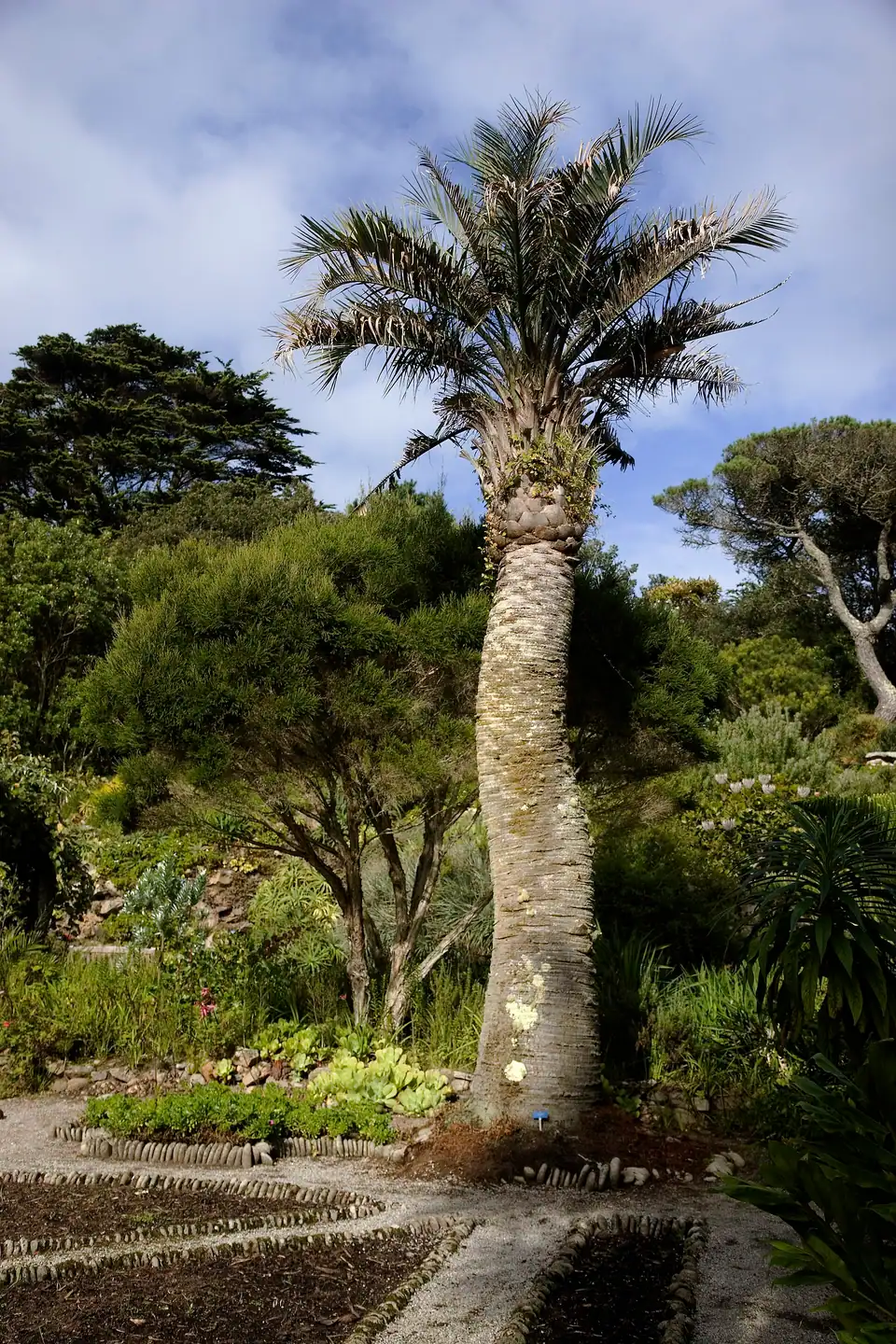
This palm gives you sweet orange fruits, fibrous but delicious, that are often made into jelly, and the seed kernel even yields an edible oil. Once established, it shrugs off drought, grows happily in full sun or partial shade, and reaches 15–20 ft tall. Start it from freshly ripe seed in pots, or simply keep it in a container.
- Sun
Full sun to partial shade
What the sources say (2)
Light: Full sun to partial shade
The pindo palm will grow well in either full sun or partial shade in a variety of soil types and is moderately salt tolerant.
— Pindo Palm – Gardening Solutions [4] Light: full sun Water: drought tolerant when established Soil: well-drained soil
— UNF: Butia capitata [7] - Water
Handles drought once established
- Cold
Survives winters down to 10 °F (−12.2 °C)
Hardy in cold winters · USDA 8a · RHS H5 · Z8
- Planting
Move seedlings as soon as roots start growing or the first shoot appears
What the sources say (1)
Planting: Seedlings: as soon as root growth is noticed or as soon as top growth appears
Plant out into deep pots or the open ground either as soon as root growth is noticed or as soon as top growth appears.
— Butia capitata - Useful Tropical Plants [6] - Feeding
Slow-release palm fertilizer 3 times a year; orange-speckled old leaves mean too little potassium
What the sources say (5)
Mineral fertilizers: Controlled-release palm fertilizer, analysis 8-2-12-4Mg, plus micronutrients
To prevent or correct nutrient deficiencies in pindo palms, 3 (4 in south Florida) applications per year of a controlled release 8N-2P 2 O 5 -12K 2 O-4-Mg plus micronutrients fertilizer are recommended.
— ENH264/ST105: Butia odorata: Pindo Palm [2] As with most palms, the pindo palm will benefit from a regular fertilization schedule. Select a palm-specific fertilizer
— Pindo Palm – Gardening Solutions [4] Signs of deficiency: Potassium: translucent yellow-orange and necrotic speckling toward the tips of the oldest leaves, fewer leaves in the canopy; manganese: necrotic tips on the basal leaflets of newly emerging leaves
Occasionally, translucent yellow-orange and necrotic speckling can also be seen toward the tips of the oldest leaves (Figure 3).
— ENH264/ST105: Butia odorata: Pindo Palm [2] Since K deficiency causes premature leaf loss in palms, the best measure of K deficiency severity in this species is the number of leaves in the canopy.
— ENH264/ST105: Butia odorata: Pindo Palm [2] Symptoms appear as necrotic tips on basal leaflets of newly emerging leaves (Figure 4).
— ENH264/ST105: Butia odorata: Pindo Palm [2] - Harvest
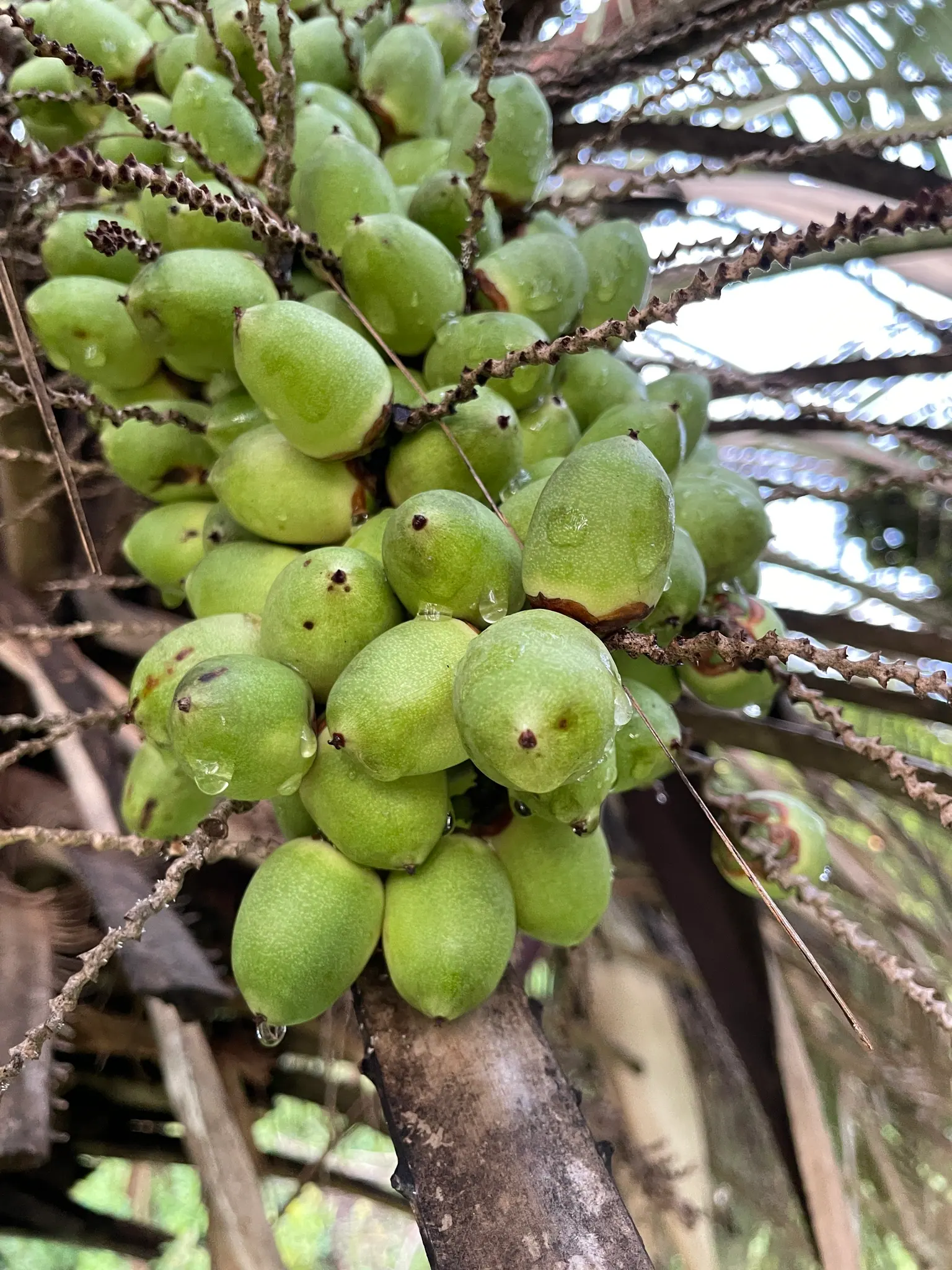
Sweet orange fruits ripen in summer or September; great for jelly
What the sources say (4)
Harvest: September (Villa Thuret, France); summer (Florida)
According to Villa Thuret (INRAE), France: A maturité (mois de septembre), les fruits ovoïdes, légèrement pointus au sommet, sont de couleur orangée
—  [1] Florida: edible yellow fruits that mature in summer and can be made into jelly
— Pindo Palm – Gardening Solutions [4] A maturité (mois de septembre), les fruits ovoïdes, légèrement pointus au sommet, sont de couleur orangée
—  [1] edible yellow fruits that mature in summer and can be made into jelly
— Pindo Palm – Gardening Solutions [4] - Size
15–20 ft tall
What the sources say (1)
Mature height: 457-610 cm (15-20 ft)
The palm is slow-growing, eventually reaching 15–20 feet, making it suitable for planting under power lines
— ENH264/ST105: Butia odorata: Pindo Palm [2] - Propagation
Grows from seed
What the sources say (2)
Propagation: Seed
Pindo palm seeds are notoriously slow and difficult to germinate, but research has shown that simply cracking the stony seed endocarps
— ENH264/ST105: Butia odorata: Pindo Palm [2] Seed - best sown as soon as it is ripe in containers. Stored seed is very slow to germinate.
— Butia capitata - Useful Tropical Plants [6] - Sowing
Sow in pots as soon as the seed is ripe
What the sources say (1)
Sowing: As soon as the seed is ripe, in containers
Seed - best sown as soon as it is ripe in containers. Stored seed is very slow to germinate.
— Butia capitata - Useful Tropical Plants [6] - Containers
Grows in containers too
What the sources say (1)
In containers: Yes
it is prudent to grow the plants in containers for some years, giving them winter protection
— Butia capitata - Useful Tropical Plants [6] - Safety
No known hazards for people
Overview
Pindo palm is a slow-growing, single-stemmed feather palm valued for its cold tolerance, grown mainly as an ornamental with edible fruit. [2][6] It grows in full sun to partial shade and is drought tolerant once established. [4][7]
This record is incomplete: the sources we read do not cover every field yet.
Not yet covered by our sources: Hardiness, warmest zone, Pruning
South American jelly palm care
How to water South American jelly palm
How much light South American jelly palm needs
Full sun to partial shade
How much cold South American jelly palm can take
Hardiness, coldest zone
8a [winter low −12.2 to −9.4 °C (10 to 15 °F)]
Hardiness, warmest zone
Not stated in the sources we read.
Where to grow South American jelly palm
Yes
What the sources say (1)
it is prudent to grow the plants in containers for some years, giving them winter protectionHow to propagate South American jelly palm
Seed
What the sources say (2)
Pindo palm seeds are notoriously slow and difficult to germinate, but research has shown that simply cracking the stony seed endocarpsSeed - best sown as soon as it is ripe in containers. Stored seed is very slow to germinate.How to grow South American jelly palm
The plant
Mature height
457-610 cm (15-20 ft)
What the sources say (1)
The palm is slow-growing, eventually reaching 15–20 feet, making it suitable for planting under power linesFertilizing
How often
Mineral fertilizers
Controlled-release palm fertilizer, analysis 8-2-12-4Mg, plus micronutrients
What the sources say (2)
To prevent or correct nutrient deficiencies in pindo palms, 3 (4 in south Florida) applications per year of a controlled release 8N-2P 2 O 5 -12K 2 O-4-Mg plus micronutrients fertilizer are recommended.As with most palms, the pindo palm will benefit from a regular fertilization schedule. Select a palm-specific fertilizerMicronutrients
Magnesium and micronutrients included in the palm fertilizer; manganese deficiency has been observed
What the sources say (2)
3 (4 in south Florida) applications per year of a controlled release 8N-2P 2 O 5 -12K 2 O-4-Mg plus micronutrients fertilizer are recommended.Although it is not common, manganese (Mn) deficiency (see Manganese Deficiency in Palms , https://edis.ifas.ufl.edu/ep267 ) has been observed in pindo palms.Signs of deficiency
Potassium: translucent yellow-orange and necrotic speckling toward the tips of the oldest leaves, fewer leaves in the canopy; manganese: necrotic tips on the basal leaflets of newly emerging leaves
What the sources say (3)
Occasionally, translucent yellow-orange and necrotic speckling can also be seen toward the tips of the oldest leaves (Figure 3).Since K deficiency causes premature leaf loss in palms, the best measure of K deficiency severity in this species is the number of leaves in the canopy.Symptoms appear as necrotic tips on basal leaflets of newly emerging leaves (Figure 4).South American jelly palm pests and problems
Potassium deficiency
Symptom: Gray, necrotic leaflet tip symptoms, less conspicuous because of the natural gray foliage; the number of leaves in the canopy is the best measure of severity.
What to do: 3 (4 in south Florida) applications per year of a controlled release 8N-2P 2 O 5 -12K 2 O-4-Mg plus micronutrients fertilizer are recommended.
What the sources say (1)
Although they are susceptible to potassium (K) deficiency
— ENH264/ST105: Butia odorata: Pindo Palm [2]
Remedies
Each remedy shows what official sources say about it; traditional remedies without an official source are marked as such. Harmful ones are listed so you know to avoid them.
Treating the plant
false smut
avoid excessive frond removal Official source, not independently tested
How: Avoid excessive frond removal, as palms are sensitive to nutrient deficiencies, and over-pruning may further weaken the tree.
Avoid excessive frond removal, as palms are sensitive to nutrient deficiencies, and over-pruning may further weaken the tree.
— hgic.clemson.edu [8] spacing palms and avoiding overhead irrigation Official source, not independently tested
How: Space palms to improve airflow and avoid overhead irrigation whenever possible.
Space palms to improve airflow. - Avoid overhead irrigation whenever possible.
— hgic.clemson.edu [8]
Is South American jelly palm poisonous?
Reported by the source, quoted verbatim. This is not medical or veterinary advice: if a person or an animal may have eaten this plant, contact a poison control centre or a veterinarian.
## Known Hazards None known ## Botanical References
[6]
Calendar
Sowing
As soon as the seed is ripe, in containers
What the sources say (1)
Seed - best sown as soon as it is ripe in containers. Stored seed is very slow to germinate.Planting
Seedlings: as soon as root growth is noticed or as soon as top growth appears
What the sources say (1)
Plant out into deep pots or the open ground either as soon as root growth is noticed or as soon as top growth appears.Harvest
September (Villa Thuret, France); summer (Florida)
What each source says
According to Villa Thuret (INRAE), France: September
Florida: Summer
What the sources say (4)
According to Villa Thuret (INRAE), France: A maturité (mois de septembre), les fruits ovoïdes, légèrement pointus au sommet, sont de couleur orangéeFlorida: edible yellow fruits that mature in summer and can be made into jellyA maturité (mois de septembre), les fruits ovoïdes, légèrement pointus au sommet, sont de couleur orangéeedible yellow fruits that mature in summer and can be made into jellyPruning
Not stated in the sources we read.
Months as given by the sources, which are mostly from the United States (northern hemisphere). In the southern hemisphere they shift by about six months.
Edibility
Reported by the source, quoted verbatim. Do not eat a plant on the basis of this page alone: identification mistakes can be dangerous.
Indicative values
Values from a secondary source, not checked word for word like the rest of this page. Use them as a starting point.
- Life cycle
- PerennialIndicative value, adapt it to your climate · Secondary source
- Hours of sun
- 6-8 hoursIndicative value, adapt it to your climate · Secondary source
- Drought tolerant
- yesIndicative value, adapt it to your climate · Secondary source
- Soil pH
- 6-7.5Indicative value, adapt it to your climate · Secondary source
- Care level
- ModerateIndicative value, adapt it to your climate · Secondary source
- Growth rate
- LowIndicative value, adapt it to your climate · Secondary source
- Pruning
- March, April, March, AprilIndicative value, adapt it to your climate · Secondary source
Similar plants
- Jelly Palm Butia odorata
- Abies grandis Abies grandis
- Abraham Trachystemon orientalis
- Abyssinian banana Ensete ventricosum
- Acacia longifolia Acacia longifolia
- Acanthus hungaricus Acanthus hungaricus
- Achlys triphylla Achlys triphylla
- Aconite Aconitum napellus
Sources
Every value above is quoted from these documents. Links lead to the original publisher.
-  · jardin-thuret.hub.inrae.fr, consulted
- ENH264/ST105: Butia odorata: Pindo Palm · ask.ifas.ufl.edu, consulted
- ENH-60 · edis.ifas.ufl.edu, consulted
- Pindo Palm – Gardening Solutions · gardeningsolutions.ifas.ufl.edu, consulted
- Butia odorata - UF/IFAS Assessment - University of Florida, Institute of Food and Agricultural Sciences · assessment.ifas.ufl.edu, consulted
- Butia capitata - Useful Tropical Plants · tropical.theferns.info, consulted
- UNF: Butia capitata · unf.edu, consulted
- hgic.clemson.edu · hgic.clemson.edu
Written by Emilio Marruso · last checked