
How to Grow and Care for Yellow Oleander
Cascabela thevetia
Written by Emilio Marruso · last checked
Toxic to: Cats, Dogs, Horses, Livestock, People · Why
At a glance
This easygoing perennial asks for very little: give it full sun or partial shade, and it gets by on little water while still responding well to a good drink. It grows happily in containers and even indoors, spreads 4–5 ft wide, and needs only a light trim after flowering. Just remember that every part is poisonous, so keep it away from kids and pets.
- Sun
Full sun to partial shade
What the sources say (4)
Light: Full sun to partial shade
According to NC State Extension: Yellow oleander does best in rich, sandy soils, but will do well in average, medium moisture soils in full sun to part shade.
— Cascabela thevetia (Be-Still Tree, Lucky Nut, Yellow Oleander) | North Carolina Extension Gardener Plant Toolbox [1] According to NParks Singapore: Plant Care and Propagation | Light Preference | Full Sun | Water Preference
— NParks | Cascabela thevetia [4] Yellow oleander does best in rich, sandy soils, but will do well in average, medium moisture soils in full sun to part shade.
— Cascabela thevetia (Be-Still Tree, Lucky Nut, Yellow Oleander) | North Carolina Extension Gardener Plant Toolbox [1] Light: full sun to part shade Water: well-drained soil, somewhat drought tolerant
— UNF: Thevetia peruviana [3] - Water
Drought tolerant and needs little water, but responds well to watering
What the sources say (4)
Watering notes: Drought tolerant, low water use; responds well to irrigation; needs well-drained soil; when overwintered indoors give very little water
Its low water use makes it an excellent addition to a drought-tolerant garden, patio planting, or near a pool.
— Cascabela thevetia (Be-Still Tree, Lucky Nut, Yellow Oleander) | North Carolina Extension Gardener Plant Toolbox [1] Water: well-drained soil, somewhat drought tolerant, responds well to irrigation
— UNF: Thevetia peruviana [3] To overwinter yellow oleander indoors, site it in a cool location (about 40 degrees F.), such as a basement, with moderate light and very little water.
— Cascabela thevetia (Be-Still Tree, Lucky Nut, Yellow Oleander) | North Carolina Extension Gardener Plant Toolbox [1] Drought: Low water use; suited to drought-tolerant gardens.
Its low water use makes it an excellent addition to a drought-tolerant garden, patio planting, or near a pool.
— Cascabela thevetia (Be-Still Tree, Lucky Nut, Yellow Oleander) | North Carolina Extension Gardener Plant Toolbox [1] - Soil
Needs soil that drains well
What the sources say (3)
Watering notes: Drought tolerant, low water use; responds well to irrigation; needs well-drained soil; when overwintered indoors give very little water
Its low water use makes it an excellent addition to a drought-tolerant garden, patio planting, or near a pool.
— Cascabela thevetia (Be-Still Tree, Lucky Nut, Yellow Oleander) | North Carolina Extension Gardener Plant Toolbox [1] Water: well-drained soil, somewhat drought tolerant, responds well to irrigation
— UNF: Thevetia peruviana [3] To overwinter yellow oleander indoors, site it in a cool location (about 40 degrees F.), such as a basement, with moderate light and very little water.
— Cascabela thevetia (Be-Still Tree, Lucky Nut, Yellow Oleander) | North Carolina Extension Gardener Plant Toolbox [1] - Pruning
Light pruning to shape it after flowering, late summer to fall
What the sources say (4)
Pruning: After flowering (late summer to fall)
According to NC State Extension: It can be propagated from cuttings taken in late summer and the plant will tolerate light pruning to shape it after flowering (late summer to fall).
— Cascabela thevetia (Be-Still Tree, Lucky Nut, Yellow Oleander) | North Carolina Extension Gardener Plant Toolbox [1] Tanzania: Fast growing, prune about a month before the rains to induce flowering.
— Thevetia peruviana (T. neriifolia) Apocynaceae [5] It can be propagated from cuttings taken in late summer and the plant will tolerate light pruning to shape it after flowering (late summer to fall).
— Cascabela thevetia (Be-Still Tree, Lucky Nut, Yellow Oleander) | North Carolina Extension Gardener Plant Toolbox [1] When to prune: Light pruning to shape the plant after flowering (late summer to fall).
the plant will tolerate light pruning to shape it after flowering (late summer to fall).
— Cascabela thevetia (Be-Still Tree, Lucky Nut, Yellow Oleander) | North Carolina Extension Gardener Plant Toolbox [1] - Pests
Mealybugs, scale, aphids and caterpillars; remove leaves with leaf spot
What the sources say (2)
Pests: mealybugs, scale, aphids, caterpillars
Insects, Diseases, and Other Plant Problems: Minor insect issues include mealybugs, scale, and aphids. Caterpillars are known to chew on the leaves.
— Cascabela thevetia (Be-Still Tree, Lucky Nut, Yellow Oleander) | North Carolina Extension Gardener Plant Toolbox [1] Diseases: leaf spot
If leaf spot appears on the leaves, remove them from the plant. Like most members of the dogbane family, yellow oleander is toxic.
— Cascabela thevetia (Be-Still Tree, Lucky Nut, Yellow Oleander) | North Carolina Extension Gardener Plant Toolbox [1] - Size
4–5 ft wide
What the sources say (1)
Mature width: 122-152 cm (4-5 ft)
Dimensions: Height: 4 ft. 0 in. - 8 ft. 0 in. Width: 4 ft. 0 in. - 5 ft. 0 in.
— Cascabela thevetia (Be-Still Tree, Lucky Nut, Yellow Oleander) | North Carolina Extension Gardener Plant Toolbox [1] - Propagation
Tip cuttings in late summer, or from seed
What the sources say (5)
Propagation: Stem (tip) cuttings, taken in late summer; seed
It can be propagated from cuttings taken in late summer and the plant will tolerate light pruning to shape it after flowering (late summer to fall).
— Cascabela thevetia (Be-Still Tree, Lucky Nut, Yellow Oleander) | North Carolina Extension Gardener Plant Toolbox [1] Rootzone Tolerance | Drought Tolerant, Waterlogged Soils | Propagation Method | Stem Cutting (Tip)
— NParks | Cascabela thevetia [4] Propagation: Seeds, cuttings, self sows, and can become weedy
— Yellow Oleander, Lucky Nut (Thevetia peruviana) [6] Management: Seedlings, cuttings. No. of seeds per kg: about 300. Good germination rate of treatment: not necessary.
— Thevetia peruviana (T. neriifolia) Apocynaceae [5] Cuttings: Propagated from cuttings taken in late summer.
It can be propagated from cuttings taken in late summer and the plant will tolerate light pruning to shape it after flowering (late summer to fall).
— Cascabela thevetia (Be-Still Tree, Lucky Nut, Yellow Oleander) | North Carolina Extension Gardener Plant Toolbox [1] - Containers
Grows in containers and indoors; give very little water when it spends winter inside
What the sources say (5)
In containers: Yes
In cooler climates of the United States, it is often grown as a container plant brought indoors in winter or as a year-round houseplant.
— Cascabela thevetia (Be-Still Tree, Lucky Nut, Yellow Oleander) | North Carolina Extension Gardener Plant Toolbox [1] Indoors: Yes
Alternatively, you can grow it as a houseplant in a sunny but cool room with reduced water.
— Cascabela thevetia (Be-Still Tree, Lucky Nut, Yellow Oleander) | North Carolina Extension Gardener Plant Toolbox [1] Watering notes: Drought tolerant, low water use; responds well to irrigation; needs well-drained soil; when overwintered indoors give very little water
Its low water use makes it an excellent addition to a drought-tolerant garden, patio planting, or near a pool.
— Cascabela thevetia (Be-Still Tree, Lucky Nut, Yellow Oleander) | North Carolina Extension Gardener Plant Toolbox [1] Water: well-drained soil, somewhat drought tolerant, responds well to irrigation
— UNF: Thevetia peruviana [3] To overwinter yellow oleander indoors, site it in a cool location (about 40 degrees F.), such as a basement, with moderate light and very little water.
— Cascabela thevetia (Be-Still Tree, Lucky Nut, Yellow Oleander) | North Carolina Extension Gardener Plant Toolbox [1] - Safety
Every part is poisonous if eaten and the sap can irritate skin; also harmful to cats, dogs and horses
Overview
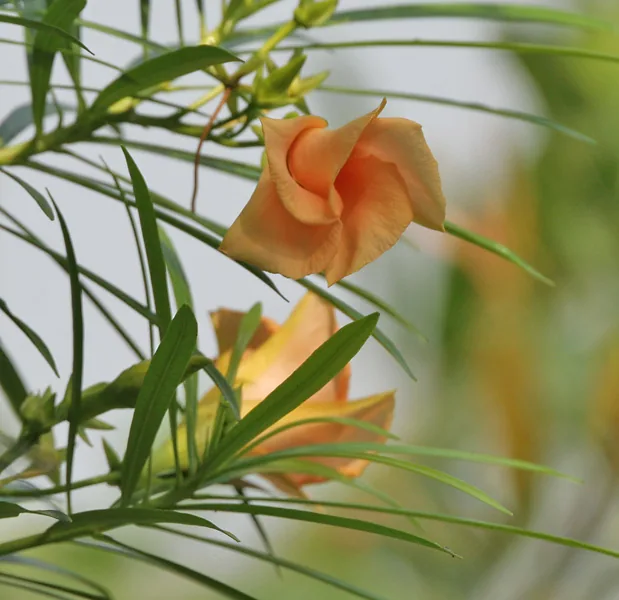
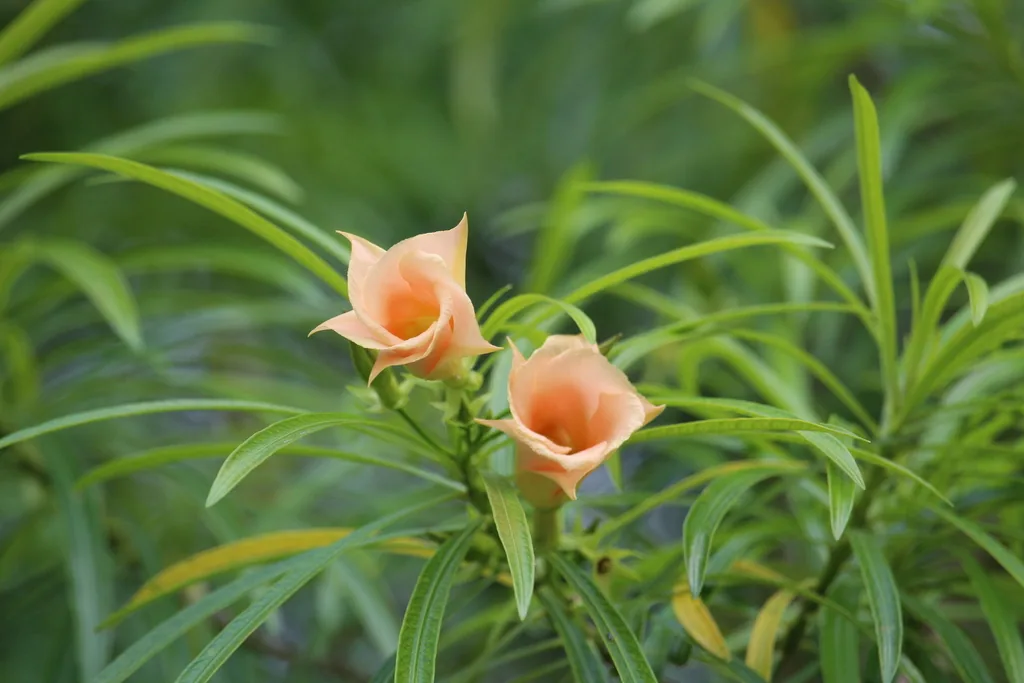
Yellow oleander is an upright evergreen tropical shrub or small tree in the dogbane family, grown for its large, fragrant, funnel-shaped yellow flowers. [1] All parts of the plant are poisonous if ingested; the milky sap contains thevetin, a cardiac glycoside. [1][2] In cooler climates it is grown in containers brought indoors in winter or as a houseplant. [1]
Yellow Oleander care
How to water Yellow Oleander
Watering
The sources give different values depending on region, zone or growing conditions.
What each source says
According to NC State Extension: Water regularly; let the soil dry out between waterings
According to Desert-Tropicals (Phoenix): Regular deep watering once established
According to NParks Singapore: Little water; drought tolerant
What the sources say (3)
According to NC State Extension: If grown in a container, use fertile soils with good drainage. Water regularly, but let the soil dry out between watering.According to Desert-Tropicals (Phoenix): Growth Habits: Small evergreen tree to 8 feet high (3 m)
Flowers: Yellow flowers
Watering Needs: When established, regular deep wateringAccording to NParks Singapore: Light Preference
| Full Sun
| Water Preference
| Little Water
| Rootzone Tolerance
| Drought Tolerant, Waterlogged SoilsWatering notes
Drought tolerant, low water use; responds well to irrigation; needs well-drained soil; when overwintered indoors give very little water
What the sources say (3)
Its low water use makes it an excellent addition to a drought-tolerant garden, patio planting, or near a pool.Water: well-drained soil, somewhat drought tolerant, responds well to irrigationTo overwinter yellow oleander indoors, site it in a cool location (about 40 degrees F.), such as a basement, with moderate light and very little water.How much light Yellow Oleander needs
Full sun to partial shade
What each source says
According to NC State Extension: Full sun to part shade
According to NParks Singapore: Full sun
What the sources say (4)
According to NC State Extension: Yellow oleander does best in rich, sandy soils, but will do well in average, medium moisture soils in full sun to part shade.According to NParks Singapore: Plant Care and Propagation
| Light Preference
| Full Sun
| Water PreferenceYellow oleander does best in rich, sandy soils, but will do well in average, medium moisture soils in full sun to part shade.Light: full sun to part shade
Water: well-drained soil, somewhat drought tolerantHow much cold Yellow Oleander can take
Hardiness, coldest zone
The sources give different values depending on region, zone or growing conditions.
What each source says
According to NC State Extension: 8a [winter low −12.2 to −9.4 °C (10 to 15 °F)]
According to Oregon State University: 9 [winter low −6.7 to −1.1 °C (20 to 30 °F)]
According to Desert-Tropicals: 9 [winter low −6.7 to −1.1 °C (20 to 30 °F)]
What the sources say (3)
According to NC State Extension: USDA Plant Hardiness Zone:
8a, 8b, 9a, 9b, 10a, 10bAccording to Oregon State University: Hardy to USDA Zone 9 (tropical) A close relative of Oleander ( Nerium oleander )According to Desert-Tropicals: Recommended Temperature Zone:
Sunset: 13-14,21-27
USDA: 9-10
Frost ToleranceHardiness, warmest zone
10b [winter low 1.7 to 4.4 °C (35 to 40 °F)]
What each source says
According to NC State Extension: 10b [winter low 1.7 to 4.4 °C (35 to 40 °F)]
According to Desert-Tropicals: 10 [winter low −1.1 to 4.4 °C (30 to 40 °F)]
What the sources say (4)
According to NC State Extension: USDA Plant Hardiness Zone:
8a, 8b, 9a, 9b, 10a, 10bAccording to Desert-Tropicals: Recommended Temperature Zone:
Sunset: 13-14,21-27
USDA: 9-10
Frost ToleranceUSDA Plant Hardiness Zone:
8a, 8b, 9a, 9b, 10a, 10bRecommended Temperature Zone:
Sunset: 13-14,21-27
USDA: 9-10
Frost ToleranceWhere to grow Yellow Oleander
Indoors
Yes
What the sources say (1)
Alternatively, you can grow it as a houseplant in a sunny but cool room with reduced water.In containers
Yes
What the sources say (1)
In cooler climates of the United States, it is often grown as a container plant brought indoors in winter or as a year-round houseplant.How to propagate Yellow Oleander
Stem (tip) cuttings, taken in late summer; seed
What the sources say (4)
It can be propagated from cuttings taken in late summer and the plant will tolerate light pruning to shape it after flowering (late summer to fall).Rootzone Tolerance
| Drought Tolerant, Waterlogged Soils
| Propagation Method
| Stem Cutting (Tip)Propagation: Seeds, cuttings, self sows, and can become weedyManagement: Seedlings, cuttings. No. of seeds per kg: about 300. Good germination rate of treatment: not necessary.How to grow Yellow Oleander
The plant
Life cycle
perennial
What the sources say (1)
Life Cycle:
Perennial
Woody
Recommended Propagation Strategy:
Stem CuttingFamily
Apocynaceae
What the sources say (1)
Genus:
Cascabela
Species:
thevetia
Family:
Apocynaceae
Uses (Ethnobotany):
Used as an animal foodMature height
The sources disagree:
Description Yellow oleander is an upright, evergreen, tropical shrub or small tree in the dogbane family (Apocynaceae) growing to a mature height of 8 feet and a spread of 4 feet.
[1]Broadleaf evergreen shrub or small tree to about 25 ft (~8 m) tall.
[2]Size: Shrub or small tree to about ten feet tall. ## Care Instructions:
[3]
Mature width
122-152 cm (4-5 ft)
What the sources say (1)
Dimensions:
Height: 4 ft. 0 in. - 8 ft. 0 in.
Width: 4 ft. 0 in. - 5 ft. 0 in.Pests and diseases
Pests
mealybugs, scale, aphids, caterpillars
What the sources say (1)
Insects, Diseases, and Other Plant Problems: Minor insect issues include mealybugs, scale, and aphids. Caterpillars are known to chew on the leaves.Diseases
leaf spot
What the sources say (1)
If leaf spot appears on the leaves, remove them from the plant. Like most members of the dogbane family, yellow oleander is toxic.Propagation
Cuttings
Propagated from cuttings taken in late summer.
What the sources say (1)
It can be propagated from cuttings taken in late summer and the plant will tolerate light pruning to shape it after flowering (late summer to fall).Heat and drought
Drought
Low water use; suited to drought-tolerant gardens.
What the sources say (1)
Its low water use makes it an excellent addition to a drought-tolerant garden, patio planting, or near a pool.Pruning
When to prune
Light pruning to shape the plant after flowering (late summer to fall).
What the sources say (1)
the plant will tolerate light pruning to shape it after flowering (late summer to fall).Yellow Oleander pests and problems
Mealybugs, scale and aphids
Symptom: Minor insect infestations
What the sources say (1)
Insects, Diseases, and Other Plant Problems: Minor insect issues include mealybugs, scale, and aphids. Caterpillars are known to chew on the leaves.
— Cascabela thevetia (Be-Still Tree, Lucky Nut, Yellow Oleander) | North Carolina Extension Gardener Plant Toolbox [1] Leaf spot
Symptom: Spots on the leaves
What to do: Remove affected leaves from the plant
What the sources say (1)
If leaf spot appears on the leaves, remove them from the plant. Like most members of the dogbane family, yellow oleander is toxic.
— Cascabela thevetia (Be-Still Tree, Lucky Nut, Yellow Oleander) | North Carolina Extension Gardener Plant Toolbox [1]
Remedies
Each remedy shows what official sources say about it; traditional remedies without an official source are marked as such. Harmful ones are listed so you know to avoid them.
First aid
First aid: not a substitute for a doctor
sap on skin or eyes
washing skin and flushing eyes with running water Official source, not independently tested
Call the NSW Poisons Information Centre on 13 11 26 for immediate support. They will give you information about any first aid you need to do and tell you which emergency department to go to.
— schn.health.nsw.gov.au [7] How: Wash the affected skin with running water; flush the eyes with clean, running water for 10-15 minutes.
washing the affected skin with running water - flushing the eyes with clean, running water for 10-15 minutes
— schn.health.nsw.gov.au [7]
ingestion
removing plant pieces from the mouth and rinsing Official source, not independently tested
Call the NSW Poisons Information Centre on 13 11 26 for immediate support. They will give you information about any first aid you need to do and tell you which emergency department to go to.
— schn.health.nsw.gov.au [7] Seek immediate medical help. DO NOT make a person throw up unless told to do so by poison control or a health care provider.
— medlineplus.gov [8] How: Remove plant pieces from the mouth, then rinse with water.
flushing the eyes with clean, running water for 10-15 minutes - removing plant pieces from your child's mouth, then rinsing with water.
— schn.health.nsw.gov.au [7]
Treating the plant
leaf spot
removing affected leaves Official source, not independently tested
Plant saps can cause allergic skin reactions in some people and smoke from burning plant material can be toxic. Use extreme caution growing this plant around children or pets.
— Cascabela thevetia (Be-Still Tree, Lucky Nut, Yellow Oleander) | North Carolina Extension Gardener Plant Toolbox [1] How: If leaf spot appears on the leaves, remove them from the plant.
If leaf spot appears on the leaves, remove them from the plant. Like most members of the dogbane family, yellow oleander is toxic.
— Cascabela thevetia (Be-Still Tree, Lucky Nut, Yellow Oleander) | North Carolina Extension Gardener Plant Toolbox [1]
Getting rid of it
invasive spread
grubbing and hand pulling seedlings Not verified
Traditional remedy, not verified by an official source.
Plant saps can cause allergic skin reactions in some people and smoke from burning plant material can be toxic. Use extreme caution growing this plant around children or pets.
— Cascabela thevetia (Be-Still Tree, Lucky Nut, Yellow Oleander) | North Carolina Extension Gardener Plant Toolbox [1] How: Grub out and hand pull seedlings; small individual plants may be removed by hand, taking care to remove the roots (not feasible for larger specimens).
felling larger trees Not verified
Traditional remedy, not verified by an official source.
Plant saps can cause allergic skin reactions in some people and smoke from burning plant material can be toxic. Use extreme caution growing this plant around children or pets.
— Cascabela thevetia (Be-Still Tree, Lucky Nut, Yellow Oleander) | North Carolina Extension Gardener Plant Toolbox [1] How: Larger trees need to be felled.
checking treated areas for regrowth Official source, not independently tested
How: Periodically check all treated areas and treat any regrowth; follow-up is needed for a successful control program.
All treated areas must be periodically checked and any regrowth treated, or initial treatment efforts will be wasted. Follow-up must be undertaken to ensure a successful control program.
— business.qld.gov.au [9]
Is Yellow Oleander toxic to pets?
Reported by the source, quoted verbatim. This is not medical or veterinary advice: if a person or an animal may have eaten this plant, contact a poison control centre or a veterinarian.
Animals
Poisonous to Humans Problem for Cats Problem for Dogs Problem for Horses
[1]The source flags the risk for this animal but does not explain why.
Every part of the plant is extremely poisonous to livestock and is not touched even by goats—take care with children.
[5]- Poisonous parts
Every part of the plant is extremely poisonous to livestock and is not touched even by goats—take care with children.
[5]
People
All parts of the plant are poisonous if ingested and the sap can cause allergic skin reactions in some people. Smoke from burning plant material can be toxic.
[1]- Poisonous parts
Poison Toxic Principle: Unidentified, possibly a glycoside Causes Contact Dermatitis: Yes Poison Part: Sap/Juice
[1]- Poisonous parts
This compound is extremely poisonous as are all parts of the plants, especially the seeds.
[2]- Toxic principle
It has a milky sap (latex) which contains, among other things, thevetin (a cardiac glycoside, C42H66O18) with an action similar to that of the digitalis.
[2]- Severity
Poisonous to Humans: Poison Severity: High Poison Symptoms:
[1]
Calendar
Pruning
After flowering (late summer to fall)
What each source says
According to NC State Extension: After flowering (late summer to fall), light pruning to shape
Tanzania: About a month before the rains, to induce flowering
What the sources say (3)
According to NC State Extension: It can be propagated from cuttings taken in late summer and the plant will tolerate light pruning to shape it after flowering (late summer to fall).Tanzania: Fast growing, prune about a month before the rains to induce flowering.It can be propagated from cuttings taken in late summer and the plant will tolerate light pruning to shape it after flowering (late summer to fall).Months as given by the sources, which are mostly from the United States (northern hemisphere). In the southern hemisphere they shift by about six months.
Similar plants
- Allamanda Allamanda cathartica
- Asiatic Jasmine Trachelospermum asiaticum
- Bladderflower Araujia sericifera
- Blue Star Amsonia ciliata
- Blue Star Amsonia hubrichtii
- Bush allamanda Allamanda schottii
- Butterfly Weed Asclepias tuberosa
- Carolina Spinypod Matelea carolinensis
Sources
Every value above is quoted from these documents. Links lead to the original publisher.
- Cascabela thevetia (Be-Still Tree, Lucky Nut, Yellow Oleander) | North Carolina Extension Gardener Plant Toolbox · plants.ces.ncsu.edu, consulted
- Thevetia peruviana | Landscape Plants | Oregon State University · landscapeplants.oregonstate.edu, consulted
- UNF: Thevetia peruviana · unf.edu, consulted
- NParks | Cascabela thevetia · nparks.gov.sg, consulted
- Thevetia peruviana (T. neriifolia) Apocynaceae · apps.worldagroforestry.org, consulted
- Yellow Oleander, Lucky Nut (Thevetia peruviana) · desert-tropicals.com, consulted
- schn.health.nsw.gov.au · schn.health.nsw.gov.au
- medlineplus.gov · medlineplus.gov
- business.qld.gov.au · business.qld.gov.au
Written by Emilio Marruso · last checked