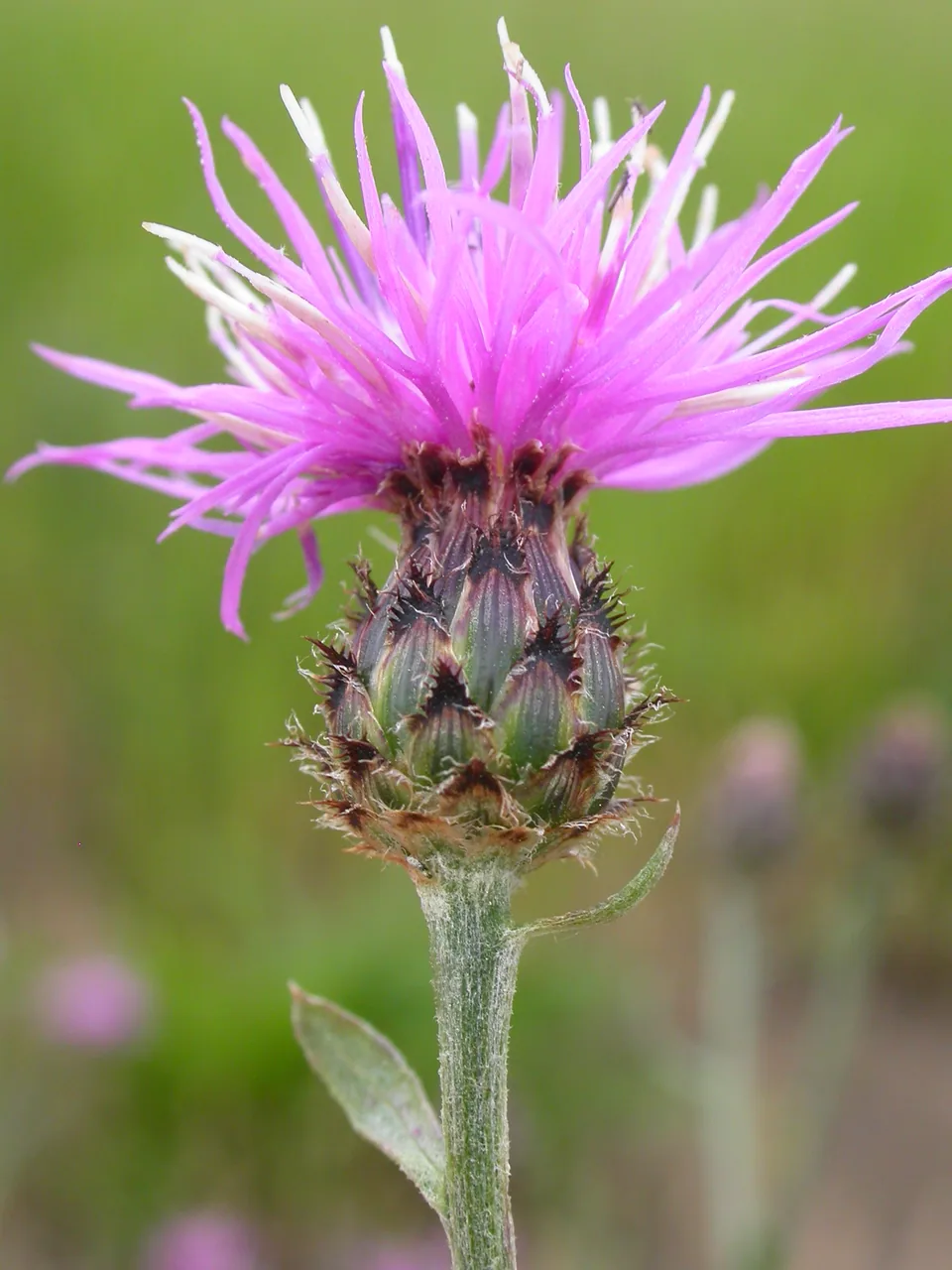


How to Grow and Care for Spotted Knapweed
Centaurea maculosa
Written by Emilio Marruso · last checked
At a glance
Spotted knapweed is a tough biennial or perennial of the daisy family that loves full sun and grows up to 3 ft tall. Before you plant it, know its other side: one plant can make up to 40,000 wind-blown seeds that crowd out native plants and livestock forage. If it shows up, pull it by hand or mow early, and keep at it for several years.
- Sun
Full sun
What the sources say (1)
Light: Full sun
Spotted knapweed prefers to grow in dry, sterile, gravelly or sandy soils, and full sunlight.
— Centaurea maculosa (Spotted Knapweed) | North Carolina Extension Gardener Plant Toolbox [1] - Cold
Survives winters down to −15 °F (−26.1 °C)
Very hardy · USDA 5b · RHS H7 · Z5
What the sources say (2)
Hardiness, coldest zone: 5b [winter low −26.1 to −23.3 °C (−15 to −10 °F)]
USDA Plant Hardiness Zone: 5b, 6a, 6b, 7a, 7b, 8a, 8b, 9a, 9b
— Centaurea maculosa (Spotted Knapweed) | North Carolina Extension Gardener Plant Toolbox [1] Hardiness, warmest zone: 9b [winter low −3.9 to −1.1 °C (25 to 30 °F)]
USDA Plant Hardiness Zone: 5b, 6a, 6b, 7a, 7b, 8a, 8b, 9a, 9b
— Centaurea maculosa (Spotted Knapweed) | North Carolina Extension Gardener Plant Toolbox [1] - Watch out
Invasive: up to 40,000 wind-blown seeds per plant crowd out native plants
- Size
Up to 3 ft tall
What the sources say (1)
Mature height: up to 91 cm (3 ft)
As many as 6 erect stems emerge from the same root crown during a single growing season and grow up to 3 feet tall.
— Centaurea maculosa (Spotted Knapweed) | North Carolina Extension Gardener Plant Toolbox [1] - Propagation
Grows from seed
What the sources say (1)
Propagation: Seed
Recommended Propagation Strategy: Seed
— Centaurea maculosa (Spotted Knapweed) | North Carolina Extension Gardener Plant Toolbox [1]
Overview
Spotted knapweed is a biennial or perennial weed considered invasive in many US states. [1] It prefers dry, sandy or gravelly soils and full sunlight. [1]
Spotted Knapweed care
How much light Spotted Knapweed needs
Full sun
What the sources say (1)
Spotted knapweed prefers to grow in dry, sterile, gravelly or sandy soils, and full sunlight.How much cold Spotted Knapweed can take
Hardiness, coldest zone
5b [winter low −26.1 to −23.3 °C (−15 to −10 °F)]
What the sources say (1)
USDA Plant Hardiness Zone: 5b, 6a, 6b, 7a, 7b, 8a, 8b, 9a, 9bHardiness, warmest zone
9b [winter low −3.9 to −1.1 °C (25 to 30 °F)]
What the sources say (1)
USDA Plant Hardiness Zone: 5b, 6a, 6b, 7a, 7b, 8a, 8b, 9a, 9bHow to propagate Spotted Knapweed
Seed
What the sources say (1)
Recommended Propagation Strategy: SeedHow to grow Spotted Knapweed
The plant
Life cycle
biennial or perennial
What the sources say (1)
Spotted knapweed is an herbaceous biennial or perennial weed in the Asteraceae (aster) family and native to Europe and western Asia.Family
Asteraceae
What the sources say (1)
Spotted knapweed is an herbaceous biennial or perennial weed in the Asteraceae (aster) family and native to Europe and western Asia.Mature height
up to 91 cm (3 ft)
What the sources say (1)
As many as 6 erect stems emerge from the same root crown during a single growing season and grow up to 3 feet tall.Spotted Knapweed pests and problems
Invasive spread
Symptom: Crowds out native species and forage for livestock; seeds spread by wind; up to 40,000 seeds per plant
What to do: Light infestations: hand pulling or early mowing; repeat for several years until soil seed is depleted; resistant to some herbicides
What the sources say (1)
Light infestations of this invasive weed can be managed by pulling the weeds by hand or by mowing early when the plant is just beginning to flower.
— Centaurea maculosa (Spotted Knapweed) | North Carolina Extension Gardener Plant Toolbox [1]
Remedies
Each remedy shows what official sources say about it; traditional remedies without an official source are marked as such. Harmful ones are listed so you know to avoid them.
Getting rid of it
spotted knapweed infestation
hand-pulling and digging Partly works
Use of gloves is necessary as this plant contains an irritant.
— mdc.mo.gov [2] Wear long sleeves and gloves when handling this plant, it can be a skin irritant to some people.
— mda.state.mn.us [3] How: Hand-pull small infestations before seeding, removing the entire crown and taproot; wear long sleeves and gloves.
Hand-pulling is effective for small infestations if completed prior to seeding. Remove the entire crown and taproot to prevent regrowth.
— mdc.mo.gov [2] What the evidence says Hand-pulling is effective for small infestations if completed prior to seeding. Remove the entire crown and taproot to prevent regrowth.
— mdc.mo.gov [2] repeated mowing before flowering Partly works
Wash equipment thoroughly following mowing to prevent spread of seeds to new areas.
— mda.state.mn.us [3] How: Mow before flowering to reduce seed production; mowing must be repeated through the season to stop re-sprouting.
Mowing before flowering can reduce seed production. However, because the plants continue to bloom throughout the summer/early fall, repeated mowing throughout the season is required
— mda.state.mn.us [3] What the evidence says However, in many regions, mowing must be performed more than once a growing season because rootstocks will continue to sprout new growth.
— cipwg.uconn.edu [4] grazing with sheep or goats Partly works
How: Long-term grazing by sheep and goats can control the plant; repeat each year until the seed bank is exhausted.
Long-term grazing by sheep and goats also can be successful in controlling the plant. These activities will have to be repeated each year until the seed bank is exhausted.
— mdc.mo.gov [2] What the evidence says Long-term grazing by sheep and goats also can be successful in controlling the plant. These activities will have to be repeated each year until the seed bank is exhausted.
— mdc.mo.gov [2]
Indicative values
Values from a secondary source, not checked word for word like the rest of this page. Use them as a starting point.
- Watering
- MinimalIndicative value, adapt it to your climate · Secondary source
- Drought tolerant
- yesIndicative value, adapt it to your climate · Secondary source
- Soil pH
- 6-7.5Indicative value, adapt it to your climate · Secondary source
- Growth rate
- HighIndicative value, adapt it to your climate · Secondary source
Similar plants
- Cornflower Centaurea cyanus
- Yellow Star Thistle Centaurea solstitialis
- Brown knapweed Centaurea jacea
- Dusty Miller Centaurea cineraria
- Mountain Bluet Centaurea montana
- Bighead knapweed Centaurea macrocephala
- Tyrol knapweed Centaurea nigrescens
- Whitewash cornflower Centaurea dealbata
Sources
Every value above is quoted from these documents. Links lead to the original publisher.
- Centaurea maculosa (Spotted Knapweed) | North Carolina Extension Gardener Plant Toolbox · plants.ces.ncsu.edu, consulted
- mdc.mo.gov · mdc.mo.gov
- mda.state.mn.us · mda.state.mn.us
- cipwg.uconn.edu · cipwg.uconn.edu
Written by Emilio Marruso · last checked