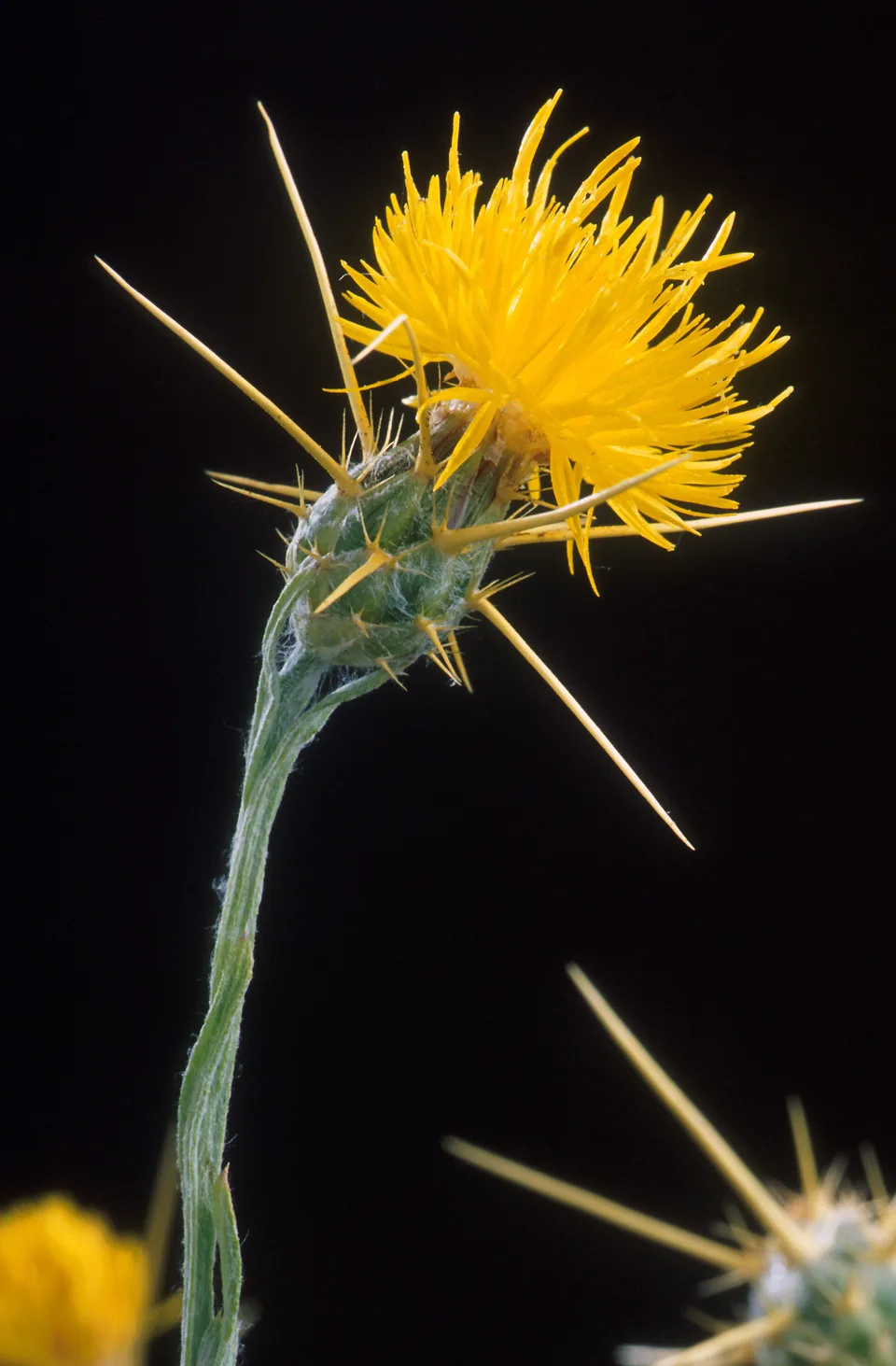


How to Grow and Care for Yellow Star Thistle
Centaurea solstitialis
Written by Emilio Marruso · last checked
Toxic to: Horses · Why
At a glance
Yellow star thistle is a sun-loving annual that asks for very little: give it full sun and well-drained soil, and it shrugs off drought. It grows from seed up to 3 feet tall, and goats happily eat it even when it's spiny. Just keep it well away from horses, because eating it destroys them.
- Sun
Full sun; it cannot grow in shade
What the sources say (1)
Light: Full sun; cannot grow in shade
It can tolerate drought. It cannot grow in the shade.
— Centaurea solstitialis (Barnaby's Thistle, Yellow Knapweed, Yellow Star Thistle) | North Carolina Extension Gardener Plant Toolbox [1] - Water
Tolerates drought, so it needs little watering
What the sources say (1)
Watering: Tolerates drought; prefers well-drained soil
Prefers well-drained soil of any type and any pH and can grow in nutritionally poor soil as well as very alkaline soils. It can tolerate drought.
— Centaurea solstitialis (Barnaby's Thistle, Yellow Knapweed, Yellow Star Thistle) | North Carolina Extension Gardener Plant Toolbox [1] - Cold
Survives winters down to −20 °F (−28.9 °C)
Very hardy · USDA 5a · RHS H7 · Z5
What the sources say (2)
Hardiness, coldest zone: 5a [winter low −28.9 to −26.1 °C (−20 to −15 °F)]
USDA Plant Hardiness Zone: 5a, 5b, 6a, 6b, 7a, 7b, 8a, 8b, 9a
— Centaurea solstitialis (Barnaby's Thistle, Yellow Knapweed, Yellow Star Thistle) | North Carolina Extension Gardener Plant Toolbox [1] Hardiness, warmest zone: 9a [winter low −6.7 to −3.9 °C (20 to 25 °F)]
USDA Plant Hardiness Zone: 5a, 5b, 6a, 6b, 7a, 7b, 8a, 8b, 9a
— Centaurea solstitialis (Barnaby's Thistle, Yellow Knapweed, Yellow Star Thistle) | North Carolina Extension Gardener Plant Toolbox [1] - Soil
Prefers well-drained soil
What the sources say (1)
Watering: Tolerates drought; prefers well-drained soil
Prefers well-drained soil of any type and any pH and can grow in nutritionally poor soil as well as very alkaline soils. It can tolerate drought.
— Centaurea solstitialis (Barnaby's Thistle, Yellow Knapweed, Yellow Star Thistle) | North Carolina Extension Gardener Plant Toolbox [1] - Size
An annual that grows up to 3 ft tall
What the sources say (2)
Mature height: up to 91.44 cm (3 feet)
The stem is erect, slender, hairy and branching, and can grow up to three feet tall
— Centaurea solstitialis (Barnaby's Thistle, Yellow Knapweed, Yellow Star Thistle) | North Carolina Extension Gardener Plant Toolbox [1] Life cycle: annual
Genus: Centaurea Species: solstitialis Family: Asteraceae Life Cycle: Annual
— Centaurea solstitialis (Barnaby's Thistle, Yellow Knapweed, Yellow Star Thistle) | North Carolina Extension Gardener Plant Toolbox [1] - Propagation
Grows from seed
What the sources say (1)
Propagation: Seed
Recommended Propagation Strategy: Seed
— Centaurea solstitialis (Barnaby's Thistle, Yellow Knapweed, Yellow Star Thistle) | North Carolina Extension Gardener Plant Toolbox [1] - Safety
Deadly for horses if they eat it; not toxic to cats and dogs
Overview
Yellow star thistle is a winter annual considered invasive in many western and upper mid-Western United States. [1] It prefers well-drained soil, tolerates drought and cannot grow in the shade. [1] Ingested by horses, it can cause death through starvation or dehydration. [1]
Yellow Star Thistle care
How to water Yellow Star Thistle
Tolerates drought; prefers well-drained soil
What the sources say (1)
Prefers well-drained soil of any type and any pH and can grow in nutritionally poor soil as well as very alkaline soils. It can tolerate drought.How much light Yellow Star Thistle needs
Full sun; cannot grow in shade
What the sources say (1)
It can tolerate drought. It cannot grow in the shade.How much cold Yellow Star Thistle can take
Hardiness, coldest zone
5a [winter low −28.9 to −26.1 °C (−20 to −15 °F)]
What the sources say (1)
USDA Plant Hardiness Zone:
5a, 5b, 6a, 6b, 7a, 7b, 8a, 8b, 9aHardiness, warmest zone
9a [winter low −6.7 to −3.9 °C (20 to 25 °F)]
What the sources say (1)
USDA Plant Hardiness Zone:
5a, 5b, 6a, 6b, 7a, 7b, 8a, 8b, 9aHow to propagate Yellow Star Thistle
Seed
What the sources say (1)
Recommended Propagation Strategy:
SeedHow to grow Yellow Star Thistle
The plant
Life cycle
annual
What the sources say (1)
Genus:
Centaurea
Species:
solstitialis
Family:
Asteraceae
Life Cycle:
AnnualFamily
Asteraceae
What the sources say (1)
Genus:
Centaurea
Species:
solstitialis
Family:
Asteraceae
Life Cycle:
Annual
Recommended Propagation Strategy:
SeedMature height
up to 91.44 cm (3 feet)
What the sources say (1)
The stem is erect, slender, hairy and branching, and can grow up to three feet tallRemedies
Each remedy shows what official sources say about it; traditional remedies without an official source are marked as such. Harmful ones are listed so you know to avoid them.
Getting rid of it
yellow starthistle infestation
hand digging of plants Works
How: Cut and remove stems to access roots and chop plants below the root crown; as annual plants they will not regrow. Return to the area each year.
Cut and remove stems to access roots. Chop plants below the root crown. As annual plants, they won’t regrow.
— solvepestproblems.oregonstate.edu [2] What the evidence says Hand tools are effective to remove individual plants and small patches.
— solvepestproblems.oregonstate.edu [2] timed mowing Partly works
Plants will regrow stems and then flowers if mowed too early.
— solvepestproblems.oregonstate.edu [2] How: Mow at the late spiny or early flowering stage; mow a second or third time to keep plants from flowering.
Mow at the late spiny or early flowering stage.
— solvepestproblems.oregonstate.edu [2] What the evidence says Carefully timed mowing limits yellow starthistle seed production.
— solvepestproblems.oregonstate.edu [2] mowing then hand pulling Not verified
Traditional remedy, not verified by an official source.
How: First mow near the summer solstice, after plants have bolted but before seeds mature; after several seasons of mowing, hand pull the remaining plants before they go to seed.
cultivating the soil in spring Partly works
If you cultivate too early (before the last rains), more seeds will sprout.
— solvepestproblems.oregonstate.edu [2] How: Cultivate after the last rains and before flowering; another cultivation will be necessary to keep remaining plants from setting seed.
Cultivate yellow starthistle after the last rains and before flowering for best results.
— solvepestproblems.oregonstate.edu [2] What the evidence says Cultivating and/or mowing at the right time reduces seed production. This weakens a population of starthistle.
— solvepestproblems.oregonstate.edu [2] targeted grazing Partly works
Yellow starthistle is toxic to horses.
— solvepestproblems.oregonstate.edu [2] Move the livestock before they damage desired plants.
— solvepestproblems.oregonstate.edu [2] How: Graze heavily at least 2 times per year to prevent flowering; several years of grazing deplete the seeds in the soil. Sheep and cattle eat it before the spines form; goats at any stage.
Graze heavily at least 2 times per year to prevent flowering. Several years of grazing will deplete the yellow starthistle seeds in the soil.
— solvepestproblems.oregonstate.edu [2] What the evidence says Grazing is an effective way to reduce yellow starthistle canopy and keep it from flowering.
— solvepestproblems.oregonstate.edu [2] bag flowering plants and dispose off-site Not verified
Traditional remedy, not verified by an official source.
How: When flowering, bag the plants and dispose of them off-site.
Is Yellow Star Thistle toxic to pets?
Reported by the source, quoted verbatim. This is not medical or veterinary advice: if a person or an animal may have eaten this plant, contact a poison control centre or a veterinarian.
Edibility
Reported by the source, quoted verbatim. Do not eat a plant on the basis of this page alone: identification mistakes can be dangerous.
Goats will eat Yellow Star Thistle even in the spiny stage.
[1]
Indicative values
Values from a secondary source, not checked word for word like the rest of this page. Use them as a starting point.
- Hours of sun
- 6-8 hoursIndicative value, adapt it to your climate · Secondary source
- Drought tolerant
- yesIndicative value, adapt it to your climate · Secondary source
- Soil pH
- 6-7.5Indicative value, adapt it to your climate · Secondary source
- Care level
- MediumIndicative value, adapt it to your climate · Secondary source
- Growth rate
- HighIndicative value, adapt it to your climate · Secondary source
- Pruning
- December, January, FebruaryIndicative value, adapt it to your climate · Secondary source
Similar plants
- Cornflower Centaurea cyanus
- Spotted Knapweed Centaurea maculosa
- Brown knapweed Centaurea jacea
- Dusty Miller Centaurea cineraria
- Mountain Bluet Centaurea montana
- Bighead knapweed Centaurea macrocephala
- Tyrol knapweed Centaurea nigrescens
- Whitewash cornflower Centaurea dealbata
Sources
Every value above is quoted from these documents. Links lead to the original publisher.
- Centaurea solstitialis (Barnaby's Thistle, Yellow Knapweed, Yellow Star Thistle) | North Carolina Extension Gardener Plant Toolbox · plants.ces.ncsu.edu, consulted
- solvepestproblems.oregonstate.edu · solvepestproblems.oregonstate.edu
Written by Emilio Marruso · last checked