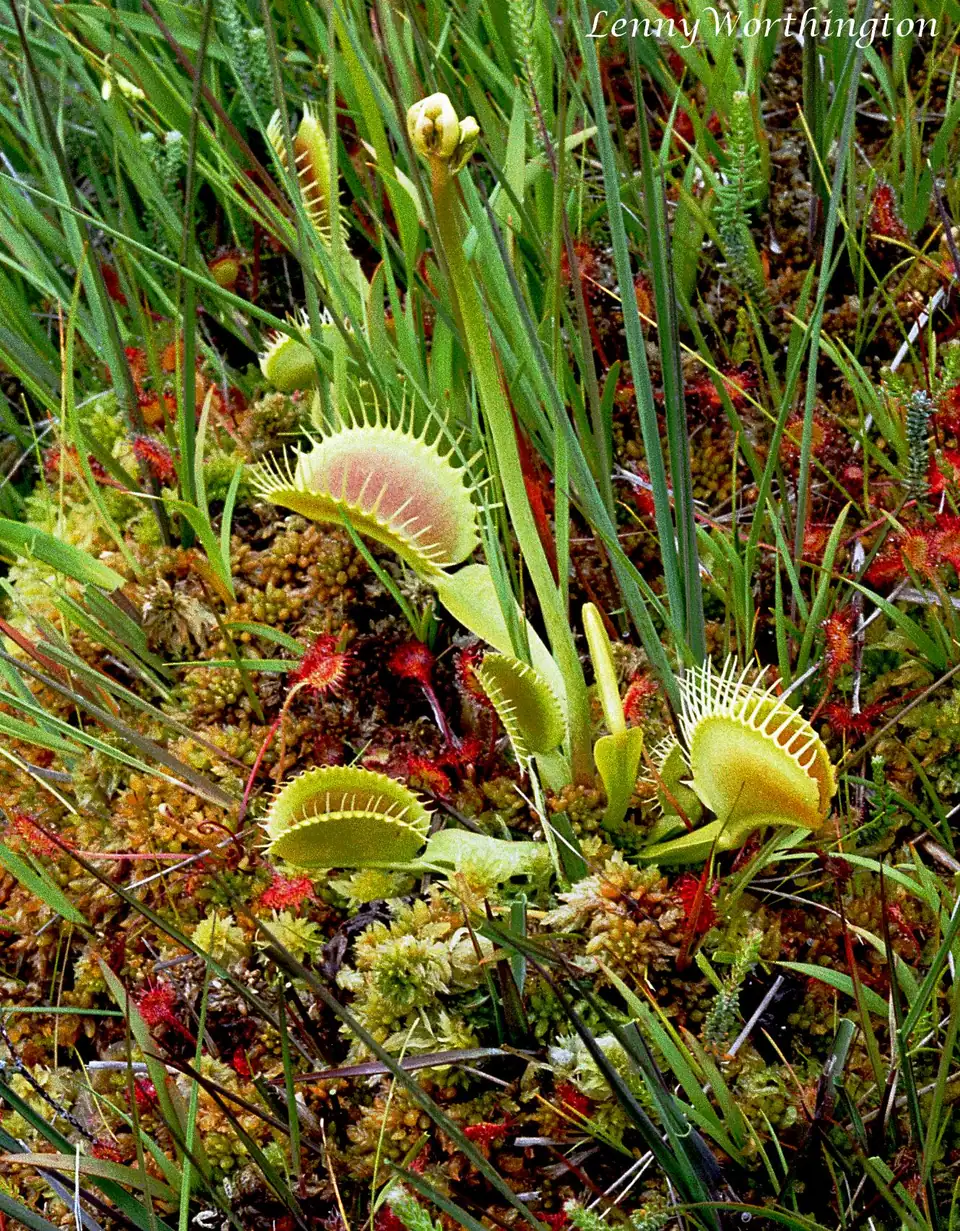


How to Grow and Care for Venus flytrap
Dionaea muscipula
Written by Emilio Marruso · last checked
Not toxic to cats and dogs, according to the sources · Sources
At a glance
The Venus flytrap is a small perennial, 6 inches to 1 foot tall, that grows happily in a pot, indoors or out. Give it full sun to partial shade, keep its soil moist with rainwater or distilled water, and skip the fertilizer entirely. It is safe around cats, dogs and horses, and it has no serious pest or disease problems.
- Sun
Full sun to partial shade
What the sources say (1)
Light: Full sun to partial shade
It needs high humidity, wet, sandy soil, and full sun to partial shade.
— Dionaea muscipula (Meadow Clams, Venus Flytrap, Venus Fly Trap) | North Carolina Extension Gardener Plant Toolbox [1] - Water
Keep the soil moist, never dry or soggy; use only rainwater or distilled water
What the sources say (3)
Watering: Do not allow the soil to dry out; keep moist but not soggy
Do not allow the soil to dry out.
— Dionaea muscipula (Meadow Clams, Venus Flytrap, Venus Fly Trap) | North Carolina Extension Gardener Plant Toolbox [1] It requires a pH around 5.0, a highly organic potting soil and moist, but not soggy conditions.
— Venus Flytrap [2] Watering notes: Irrigate with rainwater or distilled water; treated (chlorinated) water or hard water can kill the plant
Irrigate with rainwater or distilled water; treated (chlorinated) water or hard water can kill the plant.
— Dionaea muscipula (Meadow Clams, Venus Flytrap, Venus Fly Trap) | North Carolina Extension Gardener Plant Toolbox [1] - Soil
Acidic soil, pH 6.0 or lower
What the sources say (1)
Soil pH, maximum: 6.0
Soil Texture: Loam (Silt) Sand Soil pH: Acid (<6.0) Soil Drainage: Frequent Standing Water
— Dionaea muscipula (Meadow Clams, Venus Flytrap, Venus Fly Trap) | North Carolina Extension Gardener Plant Toolbox [1] - Feeding
Do not fertilize it; salts and fertilizer harm it
What the sources say (2)
Avoid: Do not fertilize; avoid high salts and high fertilizer rates
Do not allow the soil to dry out. Do not fertilize the plant.
— Dionaea muscipula (Meadow Clams, Venus Flytrap, Venus Fly Trap) | North Carolina Extension Gardener Plant Toolbox [1] Drought, high salts, high rates of fertilization, low humidity and too much fooling around with the traps are not to its liking.
— Venus Flytrap [2] - Pests
Few problems; watch for aphids, spider mites and black spot
What the sources say (2)
Pests: aphids, spider mites
Insects, Diseases, and Other Plant Problems: No serious insect or disease problems. Watch for aphids, spider mites, and black spot.
— Dionaea muscipula (Meadow Clams, Venus Flytrap, Venus Fly Trap) | North Carolina Extension Gardener Plant Toolbox [1] Diseases: black spot
Insects, Diseases, and Other Plant Problems: No serious insect or disease problems. Watch for aphids, spider mites, and black spot.
— Dionaea muscipula (Meadow Clams, Venus Flytrap, Venus Fly Trap) | North Carolina Extension Gardener Plant Toolbox [1] - Watch out
Chlorinated or hard water can kill it; avoid dry air and don't touch the traps too much
What the sources say (1)
Watering notes: Irrigate with rainwater or distilled water; treated (chlorinated) water or hard water can kill the plant
Irrigate with rainwater or distilled water; treated (chlorinated) water or hard water can kill the plant.
— Dionaea muscipula (Meadow Clams, Venus Flytrap, Venus Fly Trap) | North Carolina Extension Gardener Plant Toolbox [1] - Size
6 in to 1 ft tall, 6–8 in wide
What the sources say (2)
Mature height: 15-30 cm (6 in - 1 ft)
Dimensions: Height: 0 ft. 6 in. - 1 ft. 0 in. Width: 0 ft. 6 in. - 0 ft. 8 in.
— Dionaea muscipula (Meadow Clams, Venus Flytrap, Venus Fly Trap) | North Carolina Extension Gardener Plant Toolbox [1] Mature width: 15-20 cm (6 in - 8 in)
Dimensions: Height: 0 ft. 6 in. - 1 ft. 0 in. Width: 0 ft. 6 in. - 0 ft. 8 in.
— Dionaea muscipula (Meadow Clams, Venus Flytrap, Venus Fly Trap) | North Carolina Extension Gardener Plant Toolbox [1] - Propagation
By division or from seed
What the sources say (2)
Propagation: Division; seed; tissue culture
Life Cycle: Perennial Recommended Propagation Strategy: Division Seed
— Dionaea muscipula (Meadow Clams, Venus Flytrap, Venus Fly Trap) | North Carolina Extension Gardener Plant Toolbox [1] Tissue culture propagation has been perfected for these charming carnivores, so growing
— Venus Flytrap [2] - Containers
Grows well in pots, indoors too
What the sources say (2)
In containers: Yes
Use the plant in containers, along bogs and ponds or any sufficiently wet area.
— Dionaea muscipula (Meadow Clams, Venus Flytrap, Venus Fly Trap) | North Carolina Extension Gardener Plant Toolbox [1] Indoors: Yes
#full sun tolerant #container plant #coastal plant #pest resistant #boggy sites #wildflower #houseplant
— Dionaea muscipula (Meadow Clams, Venus Flytrap, Venus Fly Trap) | North Carolina Extension Gardener Plant Toolbox [1] - Safety
Safe for cats, dogs and horses
Overview
Venus flytrap is a carnivorous plant native to coastal North Carolina and a small area of northeastern South Carolina. [1] It needs high humidity, wet sandy soil, and full sun to partial shade, and the soil should not be allowed to dry out. [1] It should be irrigated with rainwater or distilled water, because treated (chlorinated) or hard water can kill the plant. [1]
This record is incomplete: the sources we read do not cover every field yet.
Not yet covered by our sources: Pruning
Venus flytrap care
How to water Venus flytrap
Watering
Do not allow the soil to dry out; keep moist but not soggy
Watering notes
Irrigate with rainwater or distilled water; treated (chlorinated) water or hard water can kill the plant
What the sources say (1)
Irrigate with rainwater or distilled water; treated (chlorinated) water or hard water can kill the plant.How much light Venus flytrap needs
Full sun to partial shade
What the sources say (1)
It needs high humidity, wet, sandy soil, and full sun to partial shade.How much cold Venus flytrap can take
Hardiness, coldest zone
The sources give different values depending on region, zone or growing conditions.
What each source says
According to NC State Extension (zone list): 6a [winter low −23.3 to −20.6 °C (−10 to −5 °F)]
winter hardy (NC State Extension): 7 [winter low −17.8 to −12.2 °C (0 to 10 °F)]
protected through the winter (NC State Extension): 5 [winter low −28.9 to −23.3 °C (−20 to −10 °F)]
What the sources say (4)
According to NC State Extension (zone list): 6a, 6b, 7a, 7b, 8a, 8b, 9a, 9b, 10a, 10bwinter hardy (NC State Extension): It is winter hardy in USDA zones 7 to 10, but by protecting it through the winter, it can be grown in zones 5 and 6.protected through the winter (NC State Extension): It is winter hardy in USDA zones 7 to 10, but by protecting it through the winter, it can be grown in zones 5 and 6.6a, 6b, 7a, 7b, 8a, 8b, 9a, 9b, 10a, 10bHardiness, warmest zone
10b [winter low 1.7 to 4.4 °C (35 to 40 °F)]
What the sources say (1)
6a, 6b, 7a, 7b, 8a, 8b, 9a, 9b, 10a, 10bBest soil for Venus flytrap
6.0
What the sources say (1)
Soil Texture:
Loam (Silt)
Sand
Soil pH:
Acid (<6.0)
Soil Drainage:
Frequent Standing WaterWhere to grow Venus flytrap
Indoors
Yes
What the sources say (1)
#full sun tolerant #container plant #coastal plant #pest resistant #boggy sites #wildflower #houseplantIn containers
Yes
What the sources say (1)
Use the plant in containers, along bogs and ponds or any sufficiently wet area.How to propagate Venus flytrap
Division; seed; tissue culture
What the sources say (2)
Life Cycle:
Perennial
Recommended Propagation Strategy:
Division
SeedTissue culture propagation has been perfected for these charming carnivores, so growingHow to grow Venus flytrap
The plant
Life cycle
perennial
What the sources say (1)
Life Cycle: Perennial Recommended Propagation Strategy: Division Seed Country Or Region Of Origin: North Carolina and South CarolinaFamily
Droseraceae
What the sources say (1)
Venus flytrap is one of the best-known carnivorous plants and is native to coastal NC and a small area of northeastern SC. It is a member of the sundew family (Droseraceae).Mature height
15-30 cm (6 in - 1 ft)
What the sources say (1)
Dimensions: Height: 0 ft. 6 in. - 1 ft. 0 in. Width: 0 ft. 6 in. - 0 ft. 8 in.Mature width
15-20 cm (6 in - 8 in)
What the sources say (1)
Dimensions: Height: 0 ft. 6 in. - 1 ft. 0 in. Width: 0 ft. 6 in. - 0 ft. 8 in.Pests and diseases
Pests
aphids, spider mites
What the sources say (1)
Insects, Diseases, and Other Plant Problems: No serious insect or disease problems. Watch for aphids, spider mites, and black spot.Diseases
black spot
What the sources say (1)
Insects, Diseases, and Other Plant Problems: No serious insect or disease problems. Watch for aphids, spider mites, and black spot.Fertilizing
Avoid
Do not fertilize; avoid high salts and high fertilizer rates
What the sources say (2)
Do not allow the soil to dry out. Do not fertilize the plant.Drought, high salts, high rates of fertilization, low humidity
and too much fooling around with the traps are not to its liking.Venus flytrap pests and problems
Aphids, spider mites and black spot
Symptom: No serious insect or disease problems; watch for aphids, spider mites, and black spot.
What the sources say (1)
No serious insect or disease problems. Watch for aphids, spider mites, and black spot.
— Dionaea muscipula (Meadow Clams, Venus Flytrap, Venus Fly Trap) | North Carolina Extension Gardener Plant Toolbox [1] Water quality
Symptom: Treated (chlorinated) water or hard water can kill the plant.
What to do: Irrigate with rainwater or distilled water; do not fertilize the plant.
What the sources say (1)
Irrigate with rainwater or distilled water; treated (chlorinated) water or hard water can kill the plant.
— Dionaea muscipula (Meadow Clams, Venus Flytrap, Venus Fly Trap) | North Carolina Extension Gardener Plant Toolbox [1] Unsuitable conditions
Symptom: Drought, high salts, high rates of fertilization, low humidity and too much handling of the traps are not to its liking.
What the sources say (1)
Drought, high salts, high rates of fertilization, low humidity and too much fooling around with the traps are not to its liking.
— Venus Flytrap [2]
Remedies
Each remedy shows what official sources say about it; traditional remedies without an official source are marked as such. Harmful ones are listed so you know to avoid them.
Treating the plant
aphids
tweezers removal Not verified
Traditional remedy, not verified by an official source.
How: Manually remove aphids with tweezers.
submerging the plant in water Not verified
Traditional remedy, not verified by an official source.
How: Fully submerge the plant in water for 2 days at a time and repeat every 7 days to remove aphids and spider mites.
soap spray Works
Soap sprays and other insecticidal treatments should be used sparingly, as these plants are sensitive to contaminants.
— almanac.com [3] How: Soap sprays and other insecticidal treatments should be used sparingly on this plant.
Soap sprays and other insecticidal treatments should be used sparingly, as these plants are sensitive to contaminants.
— almanac.com [3] What the evidence says For example, insecticidal soap is a safe, effective organic insecticide with minimal environmental impact.
— extension.psu.edu [4]
fungus-gnats
sticky traps Not verified
Traditional remedy, not verified by an official source.
How: Use sticky traps to catch fungus gnats.
Is Venus flytrap poisonous?
Reported by the source, quoted verbatim. This is not medical or veterinary advice: if a person or an animal may have eaten this plant, contact a poison control centre or a veterinarian.
#non-toxic for cats #non-toxic for horses #non-toxic for dogs
[1]The source flags the risk for this animal but does not explain why.
Calendar
Pruning
Not stated in the sources we read.
Months as given by the sources, which are mostly from the United States (northern hemisphere). In the southern hemisphere they shift by about six months.
Indicative values
Values from a secondary source, not checked word for word like the rest of this page. Use them as a starting point.
- Drought tolerant
- yesIndicative value, adapt it to your climate · Secondary source
- Growth rate
- HighIndicative value, adapt it to your climate · Secondary source
- Pruning
- February, March, April, August, MayIndicative value, adapt it to your climate · Secondary source
Similar plants
- Pink Sundew Drosera capillaris
- Roundleaf Sundew Drosera rotundifolia
- Spoonleaf Sundew Drosera intermedia
- Sundew Drosera filiformis
- Abies grandis Abies grandis
- Abraham Trachystemon orientalis
- Abyssinian banana Ensete ventricosum
- Acacia longifolia Acacia longifolia
Sources
Every value above is quoted from these documents. Links lead to the original publisher.
- Dionaea muscipula (Meadow Clams, Venus Flytrap, Venus Fly Trap) | North Carolina Extension Gardener Plant Toolbox · plants.ces.ncsu.edu, consulted
- Venus Flytrap · uaex.uada.edu, consulted
- almanac.com · almanac.com
- extension.psu.edu · extension.psu.edu
Written by Emilio Marruso · last checked