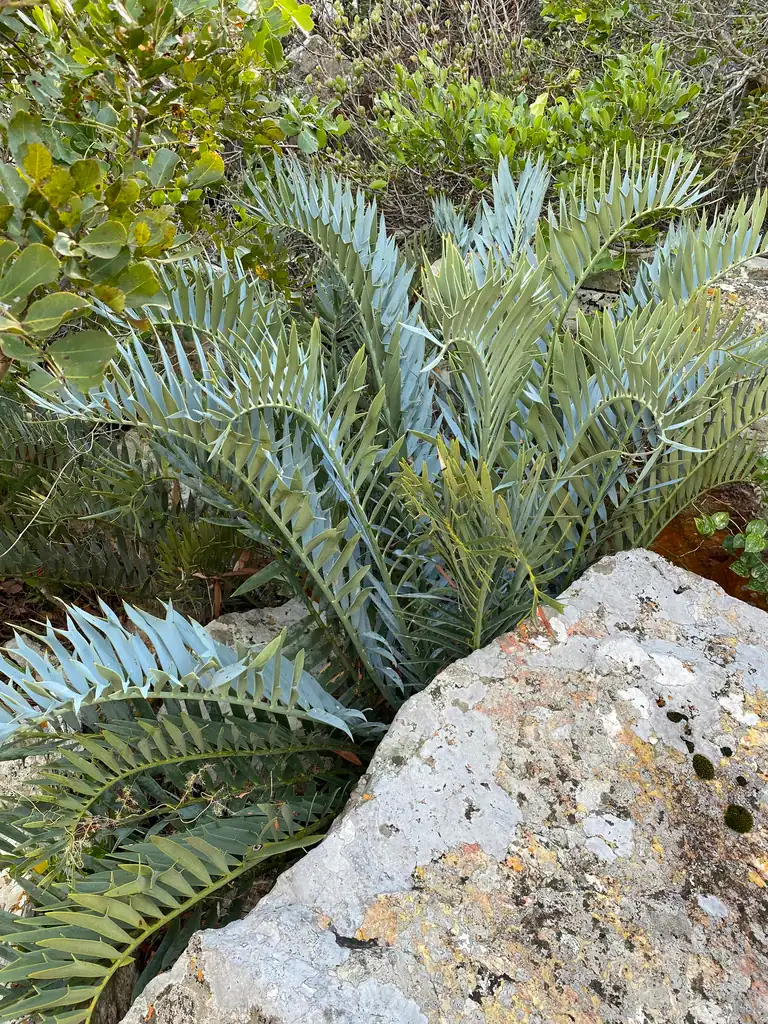
How to Grow and Care for Eastern Cape blue cycad
Encephalartos horridus
Written by Emilio Marruso · last checked
Toxic to: Animals · Why
At a glance
This cycad is a striking plant to grow: it does well in a container, and you can start new plants from seed or from the suckers it forms. Its needs are simple: give seedlings very good drainage and keep the plant completely dry in winter. Just wear gloves when you handle the seeds, because they are poisonous.
- Water
Keep it completely dry in winter; seedlings need very good drainage
What the sources say (2)
Watering notes: Keep totally dry in winter; seedlings need very good drainage
Hardiness: They do best in a tropical or sub-tropical climate and should be kept totally dry in winter at or around 10°C
— Zamia horrida [4] The seedlings need plenty of room for the tap root to develop and require very good drainage.
— Zamia horrida [4] - Cold
Survives winters down to 25 °F (−3.9 °C)
Half hardy: mild winters or an unheated greenhouse · USDA 9b · RHS H3 · Z9
What the sources say (4)
Hardiness, coldest zone: 9b [winter low −3.9 to −1.1 °C (25 to 30 °F)]
According to Desert Tropicals: Recommended Temperature Zone: USDA: 9b-11 Heat Tolerance: Enjoys very hot conditions
— Ferocious Blue Cycad (Encephalartos horridus) [6] Recommended Temperature Zone: USDA: 9b-11 Heat Tolerance: Enjoys very hot conditions
— Ferocious Blue Cycad (Encephalartos horridus) [6] Hardiness, warmest zone: 11 [winter low 4.4 to 10 °C (40 to 50 °F)]
According to Desert Tropicals: Recommended Temperature Zone: USDA: 9b-11 Heat Tolerance: Enjoys very hot conditions
— Ferocious Blue Cycad (Encephalartos horridus) [6] Recommended Temperature Zone: USDA: 9b-11 Heat Tolerance: Enjoys very hot conditions
— Ferocious Blue Cycad (Encephalartos horridus) [6] - Propagation
Grow new plants from seed or from the suckers
What the sources say (2)
Propagation: Seed, suckers
Propagation is by seeds or suckers . It is important to remember that the Seeds are poisonous and should be handled with gloves.
— Encephalartos horridus | Tree SA [3] Propagation: Plants are available from nurseries in many areas, however they are also easy to propagate from seeds. They can also be propagated from suckers with some patience and experience.
— Zamia horrida [4] - Containers
Grows in containers too
What the sources say (1)
In containers: Yes
Uses in landscape design | Encephalartos horridus are perfect plants for containers.
— Encephalartos horridus (Eastern Cape blue cycad) - Plantinfo [5] - Safety
The seeds are poisonous to people and pets: handle them with gloves
Overview
Encephalartos horridus is a low-growing cycad with rigid, curling, spiny, silvery-blue leaves that forms suckers freely. [5] It is a long-lived, slow-growing plant that takes 15 to 20 years to produce a cone. [4] Its seeds are poisonous and should be handled with gloves. [3]
This record is incomplete: the sources we read do not cover every field yet.
Not yet covered by our sources: Pruning
Eastern Cape blue cycad care
How to water Eastern Cape blue cycad
Watering
The sources give different values depending on region, zone or growing conditions.
What each source says
According to LLIFLE: Plenty of water, especially in dry weather; eventually drought resistant
According to Desert Tropicals: Regular water
According to PlantInfo: Little water
According to TreeSA: Should not be over-watered
What the sources say (4)
According to LLIFLE: Waterings: In cultivation prefers plenty of water, especially in dry weather for optimal growth. But it is eventually drought resistant.According to Desert Tropicals: Sun Exposure: Light shade to full sun
Origin: South Africa (Eastern Cape Province)
Growth Habits: Cycad, up to 2 feet tall (60cm)
Watering Needs: Regular waterAccording to PlantInfo: Full Sun – Prefers 6 or more hours of sun per day.
Semi Frost Hardy
Semi Frost Hardy – Is Able to Survive Moderately Low Temperatures.
Low Watering
Low Watering – Requires Little Water.According to TreeSA: Plant seeds in full sunlight, in well-drained soil. They should not be over-watered.Watering notes
Keep totally dry in winter; seedlings need very good drainage
How much light Eastern Cape blue cycad needs
The sources give different values depending on region, zone or growing conditions.
What each source says
According to LLIFLE: Partial shade to full sun; best in full sun
According to Desert Tropicals: Light shade to full sun
According to PlantInfo: Full sun
What the sources say (6)
According to LLIFLE: Exposure: It will grow in partial shade, however best results are obtained growing the seedlings in full sun.According to Desert Tropicals: Sun Exposure: Light shade to full sun
Origin: South Africa (Eastern Cape Province)
Growth Habits: Cycad, up to 2 feet tall (60cm)
Watering Needs: Regular waterAccording to PlantInfo: Full Sun – Prefers 6 or more hours of sun per day.
Semi Frost Hardy
Semi Frost Hardy – Is Able to Survive Moderately Low Temperatures.
Low Watering
Low Watering – Requires Little Water.Exposure: It will grow in partial shade, however best results are obtained growing the seedlings in full sun.is an adaptable plant well suited to warm temperate and subtropical climates, and can handle light frosts. It can be grown in full sun without its leaves burning.Sun Exposure: Light shade to full sun
Origin: South Africa (Eastern Cape Province)
Growth Habits: Cycad, up to 2 feet tall (60cm)
Watering Needs: Regular waterHow much cold Eastern Cape blue cycad can take
Hardiness, coldest zone
9b [winter low −3.9 to −1.1 °C (25 to 30 °F)]
What each source says
According to Desert Tropicals: 9b-11 [winter low −3.9 to 10 °C (25 to 50 °F)]
What the sources say (2)
According to Desert Tropicals: Recommended Temperature Zone:
USDA: 9b-11
Heat Tolerance: Enjoys very hot conditionsRecommended Temperature Zone:
USDA: 9b-11
Heat Tolerance: Enjoys very hot conditionsHardiness, warmest zone
11 [winter low 4.4 to 10 °C (40 to 50 °F)]
What each source says
According to Desert Tropicals: 9b-11 [winter low −3.9 to 10 °C (25 to 50 °F)]
What the sources say (2)
According to Desert Tropicals: Recommended Temperature Zone:
USDA: 9b-11
Heat Tolerance: Enjoys very hot conditionsRecommended Temperature Zone:
USDA: 9b-11
Heat Tolerance: Enjoys very hot conditionsWhere to grow Eastern Cape blue cycad
Yes
What the sources say (1)
Uses in landscape design
| Encephalartos horridus are perfect plants for containers.How to propagate Eastern Cape blue cycad
Seed, suckers
What the sources say (2)
Propagation is by seeds or suckers . It is important to remember that the Seeds are poisonous and should be handled with gloves.Propagation: Plants are available from nurseries in many areas, however they are also easy to propagate from seeds. They can also be propagated from suckers with some patience and experience.Remedies
Each remedy shows what official sources say about it; traditional remedies without an official source are marked as such. Harmful ones are listed so you know to avoid them.
Treating the plant
trunk-boring beetle larvae
cutting out infected trunk tissue Not verified
Traditional remedy, not verified by an official source.
How: Carefully cut out any infected trunk tissue, then sterilize and seal the trunk to stop fungal and bacterial infection.
fungal infections
removing and burning infected leaves Not verified
Traditional remedy, not verified by an official source.
How: Remove infected and even old dry leaves and burn them to stop spores from germinating.
Is Eastern Cape blue cycad toxic to pets?
Reported by the source, quoted verbatim. This is not medical or veterinary advice: if a person or an animal may have eaten this plant, contact a poison control centre or a veterinarian.
It is important to remember that the Seeds are poisonous and should be handled with gloves. All cycad seeds are car cinogenic and contain neurotoxic glycosides (cycasins). These are poisonous to mammals.
[3]- Poisonous parts
It is important to remember that the Seeds are poisonous and should be handled with gloves. All cycad seeds are car cinogenic and contain neurotoxic glycosides (cycasins). These are poisonous to mammals.
[3]- Toxic principle
It is important to remember that the Seeds are poisonous and should be handled with gloves. All cycad seeds are car cinogenic and contain neurotoxic glycosides (cycasins). These are poisonous to mammals.
[3]
Calendar
Pruning
Not stated in the sources we read.
Months as given by the sources, which are mostly from the United States (northern hemisphere). In the southern hemisphere they shift by about six months.
Indicative values
Values from a secondary source, not checked word for word like the rest of this page. Use them as a starting point.
- Life cycle
- PerennialIndicative value, adapt it to your climate · Secondary source
- Mature height
- 61-91.4 cm (2-3 ft)Indicative value, adapt it to your climate · Secondary source
- Hours of sun
- 10-12 hoursIndicative value, adapt it to your climate · Secondary source
- Drought tolerant
- yesIndicative value, adapt it to your climate · Secondary source
- Soil pH
- 6-7Indicative value, adapt it to your climate · Secondary source
- Care level
- HighIndicative value, adapt it to your climate · Secondary source
- Growth rate
- LowIndicative value, adapt it to your climate · Secondary source
- Pruning
- February, March, AprilIndicative value, adapt it to your climate · Secondary source
Similar plants
- Bushman's River Cycad Encephalartos altensteinii
- Aaron's Beard Hypericum calycinum
- Abies grandis Abies grandis
- Abraham Trachystemon orientalis
- Abyssinian banana Ensete ventricosum
- Acacia longifolia Acacia longifolia
- Acacia retinodes Acacia retinodes
- Acanthus hungaricus Acanthus hungaricus
Sources
Every value above is quoted from these documents. Links lead to the original publisher.
- Encephalartos horridus · www-archiv.fdm.uni-hamburg.de, consulted
- Cycadlist.org · cycadlist.org, consulted
- Encephalartos horridus | Tree SA · treesa.org, consulted
- Zamia horrida · llifle.com, consulted
- Encephalartos horridus (Eastern Cape blue cycad) - Plantinfo · plantinfo.co.za, consulted
- Ferocious Blue Cycad (Encephalartos horridus) · desert-tropicals.com, consulted
Written by Emilio Marruso · last checked