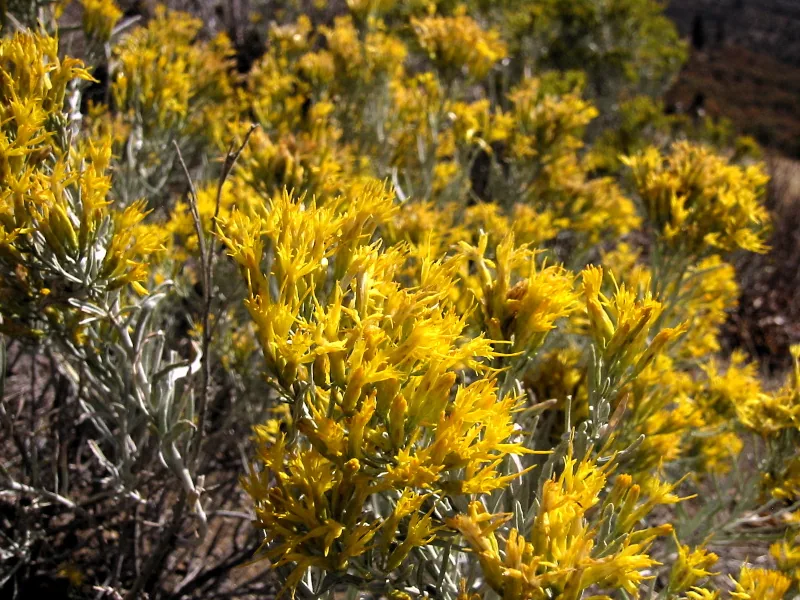
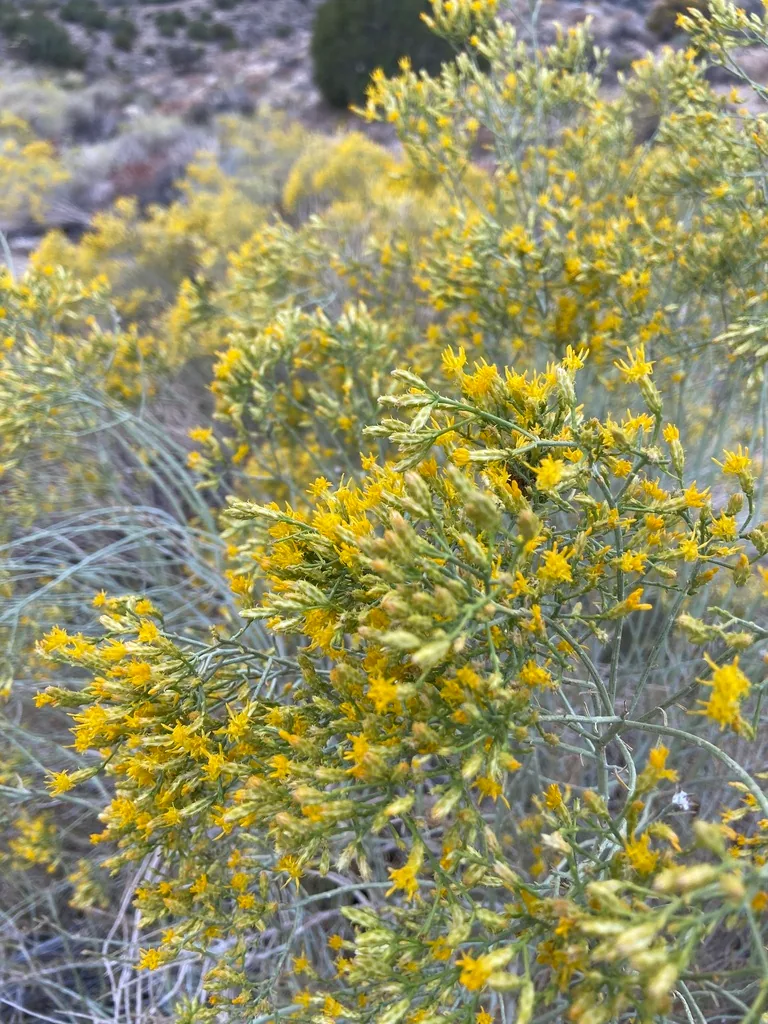

How to Grow and Care for Rubber rabbitbrush
Ericameria nauseosa
Written by Emilio Marruso · last checked
Toxic to: Livestock, People · Why
At a glance
This sun-loving perennial comes back year after year. Plant it in spring once the soil has warmed and frost is gone, or start your own from seeds or cuttings. Water new plants often at first; grown plants need much less. Depending on the plant, it can stay at 12 inches or reach 90 inches tall.
- Sun
Full sun
- Water
Water new plants much more often than grown ones
What the sources say (1)
Watering notes: New transplants should be watered much more frequently than mature plants
new transplants should be watered much more frequently.
— Best Care For Chamisa Shrubs: How To Grow Rubber Rabbitbrush | Gardening Know How [7] - Cold
Survives winters down to −30 °F (−34.4 °C)
Very hardy · USDA 4 · RHS H7 · Z4
What the sources say (2)
Hardiness, coldest zone: 4 [winter low −34.4 to −28.9 °C (−30 to −20 °F)]
Hardiness: USDA zones 4-9
— Best Care For Chamisa Shrubs: How To Grow Rubber Rabbitbrush | Gardening Know How [7] Hardiness, warmest zone: 9 [winter low −6.7 to −1.1 °C (20 to 30 °F)]
Hardiness: USDA zones 4-9
— Best Care For Chamisa Shrubs: How To Grow Rubber Rabbitbrush | Gardening Know How [7] - Spacing
24–36 inches between plants
What the sources say (1)
Spacing: 60-90 cm (24-36 in)
Spacing is 24-36 in. (60-90 cm).
— Plant Data Sheet [4] - Planting
Plant in spring, once the soil is warm and frost is gone
What the sources say (1)
Planting: Spring, after the soil has warmed and all chances of frost have passed
Rabbitbrush seedlings are best moved into the garden in spring after the soil has warmed and all chances of frost have passed.
— Best Care For Chamisa Shrubs: How To Grow Rubber Rabbitbrush | Gardening Know How [7] - Harvest
A gum from the root is used for chewing
- Size
12 to 90 inches tall
What the sources say (1)
Mature height: 30.48-228.6 cm (12-90 in)
A 12 to 90 inch tall shrub with a rounded crown and several erect stems from the base.
— Rubber Rabbitbrush | USU [2] - Propagation
Grow new plants from seeds or cuttings
What the sources say (1)
Propagation: Seeds and cuttings
Propagated by seeds and cuttings.
— Plant Data Sheet [4] - Sowing
Sow in fall as soon as the seed is ripe, or in spring
What the sources say (1)
Sowing: Fall, as soon as the seed has matured, or spring
Rabbitbrush seed is most frequently sown in fall, as soon as it has matured in the garden, or in spring.
— Best Care For Chamisa Shrubs: How To Grow Rubber Rabbitbrush | Gardening Know How [7] - Safety
Can poison livestock that eat it; the pollen may cause allergies
Overview
Rubber rabbitbrush is a drought-tolerant native shrub of western North America that is gaining popularity as an ornamental. [5][3] It grows on a wide range of soils, from moderately acidic to strongly alkaline, and is somewhat salt tolerant. [2] It has been reported to poison livestock that eat it. [6][2]
Rubber rabbitbrush care
How to water Rubber rabbitbrush
Watering
The sources give different values depending on region, zone or growing conditions.
What each source says
According to Gardening Know How: Supplemental irrigation only seldom needed
According to Arizona-Sonora Desert Museum: Regular watering to establish and during dry times of the year
What the sources say (2)
According to Gardening Know How: As an ornamental, supplemental irrigation is only seldom needed.According to Arizona-Sonora Desert Museum: It will need regular watering to establish and to maintain during dry times of the year.Watering notes
New transplants should be watered much more frequently than mature plants
What the sources say (1)
new transplants should be watered much more frequently.How much light Rubber rabbitbrush needs
How much cold Rubber rabbitbrush can take
Hardiness, coldest zone
4 [winter low −34.4 to −28.9 °C (−30 to −20 °F)]
What the sources say (1)
Hardiness: USDA zones 4-9Hardiness, warmest zone
9 [winter low −6.7 to −1.1 °C (20 to 30 °F)]
What the sources say (1)
Hardiness: USDA zones 4-9Where to grow Rubber rabbitbrush
60-90 cm (24-36 in)
What the sources say (1)
Spacing is 24-36 in. (60-90 cm).How to propagate Rubber rabbitbrush
Seeds and cuttings
What the sources say (1)
Propagated
by seeds and cuttings.How to grow Rubber rabbitbrush
The plant
Life cycle
perennial
What the sources say (1)
This perennial shrub is a member of the Aster family (Asteraceae) along with sagebrush, with which it is often found.Family
Asteraceae
What the sources say (1)
This perennial shrub is a member of the Aster family (Asteraceae) along with sagebrush, with which it is often found.Mature height
30.48-228.6 cm (12-90 in)
What the sources say (1)
A 12 to 90 inch tall shrub with a rounded crown and several erect stems from the base.Remedies
Each remedy shows what official sources say about it; traditional remedies without an official source are marked as such. Harmful ones are listed so you know to avoid them.
Getting rid of it
dense rabbitbrush stands
mowing alone Not proven
How: Mowing was tested on its own in pilot treatments on rubber rabbitbrush; management is difficult because the shrub is deep rooted and sprouts vigorously after mechanical disturbance.
Management of rabbitbrush is difficult because it is deep rooted and sprouts vigorously after disturbance such as fire or mechanical treatments.
— extension.usu.edu [9] What the evidence says Curtail (clopyralid), 2,4-D and mowing alone provided no control.
— extension.usu.edu [9]
Is Rubber rabbitbrush toxic to pets?
Reported by the source, quoted verbatim. This is not medical or veterinary advice: if a person or an animal may have eaten this plant, contact a poison control centre or a veterinarian.
Animals
It is occasionally reported to be toxic to livestock.
[2]The source flags the risk for this animal but does not explain why.
Rabbitbrush has caused poisoning in livestock that have eaten it.
[6]The source flags the risk for this animal but does not explain why.
People
Calendar
Sowing
Fall, as soon as the seed has matured, or spring
What the sources say (1)
Rabbitbrush seed is most frequently sown in fall, as soon as it has matured in the garden, or in spring.Planting
Spring, after the soil has warmed and all chances of frost have passed
What the sources say (1)
Rabbitbrush seedlings are best moved into the garden in spring after the soil has warmed and all chances of frost have passed.Pruning
The sources give different values depending on region, zone or growing conditions.
What each source says
According to Gardening Know How: Late winter or very early spring
According to Useful Temperate Plants: After autumn flowering
What the sources say (2)
According to Gardening Know How: This is best done in late winter or very early spring, just before their growth resumes.According to Useful Temperate Plants: The plant can be cut back after autumn flowering to preventMonths as given by the sources, which are mostly from the United States (northern hemisphere). In the southern hemisphere they shift by about six months.
Edibility
Reported by the source, quoted verbatim. Do not eat a plant on the basis of this page alone: identification mistakes can be dangerous.
Indicative values
Values from a secondary source, not checked word for word like the rest of this page. Use them as a starting point.
- Soil pH
- 6-8Indicative value, adapt it to your climate · Secondary source
- Growth rate
- LowIndicative value, adapt it to your climate · Secondary source
Similar plants
- African Daisy Dimorphotheca pluvialis
- African Marigold Tagetes erecta
- Ageratum Ageratum houstonianum
- Alpine aster Aster alpinus
- Appalachian Blazing Star Liatris squarrulosa
- Appalachian Ironweed Vernonia glauca
- Appalachian Sunflower Helianthus atrorubens
- Aromatic Aster Symphyotrichum oblongifolium
Sources
Every value above is quoted from these documents. Links lead to the original publisher.
- Ericameria nauseosa - rubber rabbitbrush | Yavapai County Native and Naturalized Plants · yavapaiplants.extension.arizona.edu, consulted
- Rubber Rabbitbrush | USU · extension.usu.edu, consulted
- Ericameria nauseosa - Useful Temperate Plants · temperate.theferns.info, consulted
- Plant Data Sheet · depts.washington.edu, consulted
- Rubber Rabbitbrush · fs.usda.gov, consulted
- Lady Bird Johnson Wildflower Center - The University of Texas at Austin · wildflower.org, consulted
- Best Care For Chamisa Shrubs: How To Grow Rubber Rabbitbrush | Gardening Know How · gardeningknowhow.com, consulted
- ARIZONA-SONORA DESERT MUSEUM · desertmuseum.org, consulted
- extension.usu.edu · extension.usu.edu
Written by Emilio Marruso · last checked