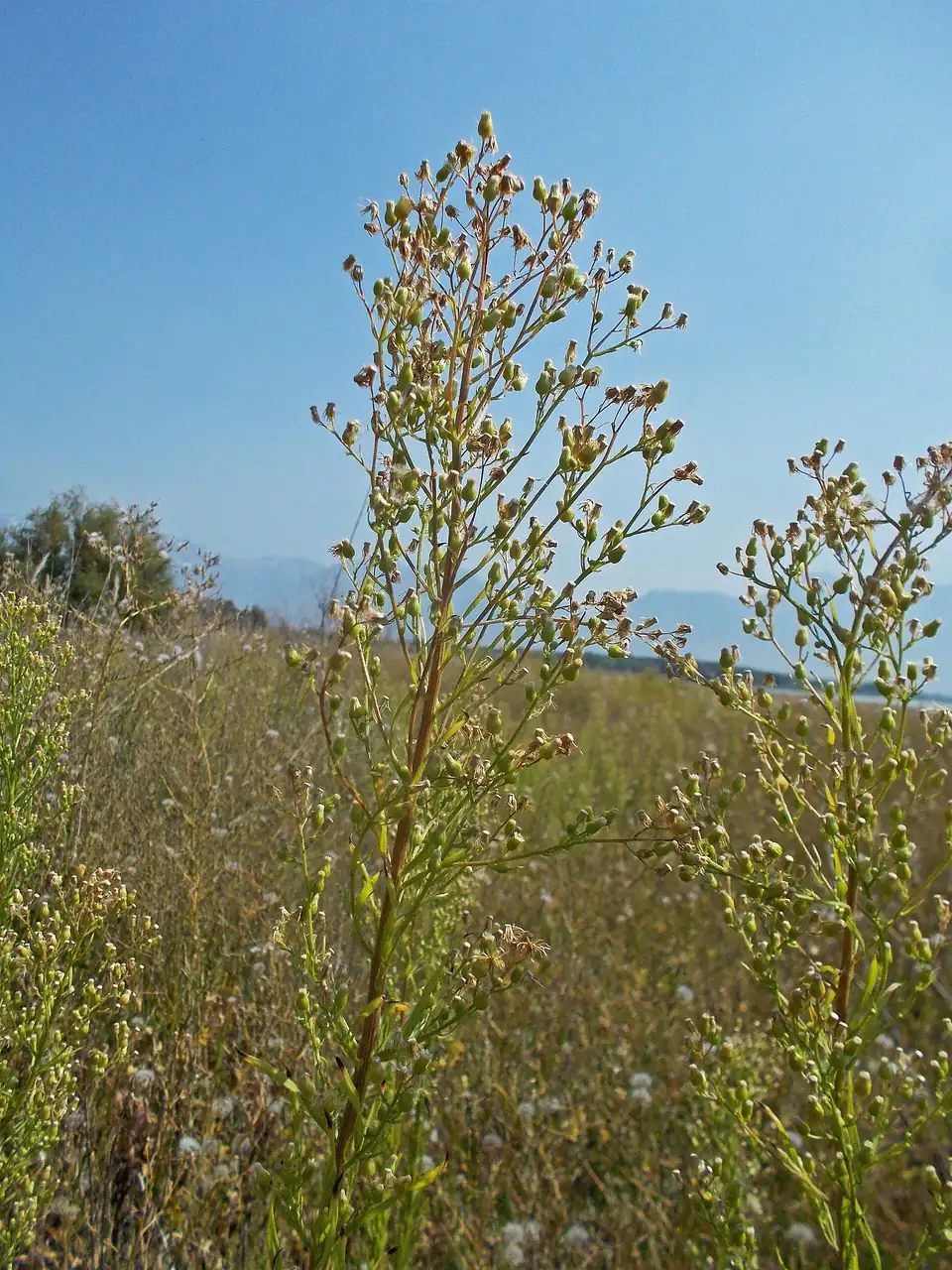


How to Grow and Care for Horseweed
Erigeron canadensis
Written by Emilio Marruso · last checked
Toxic to: Livestock, People · Why
At a glance
Horseweed is a tough sun lover with a hidden gift: its flowers feed native bees with nectar and pollen, and solitary bees nest in its stems. This winter annual shoots up to 3–6 feet tall in spring. Just keep it in check, because it is an aggressive weed: never let it go to seed, and pull out the whole plant.
- Sun
Full sun
What the sources say (1)
Light: Full sun
Light: Full sun (6 or more hours of direct sunlight a day)
— Erigeron canadensis (Butterweed, Canadian Horseweed, Colstail, Horseweed, Horse Weed, Marestail) | North Carolina Extension Gardener Plant Toolbox [1] - Watch out
Aggressive weed: don't let it go to seed; pull it out whole, since broken stems sprout again
- Size
3–6 ft tall in spring, 6 in to 2 ft wide
What the sources say (2)
Mature height: 91-183 cm (3-6 ft) when bolting in spring
In spring, plants bolt upright 3 to 6 feet tall.
— Erigeron canadensis (Butterweed, Canadian Horseweed, Colstail, Horseweed, Horse Weed, Marestail) | North Carolina Extension Gardener Plant Toolbox [1] Mature width: 15-61 cm (0.5-2 ft)
Dimensions: Height: 0 ft. 6 in. - 7 ft. 0 in. Width: 0 ft. 6 in. - 2 ft. 0 in.
— Erigeron canadensis (Butterweed, Canadian Horseweed, Colstail, Horseweed, Horse Weed, Marestail) | North Carolina Extension Gardener Plant Toolbox [1] - Safety
Mildly toxic: it can irritate the mouth of people and livestock
Overview
Horseweed is a winter annual in the aster family (Asteraceae). [1] It is an aggressive annual weed of waste places and disturbed areas, and also a nectar and pollen source for native bees. [1] Poison symptoms are listed as mucosal irritation to humans and livestock, at low severity. [1]
This record is incomplete: the sources we read do not cover every field yet.
Not yet covered by our sources: Hardiness, coldest zone, Hardiness, warmest zone, Propagation
Horseweed care
How much light Horseweed needs
Full sun
What the sources say (1)
Light:
Full sun (6 or more hours of direct sunlight a day)How much cold Horseweed can take
Hardiness, coldest zone
Not stated in the sources we read.
Hardiness, warmest zone
Not stated in the sources we read.
How to propagate Horseweed
Not stated in the sources we read.
How to grow Horseweed
The plant
Life cycle
annual (winter annual)
What the sources say (1)
Horseweed is a winter annual in the aster family (Asteraceae).Family
Asteraceae
What the sources say (1)
Horseweed is a winter annual in the aster family (Asteraceae).Mature height
91-183 cm (3-6 ft) when bolting in spring
What the sources say (1)
In spring, plants bolt upright 3 to 6 feet tall.Mature width
15-61 cm (0.5-2 ft)
What the sources say (1)
Dimensions:
Height: 0 ft. 6 in. - 7 ft. 0 in.
Width: 0 ft. 6 in. - 2 ft. 0 in.Horseweed pests and problems
Aggressive weed
Symptom: While this species is an aggressive annual weed of waste places and disturbed areas, it is a nectar and pollen source for native bees, and its stems are used as nesting sites for solitary bees.
What to do: Do not let plants go to seed; when hand weeding, remove completely as plants can re-sprout from broken stems; can be managed by preemergence broadleaf herbicides.
What the sources say (2)
While this species is an aggressive annual weed of waste places and disturbed areas, it is a nectar and pollen source for native bees, and its stems are used as nesting sites for solitary bees.
— Erigeron canadensis (Butterweed, Canadian Horseweed, Colstail, Horseweed, Horse Weed, Marestail) | North Carolina Extension Gardener Plant Toolbox [1] When hand weeding, remove completely as plants can re-sprout from broken stems. Horseweed can be managed by preemergence broadleaf herbicides.
— Erigeron canadensis (Butterweed, Canadian Horseweed, Colstail, Horseweed, Horse Weed, Marestail) | North Carolina Extension Gardener Plant Toolbox [1] Glyphosate resistance
Symptom: Glyphosate-resistant horseweed has been reported where glyphosate-resistant crops are grown.
What the sources say (1)
Glyphosate-resistant horseweed has been reported in areas where glyphosate-resistant crops are grown.
— Erigeron canadensis (Butterweed, Canadian Horseweed, Colstail, Horseweed, Horse Weed, Marestail) | North Carolina Extension Gardener Plant Toolbox [1]
Remedies
Each remedy shows what official sources say about it; traditional remedies without an official source are marked as such. Harmful ones are listed so you know to avoid them.
Getting rid of it
horseweed
hand weeding Partly works
Plants have a tap root with some fibrous roots making them difficult to remove.
— Erigeron canadensis (Butterweed, Canadian Horseweed, Colstail, Horseweed, Horse Weed, Marestail) | North Carolina Extension Gardener Plant Toolbox [1] How: Dig or pull plants out before they set seed; remove the plant completely because it can re-sprout from broken stems.
Yes, pull or dig it out before it finishes flowering. This will prevent it from dispersing its seeds and creating new plants.
— gardenersworld.com [3] What the evidence says When hand weeding, remove completely as plants can re-sprout from broken stems.
— Erigeron canadensis (Butterweed, Canadian Horseweed, Colstail, Horseweed, Horse Weed, Marestail) | North Carolina Extension Gardener Plant Toolbox [1] thick mulch layer Official source, not independently tested
How: Apply a thick layer of mulch to manage horseweed.
can be managed by - thick mulch layer - hand pulling - continued mowing - post emergent herbicides
— Canadian horseweed - Cooperative Extension: Maine Wild Blueberries - University of Maine Cooperative Extension [2] continued mowing Official source, not independently tested
How: Mow repeatedly to manage horseweed.
can be managed by - thick mulch layer - hand pulling - continued mowing - post emergent herbicides
— Canadian horseweed - Cooperative Extension: Maine Wild Blueberries - University of Maine Cooperative Extension [2] tillage Not verified
Traditional remedy, not verified by an official source.
How: Dig over the soil and remove rosettes in autumn; seeds buried by even a little soil germinate far less because they need light.
autumn digging of rosettes Not verified
Traditional remedy, not verified by an official source.
How: Dig over the soil and remove any rosettes in the autumn.
winter cover crops Not verified
Traditional remedy, not verified by an official source.
High biomass cover crops have the potential to suppress horseweed early in the cash crop growing season but as the cover crop residue degrades, horseweed can emerge and still be a weed of concern in the field.
— growiwm.org [4] How: Winter cover crops suppress horseweed in fall and spring by blocking light and competing with seedlings.
Is Horseweed toxic to pets?
Reported by the source, quoted verbatim. This is not medical or veterinary advice: if a person or an animal may have eaten this plant, contact a poison control centre or a veterinarian.
Similar plants
- Aspen Fleabane Erigeron speciosus
- Hairy Fleabane Erigeron bonariensis
- Bitter Fleabane Erigeron acris
- Robin's Plantain Erigeron pulchellus
- Mexican fleabane Erigeron karvinskianus
- Seaside fleabane Erigeron glaucus
- African Marigold Tagetes erecta
- American Burnweed Erechtites hieraciifolius
Sources
Every value above is quoted from these documents. Links lead to the original publisher.
- Erigeron canadensis (Butterweed, Canadian Horseweed, Colstail, Horseweed, Horse Weed, Marestail) | North Carolina Extension Gardener Plant Toolbox · plants.ces.ncsu.edu, consulted
- Canadian horseweed - Cooperative Extension: Maine Wild Blueberries - University of Maine Cooperative Extension · extension.umaine.edu, consulted
- gardenersworld.com · gardenersworld.com
- growiwm.org · growiwm.org
Written by Emilio Marruso · last checked