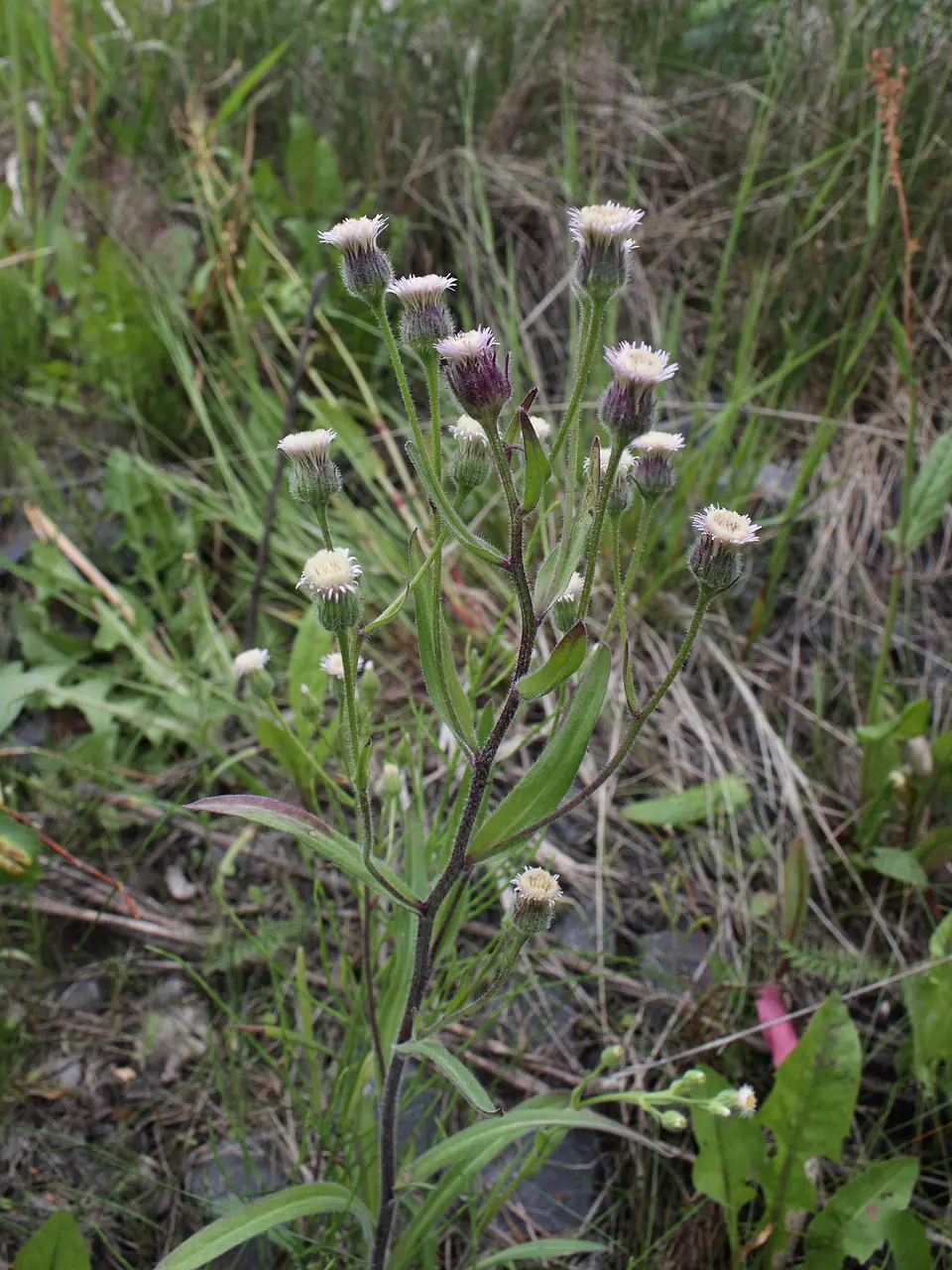


How to Grow and Care for Bitter Fleabane
Erigeron acris
Written by Emilio Marruso · last checked
At a glance
Bitter fleabane is an easygoing member of the daisy family that grows happily in full sun or partial shade. It is a biennial or short-lived perennial that you can start from seed, and it reaches 18 inches to 3 feet tall. Give each plant 18–24 inches of room, and keep in mind it may struggle in very hot, humid climates.
- Sun
Full sun to partial shade
What the sources say (2)
Light: Full sun to partial shade
Light: Full sun (6 or more hours of direct sunlight a day) Partial Shade (Direct sunlight only part of the day, 2-6 hours)
— Erigeron acris (Bitter Daisy, Bitter Fleabane, Blue Fleabane, Daisy Fleabane, Philadelphia Fleabane) | North Carolina Extension Gardener Plant Toolbox [1] Some shade is tolerated in hotter climates. It is, however, easy to grow in a variety of garden locations.
— Erigeron acris (Bitter Daisy, Bitter Fleabane, Blue Fleabane, Daisy Fleabane, Philadelphia Fleabane) | North Carolina Extension Gardener Plant Toolbox [1] - Cold
Survives winters down to −50 °F (−45.6 °C)
Very hardy · USDA 2a · RHS H7 · Z2
What the sources say (2)
Hardiness, coldest zone: 2a [winter low −45.6 to −42.8 °C (−50 to −45 °F)]
USDA Plant Hardiness Zone: 2a, 2b, 3a, 3b, 4a, 4b, 5a, 5b, 6a, 6b, 7a, 7b
— Erigeron acris (Bitter Daisy, Bitter Fleabane, Blue Fleabane, Daisy Fleabane, Philadelphia Fleabane) | North Carolina Extension Gardener Plant Toolbox [1] Hardiness, warmest zone: 7b [winter low −15 to −12.2 °C (5 to 10 °F)]
USDA Plant Hardiness Zone: 2a, 2b, 3a, 3b, 4a, 4b, 5a, 5b, 6a, 6b, 7a, 7b
— Erigeron acris (Bitter Daisy, Bitter Fleabane, Blue Fleabane, Daisy Fleabane, Philadelphia Fleabane) | North Carolina Extension Gardener Plant Toolbox [1] - Spacing
18–24 in between plants
What the sources say (1)
Spacing: 45.7-61.0 cm (1.5-2 ft)
Plant between 1.5 and 2 feet apart. It self-seeds easily. Plant in mass in a cottage, butterfly, or rock garden
— Erigeron acris (Bitter Daisy, Bitter Fleabane, Blue Fleabane, Daisy Fleabane, Philadelphia Fleabane) | North Carolina Extension Gardener Plant Toolbox [1] - Pests
Can get powdery mildew, leaf spots and rust, especially in very hot, humid climates
What the sources say (1)
Diseases: powdery mildew, leaf spots, rust
It may not thrive in a very hot and humid climate, which may also be factored in some susceptibility to powdery mildew, leaf spots, and rust.
— Erigeron acris (Bitter Daisy, Bitter Fleabane, Blue Fleabane, Daisy Fleabane, Philadelphia Fleabane) | North Carolina Extension Gardener Plant Toolbox [1] - Size
18 in to 3 ft tall and 1 to 1.5 ft wide
What the sources say (2)
Mature height: 45.72-91.44 cm (1 ft 6 in-3 ft)
Height: 3 ft. 0 in. - 1 ft. 6 in.
— Erigeron acris (Bitter Daisy, Bitter Fleabane, Blue Fleabane, Daisy Fleabane, Philadelphia Fleabane) | North Carolina Extension Gardener Plant Toolbox [1] Mature width: 30.48-45.72 cm (1 ft-1 ft 6 in)
Width: 1 ft. 6 in. - 1 ft. 0 in.
— Erigeron acris (Bitter Daisy, Bitter Fleabane, Blue Fleabane, Daisy Fleabane, Philadelphia Fleabane) | North Carolina Extension Gardener Plant Toolbox [1] - Propagation
Grows from seed; it lives two years or a few more
What the sources say (2)
Propagation: Seed
Life Cycle: Annual Biennial Perennial Recommended Propagation Strategy: Seed
— Erigeron acris (Bitter Daisy, Bitter Fleabane, Blue Fleabane, Daisy Fleabane, Philadelphia Fleabane) | North Carolina Extension Gardener Plant Toolbox [1] Life cycle: biennial or short-lived perennial
It is considered a biennial or short-lived perennial.
— Erigeron acris (Bitter Daisy, Bitter Fleabane, Blue Fleabane, Daisy Fleabane, Philadelphia Fleabane) | North Carolina Extension Gardener Plant Toolbox [1]
Overview
Erigeron acris is a delicate wildflower considered a biennial or short-lived perennial, native to the north-western US. [1] It likes thickets, fields and open woods, and is planted 1.5 to 2 feet [46–61 cm] apart; it self-seeds easily. [1]
This record is incomplete: the sources we read do not cover every field yet.
Not yet covered by our sources: Watering, Pruning
Bitter Fleabane care
Measurements in square brackets are our conversion into the other unit system; the quoted text is unchanged.
How to water Bitter Fleabane
Not stated in the sources we read.
How much light Bitter Fleabane needs
Full sun to partial shade
What the sources say (2)
Light:
Full sun (6 or more hours of direct sunlight a day)
Partial Shade (Direct sunlight only part of the day, 2-6 hours)Some shade is tolerated in hotter climates. It is, however, easy to grow in a variety of garden locations.How much cold Bitter Fleabane can take
Hardiness, coldest zone
2a [winter low −45.6 to −42.8 °C (−50 to −45 °F)]
What the sources say (1)
USDA Plant Hardiness Zone:
2a, 2b, 3a, 3b, 4a, 4b, 5a, 5b, 6a, 6b, 7a, 7bHardiness, warmest zone
7b [winter low −15 to −12.2 °C (5 to 10 °F)]
What the sources say (1)
USDA Plant Hardiness Zone:
2a, 2b, 3a, 3b, 4a, 4b, 5a, 5b, 6a, 6b, 7a, 7bWhere to grow Bitter Fleabane
45.7-61.0 cm (1.5-2 ft)
What the sources say (1)
Plant between 1.5 and 2 feet apart. It self-seeds easily. Plant in mass in a cottage, butterfly, or rock gardenHow to propagate Bitter Fleabane
Seed
What the sources say (1)
Life Cycle:
Annual
Biennial
Perennial
Recommended Propagation Strategy:
SeedHow to grow Bitter Fleabane
The plant
Life cycle
biennial or short-lived perennial
What the sources say (1)
It is considered a biennial or short-lived perennial.Family
Asteraceae
What the sources say (1)
Genus:
Erigeron
Species:
acris
Family:
Asteraceae
Uses (Ethnobotany):Mature height
45.72-91.44 cm (1 ft 6 in-3 ft)
What the sources say (1)
Height: 3 ft. 0 in. - 1 ft. 6 in.Mature width
30.48-45.72 cm (1 ft-1 ft 6 in)
What the sources say (1)
Width: 1 ft. 6 in. - 1 ft. 0 in.Pests and diseases
Diseases
powdery mildew, leaf spots, rust
What the sources say (1)
It may not thrive in a very hot and humid climate, which may also be factored in some susceptibility to powdery mildew, leaf spots, and rust.Fertilizing
When
The sources give different values depending on region, zone or growing conditions.
What each source says
in containers: Only during the growing season, starting at the beginning of the season
What the sources say (1)
in containers: use a liquid seaweed feed every 14 days, diluted to half strength, to keep your erigerons performing well. Feed only during the growing seasonHow often
The sources give different values depending on region, zone or growing conditions.
What each source says
in containers: Every 14 days with a liquid feed, or a single slow-release application at the start of the season
What the sources say (1)
in containers: Either add some slow-release fertiliser at the beginning of the season (according to the manufacturer’s instructions), or use a liquid seaweed feed every 14 days, diluted to half strength, to keep your erigerons performing well.Natural fertilizers
The sources give different values depending on region, zone or growing conditions.
What each source says
in containers: Liquid seaweed feed diluted to half strength
What the sources say (1)
in containers: Either add some slow-release fertiliser at the beginning of the season (according to the manufacturer’s instructions), or use a liquid seaweed feed every 14 days, diluted to half strength, to keep your erigerons performing well.Mineral fertilizers
The sources give different values depending on region, zone or growing conditions.
What each source says
in containers: Slow-release fertilizer at the start of the season, at label rate
What the sources say (1)
in containers: Either add some slow-release fertiliser at the beginning of the season (according to the manufacturer’s instructions), or use a liquid seaweed feed every 14 days, diluted to half strength, to keep your erigerons performing well.Avoid
The sources give different values depending on region, zone or growing conditions.
What each source says
nursery propagation, hardening phase: Excessive fertilizer, which can reduce root development
What the sources say (1)
nursery propagation, hardening phase: No excessive fertilizers as it may decrease adequate root developmentBitter Fleabane pests and problems
Powdery mildew, leaf spots and rust
Symptom: Susceptibility in very hot and humid climates
What to do: Not stated; the plant may not thrive in very hot and humid climates
What the sources say (1)
It may not thrive in a very hot and humid climate, which may also be factored in some susceptibility to powdery mildew, leaf spots, and rust.
— Erigeron acris (Bitter Daisy, Bitter Fleabane, Blue Fleabane, Daisy Fleabane, Philadelphia Fleabane) | North Carolina Extension Gardener Plant Toolbox [1]
Remedies
Each remedy shows what official sources say about it; traditional remedies without an official source are marked as such. Harmful ones are listed so you know to avoid them.
Treating the plant
powdery mildew
baking soda spray Not verified
Traditional remedy, not verified by an official source.
How: Mix 5 mL (1 tsp.) of baking soda into 1 quart/1 liter of water and spray on susceptible plants.
milk spray Not verified
Traditional remedy, not verified by an official source.
How: Add one part milk to nine parts water and spray to saturation.
removing diseased foliage Official source, not independently tested
How: Seriously diseased perennial plants or their affected foliage should be removed promptly from the garden.
Seriously diseased annuals and perennials plants (or their affected foliage) should be removed promptly from the garden.
— ipm.missouri.edu [9]
Calendar
Pruning
Not stated in the sources we read.
Months as given by the sources, which are mostly from the United States (northern hemisphere). In the southern hemisphere they shift by about six months.
Similar plants
- Aspen Fleabane Erigeron speciosus
- Robin's Plantain Erigeron pulchellus
- Hairy Fleabane Erigeron bonariensis
- Horseweed Erigeron canadensis
- Mexican fleabane Erigeron karvinskianus
- Seaside fleabane Erigeron glaucus
- African Daisy Dimorphotheca pluvialis
- African Marigold Tagetes erecta
Sources
Every value above is quoted from these documents. Links lead to the original publisher.
- Erigeron acris (Bitter Daisy, Bitter Fleabane, Blue Fleabane, Daisy Fleabane, Philadelphia Fleabane) | North Carolina Extension Gardener Plant Toolbox · plants.ces.ncsu.edu, consulted
- Daisy Fleabane - Erigeron acris | North Carolina Extension Gardener Plant Toolbox · plants.ces.ncsu.edu, consulted
- Bitter Daisy - Erigeron acris | North Carolina Extension Gardener Plant Toolbox · plants.ces.ncsu.edu, consulted
- Daisy Fleabane - Erigeron | North Carolina Extension Gardener Plant Toolbox · plants.ces.ncsu.edu, consulted
- Philadelphia Fleabane - Erigeron acris | North Carolina Extension Gardener Plant Toolbox · plants.ces.ncsu.edu, consulted
- Erigeron (Common Fleabane, Daisy Fleabane, Fleabane) | North Carolina Extension Gardener Plant Toolbox · plants.ces.ncsu.edu, consulted
- rhs.org.uk · rhs.org.uk
- courses.washington.edu · courses.washington.edu
- ipm.missouri.edu · ipm.missouri.edu
Written by Emilio Marruso · last checked