
How to Grow and Care for Chilean gunnera
Gunnera tinctoria
Written by Emilio Marruso · last checked
Toxic to: People · Why
At a glance
Gunnera tinctoria loves damp, humus-rich soil and grows happily in sun or partial shade. Plant it in late spring or early summer, once the last frosts are over. It even gives you something to eat: the young leaf stalks can be peeled and cooked like a vegetable or eaten raw, and no toxic effects have been reported.
- Sun
Full sun or partial shade
What the sources say (1)
Light: Sunny position or semi-shade
Requires a damp humus rich soil in a sunny position or semi-shade, sheltered from strong winds.
— Gunnera tinctoria - Useful Temperate Plants [3] - Water
Keep the soil damp
What the sources say (1)
Watering: Damp, humus-rich soil
Requires a damp humus rich soil in a sunny position or semi-shade, sheltered from strong winds.
— Gunnera tinctoria - Useful Temperate Plants [3] - Soil
Damp soil rich in humus
What the sources say (1)
Watering: Damp, humus-rich soil
Requires a damp humus rich soil in a sunny position or semi-shade, sheltered from strong winds.
— Gunnera tinctoria - Useful Temperate Plants [3] - Planting
Plant in late spring or early summer, after the last frosts
What the sources say (1)
Planting: Late spring or early summer, after the last expected frosts
Plant them out into their permanent positions in late spring or early summer, after the last expected frosts.
— Gunnera tinctoria - Useful Temperate Plants [3] - Harvest
Young leaf stalks: peel and cook them like a vegetable, or eat them raw
- Propagation
From seed or by dividing the plant
What the sources say (1)
Propagation: Seed; division
Division as new growth commences in the spring. The clumps can be planted out direct into their permanent positions.
— Gunnera tinctoria - Useful Temperate Plants [3] - Sowing
Sow fresh seed in fall in a cold frame, or in spring in a shady spot in a greenhouse
What the sources say (1)
Sowing: Autumn as soon as ripe (cold frame), or spring (shady position in a greenhouse)
Seed - best sown as soon as it is ripe in the autumn in a sandy mix in a cold frame.
— Gunnera tinctoria - Useful Temperate Plants [3] - Safety
No toxic effects reported
Overview
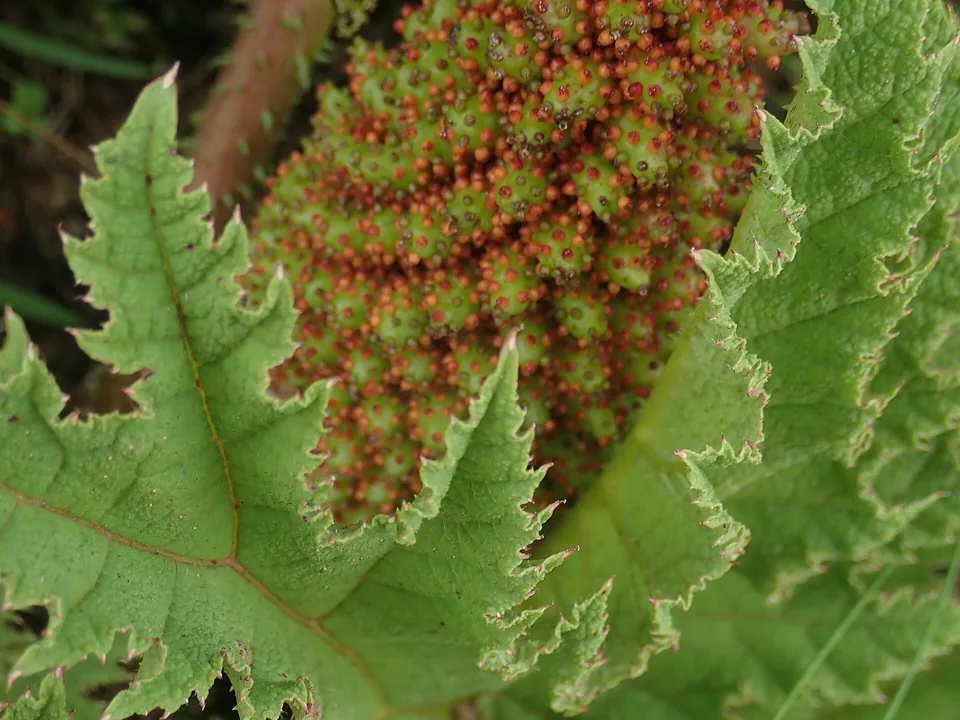
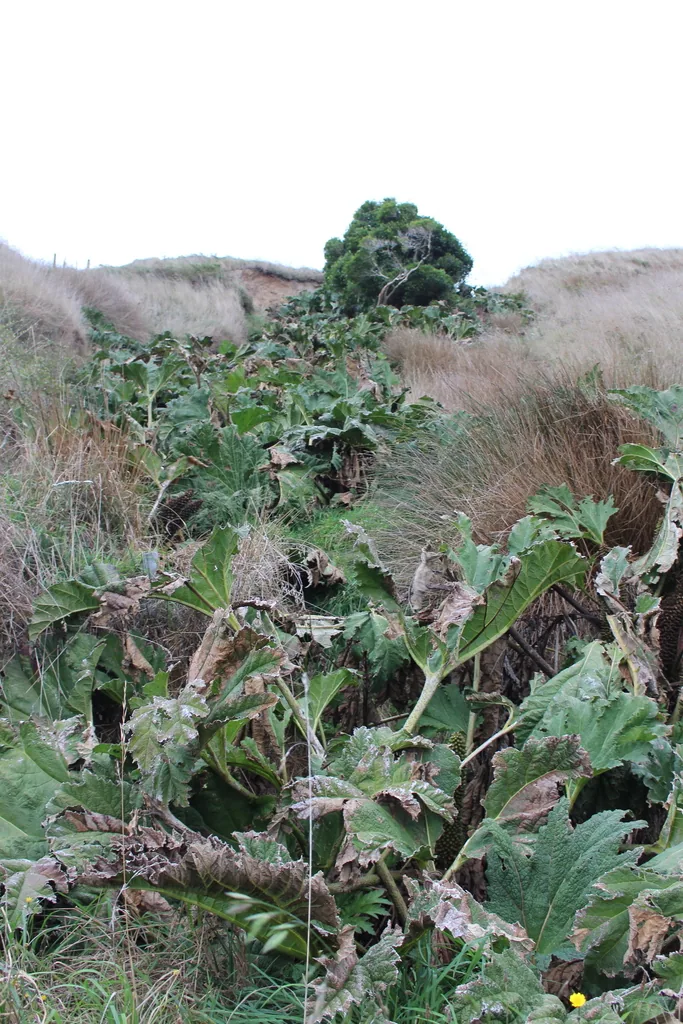
Gunnera tinctoria is a very ornamental perennial with huge leaves that forms a slowly spreading dense clump. [3] It is considered invasive in the British Isles, where it has been banned under the Invasive Alien Species Regulation. [4][1] It needs a damp, humus-rich soil in a sunny position or semi-shade, sheltered from strong winds. [3]
This record is incomplete: the sources we read do not cover every field yet.
Not yet covered by our sources: Hardiness, coldest zone, Hardiness, warmest zone
Chilean gunnera care
How to water Chilean gunnera
Damp, humus-rich soil
What the sources say (1)
Requires a damp humus rich soil in a sunny position or semi-shade, sheltered from strong winds.How much light Chilean gunnera needs
Sunny position or semi-shade
What the sources say (1)
Requires a damp humus rich soil in a sunny position or semi-shade, sheltered from strong winds.How much cold Chilean gunnera can take
Hardiness, coldest zone
Not stated in the sources we read.
Hardiness, warmest zone
Not stated in the sources we read.
How to propagate Chilean gunnera
Seed; division
What the sources say (1)
Division as new growth commences in the spring. The clumps can be planted out direct into their permanent positions.Remedies
Each remedy shows what official sources say about it; traditional remedies without an official source are marked as such. Harmful ones are listed so you know to avoid them.
Getting rid of it
chilean rhubarb infestation
dig out whole plants with all rhizomes Not verified
Traditional remedy, not verified by an official source.
How: Pull or dig out individual plants: ensure removal of all rhizomes (an underground fleshy stem) and seed/flower heads and dispose at landfill (year-round).
chilean rhubarb flowering and seeding
remove flower spikes and seedlings Not verified
Traditional remedy, not verified by an official source.
How: Remove flower spikes and seedlings and dispose at landfill (year-round).
chilean rhubarb regrowth
dig out and dispose of seeds and rhizomes, follow up three times a year Not verified
Traditional remedy, not verified by an official source.
How: Follow up treated areas 3 times per year. Encourage natural regeneration of native plants or replant treated areas where possible after 2-3 treatments to establish dense ground cover and minimise reinvasion.
Is Chilean gunnera poisonous?
Reported by the source, quoted verbatim. This is not medical or veterinary advice: if a person or an animal may have eaten this plant, contact a poison control centre or a veterinarian.
Gunnera ‘Tinctoria’ has no toxic effects reported. No reported toxicity to: Is
[4]
Calendar
Sowing
Autumn as soon as ripe (cold frame), or spring (shady position in a greenhouse)
What the sources say (1)
Seed - best sown as soon as it is ripe in the autumn in a sandy mix in a cold frame.Planting
Late spring or early summer, after the last expected frosts
What the sources say (1)
Plant them out into their permanent positions in late spring or early summer, after the last expected frosts.Months as given by the sources, which are mostly from the United States (northern hemisphere). In the southern hemisphere they shift by about six months.
Edibility
Reported by the source, quoted verbatim. Do not eat a plant on the basis of this page alone: identification mistakes can be dangerous.
Young leaf stalks - peeled and cooked as a vegetable or eaten raw
[3]
Indicative values
Values from a secondary source, not checked word for word like the rest of this page. Use them as a starting point.
- Life cycle
- Herbaceous PerennialIndicative value, adapt it to your climate · Secondary source
- Mature height
- 152.4-182.9 cm (5-6 ft)Indicative value, adapt it to your climate · Secondary source
- Soil pH
- 5.5-6.5Indicative value, adapt it to your climate · Secondary source
- USDA hardiness zones
- 7-9 [winter low −17.8 to −1.1 °C (0 to 30 °F)]Indicative value, adapt it to your climate · Secondary source
- Care level
- MediumIndicative value, adapt it to your climate · Secondary source
- Growth rate
- LowIndicative value, adapt it to your climate · Secondary source
- Pruning
- March, April, May, December, January, FebruaryIndicative value, adapt it to your climate · Secondary source
Similar plants
- Giant rhubarb Gunnera manicata
- Aaron's Beard Hypericum calycinum
- Abies grandis Abies grandis
- Abraham Trachystemon orientalis
- Abyssinian banana Ensete ventricosum
- Acacia longifolia Acacia longifolia
- Acacia retinodes Acacia retinodes
- Acanthus hungaricus Acanthus hungaricus
Sources
Every value above is quoted from these documents. Links lead to the original publisher.
- Gunnera: your questions answered · rhs.org.uk, consulted
- Gunnera tinctoria Profile – California Invasive Plant Council · cal-ipc.org, consulted
- Gunnera tinctoria - Useful Temperate Plants · temperate.theferns.info, consulted
- Gunnera tinctoria | BBC Gardeners World Magazine · gardenersworld.com, consulted
- Gunnera: Plant, Grow and Care For Gunnera | BBC Gardeners World Magazine · gardenersworld.com, consulted
- LIFE15 GIE/IT/001039 · specieinvasive.isprambiente.it, consulted
- Gunnera tinctoria | Invasive plant species in Portugal · invasoras.pt, consulted
- 1 · circabc.europa.eu, consulted
Written by Emilio Marruso · last checked