

How to Grow and Care for Hoya
Hoya carnosa
Written by Emilio Marruso · last checked
Not toxic to cats and dogs, according to the sources · Sources
At a glance
Hoya is an easygoing perennial that happily lives indoors in a pot. Give it bright indirect light all year, use room-temperature water, and let the soil dry out between waterings. Feed it lightly in spring and summer, then let it rest in winter so it flowers better in the warm months. Best of all, it's safe for cats and dogs.
- Sun
Bright indirect light all year, or partial shade
What the sources say (1)
Light: Bright indirect light year-round; partial shade
Bright indirect light year-round is ideal. As this plant is an epiphyte, use a loose, fast-draining potting mix high in organic matter
— Hoya carnosa (Honey Plant, Porcelainflower, Porcelain Flower, Wax Plant) | North Carolina Extension Gardener Plant Toolbox [1] - Water
Let the soil dry between waterings and use room-temperature water; too wet or too dry drops leaves
What the sources say (2)
Watering notes: Too wet or too dry soil can cause leaves to drop; cold water can shock the plant, so use water at room temperature
Too wet or too dry soil can cause the leaves to drop.
— Hoya carnosa (Honey Plant, Porcelainflower, Porcelain Flower, Wax Plant) | North Carolina Extension Gardener Plant Toolbox [1] Cold water can shock this plant. Always use water at room temperature.
— Hoya carnosa (Honey Plant, Porcelainflower, Porcelain Flower, Wax Plant) | North Carolina Extension Gardener Plant Toolbox [1] - Soil
Soil with a pH of 6.0–8.0
What the sources say (2)
Soil pH, minimum: 6.0
Soil pH: Neutral (6.0-8.0) Soil Drainage: Good Drainage
— Hoya carnosa (Honey Plant, Porcelainflower, Porcelain Flower, Wax Plant) | North Carolina Extension Gardener Plant Toolbox [1] Soil pH, maximum: 8.0
Soil pH: Neutral (6.0-8.0) Soil Drainage: Good Drainage
— Hoya carnosa (Honey Plant, Porcelainflower, Porcelain Flower, Wax Plant) | North Carolina Extension Gardener Plant Toolbox [1] - Feeding
Spring and summer, at half or quarter strength; no feeding in winter
What the sources say (5)
When: Spring and summer; no feeding in winter
Light, regular fertilizer applications in spring and summer are ideal.
— All About Hoyas | Yard and Garden [4] Do not fertilize in winter, as this allows for rest and will promote better flowering during the warmer months.
— All About Hoyas | Yard and Garden [4] Mineral fertilizers: All-purpose fertilizer at half or quarter strength; an NPK ratio of 2:1:2 or 3:1:2 supports flowering
Use an all-purpose fertilizer at 1/2 or 1/4 strength, skipping an application every other or every third watering.
— All About Hoyas | Yard and Garden [4] A fertilizer with an NPK ratio of 2:1:2 or 3:1:2 can effectively support flowering.
— Indoor Plants – Waxflowers (Hoya) | Home & Garden Information Center [6] Avoid: Fertilizing in winter, when the plant should rest to flower better in the warm months
Do not fertilize in winter, as this allows for rest and will promote better flowering during the warmer months.
— All About Hoyas | Yard and Garden [4] - Pruning
Prune in early spring, before fast growth begins
What the sources say (1)
Pruning: Early spring, before rapid growth begins
If pruning is necessary, it is best done in early spring before its rapid growth begins.
— Hoya carnosa (Honey Plant, Porcelainflower, Porcelain Flower, Wax Plant) | North Carolina Extension Gardener Plant Toolbox [1] - Pests
Mealybugs, fungus gnats, spider mites and scale; also root rot and powdery mildew
What the sources say (5)
Pests: mealybugs, fungus gnats, spider mites, scale insects, flat mites
Mealybugs can be a problem, and fungus gnats, which are attracted to potting mixes that are too wet. Occasionally, spider mites can be an issue and can appear when the air is too dry.
— Hoya carnosa (Honey Plant, Porcelainflower, Porcelain Flower, Wax Plant) | North Carolina Extension Gardener Plant Toolbox [1] Scale insects can appear as small, immobile bumps on stems and leaves, sometimes accompanied by sticky residue.
— All About Hoyas | Yard and Garden [4] Flat Mites: Another pest to watch for is flat mites.
— Indoor Plants – Waxflowers (Hoya) | Home & Garden Information Center [6] Diseases: leaf spot, powdery mildew, fungal wilt, root rot
Though rare, hoyas can occasionally develop fungal diseases such as leaf spot, powdery mildew, or fungal wilt.
— Indoor Plants – Waxflowers (Hoya) | Home & Garden Information Center [6] Overwatering is the most common issue, often leading to root rot
— Indoor Plants – Waxflowers (Hoya) | Home & Garden Information Center [6] - Propagation
Grows new plants from stem cuttings
What the sources say (1)
Propagation: Stem cutting
Propagate the wax plant by stem cutting. Repot the wax plant when it outgrows its current container
— Hoya carnosa (Honey Plant, Porcelainflower, Porcelain Flower, Wax Plant) | North Carolina Extension Gardener Plant Toolbox [1] - Containers
Great in pots, indoors too
What the sources say (2)
In containers: Yes
use a loose, fast-draining potting mix high in organic matter and a container with good drainage
— Hoya carnosa (Honey Plant, Porcelainflower, Porcelain Flower, Wax Plant) | North Carolina Extension Gardener Plant Toolbox [1] Indoors: Yes
#houseplant #interiorscape #waxy #sweet fragrance #non-toxic for cats
— Hoya carnosa (Honey Plant, Porcelainflower, Porcelain Flower, Wax Plant) | North Carolina Extension Gardener Plant Toolbox [1] - Safety
Not toxic to cats, dogs or horses
Overview
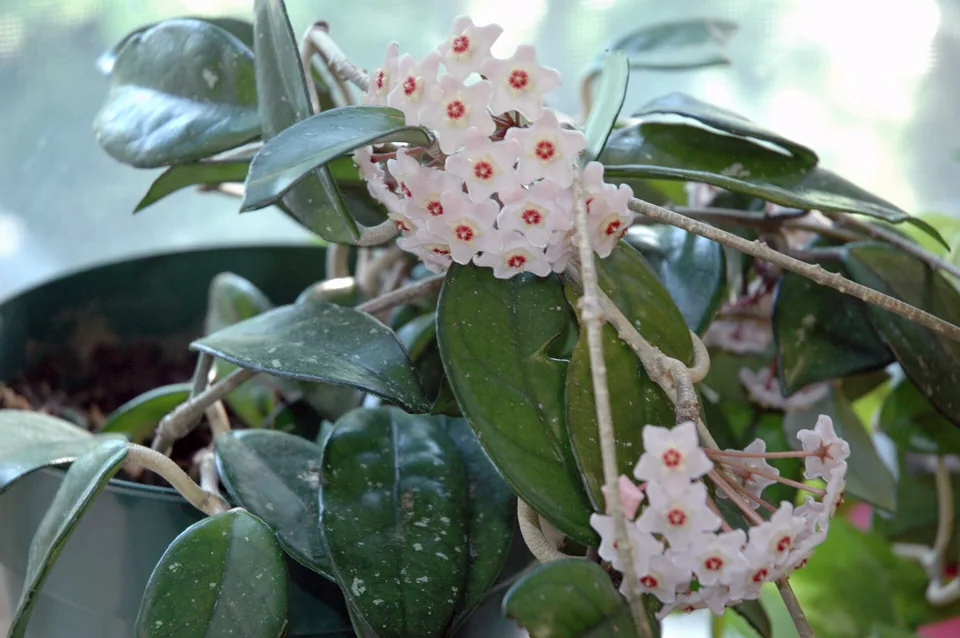
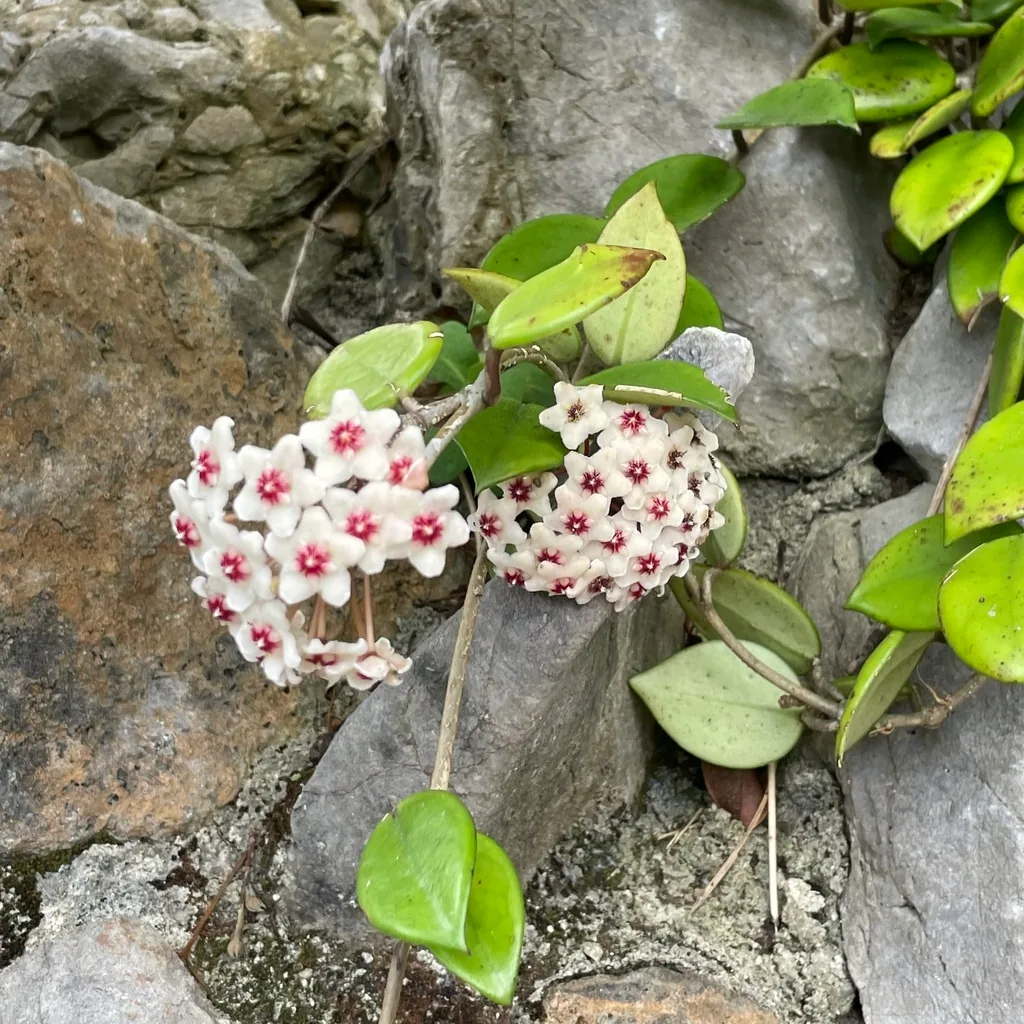
Hoya carnosa is a climbing, epiphytic evergreen perennial native to Southeast Asia, Japan, and Taiwan, grown as a houseplant. [1] It prefers bright indirect light and a loose, fast-draining potting mix, with soil allowed to dry out between waterings. [1] It is propagated by stem cutting and suits hanging baskets. [1]
Hoya care
How to water Hoya
Watering
The sources give different values depending on region, zone or growing conditions.
What each source says
According to NC State Extension: Allow the soil to dry out between watering
According to Penn State Extension: Keep the soil moist, not wet
According to Iowa State Extension: Water thoroughly, then allow the mix to dry almost completely before watering again
According to UF/IFAS: Water regularly from spring through fall, allowing the top third or half of the soil to dry out completely between waterings; water very sparingly in winter
According to Clemson Extension: Allow to dry out completely between waterings
What the sources say (6)
According to NC State Extension: Allow the soil to dry out between watering.According to Penn State Extension: Choose a well-drained soil and keep it moist, not wet.According to Iowa State Extension: Water thoroughly so the entire root zone is moistened, then allow the mix to dry almost completely before watering again.According to UF/IFAS: Water it regularly from spring through fall, allowing the top third or half of the soil to dry out completely between waterings.According to Clemson Extension: Hoyas thrive when allowed to dry out completely between waterings.Allow the soil to dry out between watering.Watering notes
Too wet or too dry soil can cause leaves to drop; cold water can shock the plant, so use water at room temperature
What the sources say (2)
Too wet or too dry soil can cause the leaves to drop.Cold water can shock this plant. Always use water at room temperature.How much light Hoya needs
Bright indirect light year-round; partial shade
What the sources say (1)
Bright indirect light year-round is ideal. As this plant is an epiphyte, use a loose, fast-draining potting mix high in organic matterBest soil for Hoya
Soil pH, minimum
6.0
What the sources say (1)
Soil pH:
Neutral (6.0-8.0)
Soil Drainage:
Good DrainageSoil pH, maximum
8.0
What the sources say (1)
Soil pH:
Neutral (6.0-8.0)
Soil Drainage:
Good DrainageWhere to grow Hoya
Indoors
Yes
What the sources say (1)
#houseplant #interiorscape #waxy #sweet fragrance #non-toxic for catsIn containers
Yes
What the sources say (1)
use a loose, fast-draining potting mix high in organic matter and a container with good drainageHow to propagate Hoya
Stem cutting
What the sources say (1)
Propagate the wax plant by stem cutting. Repot the wax plant when it outgrows its current containerHow to grow Hoya
The plant
Life cycle
perennial
What the sources say (1)
Wax plant is a broadleaf evergreen, epiphytic, vining, herbaceous perennial in the dogbane family (Asclepiadaceae).Pests and diseases
Pests
mealybugs, fungus gnats, spider mites, scale insects, flat mites
What the sources say (3)
Mealybugs can be a problem, and fungus gnats, which are attracted to potting mixes that are too wet. Occasionally, spider mites can be an issue and can appear when the air is too dry.Scale insects can appear as small, immobile bumps on stems and leaves, sometimes accompanied by sticky residue.Flat Mites: Another pest to watch for is flat mites.Diseases
leaf spot, powdery mildew, fungal wilt, root rot
What the sources say (2)
Though rare, hoyas can occasionally develop fungal diseases such as leaf spot, powdery mildew, or fungal wilt.Overwatering is the most common issue, often leading to root rotFertilizing
When
Spring and summer; no feeding in winter
How often
Light, regular feeding: with most waterings, skipping one every second or third watering
What the sources say (1)
Use an all-purpose fertilizer at 1/2 or 1/4 strength, skipping an application every other or every third watering.Mineral fertilizers
All-purpose fertilizer at half or quarter strength; an NPK ratio of 2:1:2 or 3:1:2 supports flowering
What the sources say (2)
Use an all-purpose fertilizer at 1/2 or 1/4 strength, skipping an application every other or every third watering.A fertilizer with an NPK ratio of 2:1:2 or 3:1:2 can effectively support flowering.Avoid
Fertilizing in winter, when the plant should rest to flower better in the warm months
What the sources say (1)
Do not fertilize in winter, as this allows for rest and will promote better flowering during the warmer months.Hoya pests and problems
Mealybugs
Symptom: Mealybugs can be a problem.
What to do: Not stated in source.
What the sources say (1)
Mealybugs can be a problem, and fungus gnats, which are attracted to potting mixes that are too wet.
— Hoya carnosa (Honey Plant, Porcelainflower, Porcelain Flower, Wax Plant) | North Carolina Extension Gardener Plant Toolbox [1] Fungus gnats
Symptom: Attracted to potting mixes that are too wet.
What to do: Avoid potting mixes that are too wet; allow the soil to dry out between watering.
What the sources say (1)
Mealybugs can be a problem, and fungus gnats, which are attracted to potting mixes that are too wet.
— Hoya carnosa (Honey Plant, Porcelainflower, Porcelain Flower, Wax Plant) | North Carolina Extension Gardener Plant Toolbox [1] Spider mites
Symptom: Can appear when the air is too dry.
What to do: Not stated in source.
What the sources say (1)
Occasionally, spider mites can be an issue and can appear when the air is too dry.
— Hoya carnosa (Honey Plant, Porcelainflower, Porcelain Flower, Wax Plant) | North Carolina Extension Gardener Plant Toolbox [1]
Remedies
Each remedy shows what official sources say about it; traditional remedies without an official source are marked as such. Harmful ones are listed so you know to avoid them.
Treating the plant
mealybugs
isopropyl alcohol swab Partly works
How: dab the mealybugs with a [nome commerciale] soaked in isopropyl alcohol to dry them out
To treat an infestation, dab the mealybugs with a [nome commerciale] soaked in isopropyl alcohol to dry them out, or apply insecticidal soap or an indoor insecticide to the entire plant.
— Indoor Plants – Waxflowers (Hoya) | Home & Garden Information Center [6] What the evidence says Individual mealybugs can be removed with a cotton swab dipped in rubbing alcohol or by removing infested plant parts.
— uaf.edu [7]
spider mites
neem oil Partly works
Use pesticides only according to the directions on the label.
— Indoor Plants – Waxflowers (Hoya) | Home & Garden Information Center [6] How: neem oil can offer a more organic treatment
Alternatively, neem oil or insecticidal soap can offer a more organic treatment.
— Indoor Plants – Waxflowers (Hoya) | Home & Garden Information Center [6] What the evidence says However, neem oil is not effective against every insect and disease, and often must be frequently reapplied to reach the desired outcome.
— extension.unh.edu [8]
leaf spot
removing infected leaves Official source, not independently tested
How: remove all infected leaves to prevent the spread of the disease
Additionally, remove all infected leaves to prevent the spread of the disease.
— Indoor Plants – Waxflowers (Hoya) | Home & Garden Information Center [6]
Is Hoya poisonous?
Reported by the source, quoted verbatim. This is not medical or veterinary advice: if a person or an animal may have eaten this plant, contact a poison control centre or a veterinarian.
#non-toxic for cats #non-toxic for horses #non-toxic for dogs
[1]The source flags the risk for this animal but does not explain why.
Calendar
Pruning
Early spring, before rapid growth begins
What the sources say (1)
If pruning is necessary, it is best done in early spring before its rapid growth begins.Months as given by the sources, which are mostly from the United States (northern hemisphere). In the southern hemisphere they shift by about six months.
Indicative values
Values from a secondary source, not checked word for word like the rest of this page. Use them as a starting point.
- Mature height
- 61-121.9 cm (2-4 ft)Indicative value, adapt it to your climate · Secondary source
- Hours of sun
- 4-6 hoursIndicative value, adapt it to your climate · Secondary source
- Drought tolerant
- yesIndicative value, adapt it to your climate · Secondary source
- Soil
- Well-drainedIndicative value, adapt it to your climate · Secondary source
- USDA hardiness zones
- 10-12 [winter low −1.1 to 15.6 °C (30 to 60 °F)]Indicative value, adapt it to your climate · Secondary source
- Care level
- MediumIndicative value, adapt it to your climate · Secondary source
- Growth rate
- LowIndicative value, adapt it to your climate · Secondary source
Similar plants
- Cinnamon Hoya Hoya lacunosa
- Waxflower Hoya bella
- Common Hoya Hoya australis
- Fung Wax Flower Hoya curtisii
- Sweetheart Hoya Hoya kerrii
- Wax Plant Hoya pubicalyx
- African Blood Lily Scadoxus multiflorus
- African Living Rock Pleiospilos bolusii
Sources
Every value above is quoted from these documents. Links lead to the original publisher.
- Hoya carnosa (Honey Plant, Porcelainflower, Porcelain Flower, Wax Plant) | North Carolina Extension Gardener Plant Toolbox · plants.ces.ncsu.edu, consulted
- Porcelainflower - Hoya carnosa | North Carolina Extension Gardener Plant Toolbox · plants.ces.ncsu.edu, consulted
- Hoyas as Houseplants · extension.psu.edu, consulted
- All About Hoyas | Yard and Garden · yardandgarden.extension.iastate.edu, consulted
- Hoya – Gardening Solutions · gardeningsolutions.ifas.ufl.edu, consulted
- Indoor Plants – Waxflowers (Hoya) | Home & Garden Information Center · hgic.clemson.edu, consulted
- uaf.edu · uaf.edu
- extension.unh.edu · extension.unh.edu
Written by Emilio Marruso · last checked