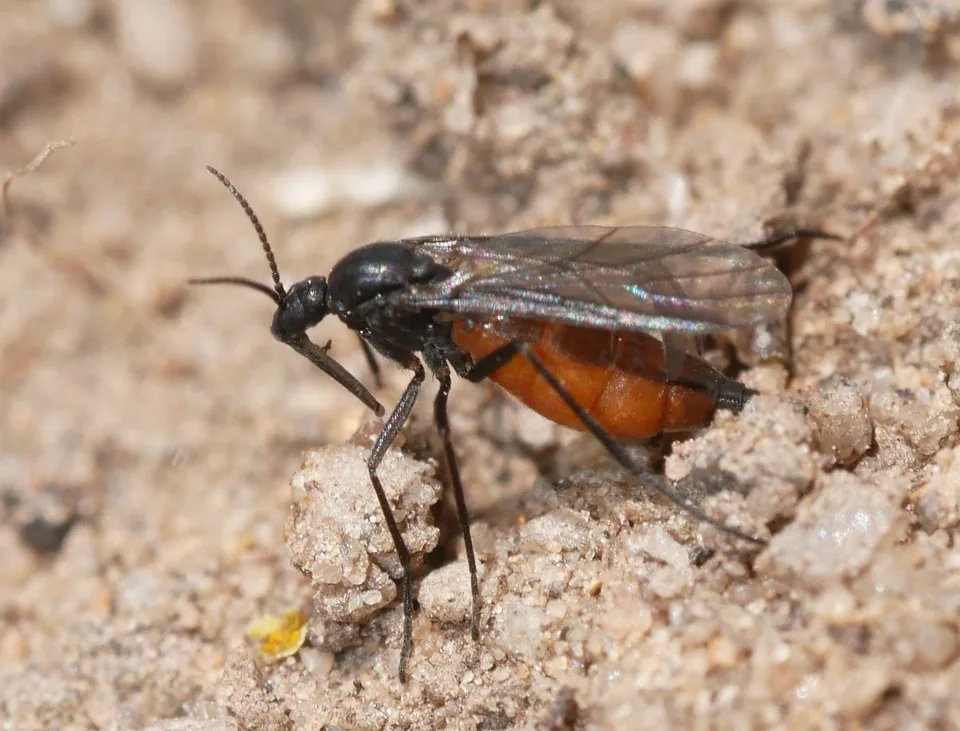
Insect
Fungus gnats
Sciaridae
Written by Emilio Marruso
Classification: Arthropoda › Hexapoda › Insecta › Diptera
How to get rid of fungus gnats in houseplants
- Let the surface of the potting mix dry between waterings. Check all nearby pots, make sure they drain, and empty standing water from saucers. Remove decaying plant debris from the surface. [1] [2]
- Set a yellow sticky trap at the edge of the pot. Use the trap to catch adult flies and see which pots still have activity. Check the mix too, since the larvae stay there. [1] [2]
- Treat persistent larvae in the mix. Choose Bacillus thuringiensis subsp. israelensis (Bti) labeled for the use, or Steinernema feltiae beneficial nematodes. Apply to the potting mix and follow the directions for application and repeat treatment. [1] [2]
If the plant also has yellow leaves, check the roots and watering. Damp mix favors the gnats, and large numbers of larvae can damage roots. [1]
Fungus gnat life cycle
At 75°F (23.9 °C), University of California IPM describes the following development times. Development speeds up as temperatures rise. The adult lifespan comes from Colorado State University Extension. [1] [2]
| Stage | Timing | What to check |
|---|---|---|
| Egg | 3 days to hatch | Females lay eggs in moist potting mix. [1] |
| Larva | 10 days to pupate | Larvae with dark heads feed in the mix. Bti and beneficial nematodes target this stage. [1] |
| Pupa | 4 days to adult emergence | Pupae stay in the mix. Keep monitoring for adults as they emerge. [1] |
| Adult | 7–10 days of life | Catch adults on yellow sticky traps near the pot. [2] |
Sources
Plants it attacks
Plants in our guide where this problem is reported. Open a plant to see the sources.
Also reported on: Aloe vera, Blue Star Fern, Blushing Philodendron, Delta Maidenhair, Ivy Leaf Peperomia, Ming Aralia, Money Tree, Monstera, Peanut, Pigtail Plant, Pink Sundew, Snake Plant, Sundew, Sweet Pitcher Plant, Thanksgiving Cactus, Xanadu Philodendron, ZZ Plant
Remedies
What our plant sheets report, with the outcome checked against official sources. Traditional remedies without an official source are flagged.
Treat
letting the soil dry between waterings Works
How: Allow the soil, especially the soil surface, to dry out between waterings, and never let plants sit in saucers filled with water.
Reported for 6 plants: Delta Maidenhair, Ivy Leaf Peperomia, Blushing Philodendron, Xanadu Philodendron, Blue Star Fern, Thanksgiving Cactus
bacillus thuringiensis Works
How: Add a product containing Bacillus thuringiensis, a bacterium ingested by the larvae that kills them.
Reported for 1 plant: Pink Sundew
beneficial nematodes Works
How: Beneficial nematodes, soil-borne roundworms that feed on fungus gnats.
Reported for 1 plant: Thanksgiving Cactus
yellow sticky traps Works
How: Place yellow sticky traps near the base of the plants and replace as needed to catch adult gnats.
Reported for 1 plant: Pink Sundew
yellow sticky traps Partly works
How: Yellow sticky card traps catch the flying adults.
Reported for 3 plants: Xanadu Philodendron, Blue Star Fern, Thanksgiving Cactus
food-grade diatomaceous earth Partly works
How: Food-grade diatomaceous earth on the potting medium; also at repotting as a preventative measure.
Reported for 1 plant: Thanksgiving Cactus
letting soil dry between waterings Partly works
How: Letting soil dry between waterings will help reduce fungus gnat problems.
Reported for 1 plant: Pigtail Plant
letting the soil dry out between waterings Partly works
How: Fungus gnat larvae prefer wet or moist soil and cannot thrive in soil that has started to dry out.
Reported for 1 plant: Money Tree
yellow sticky card traps Partly works
How: Yellow sticky card traps catch flying adults.
Reported for 1 plant: Delta Maidenhair
hydrogen peroxide soil drench Official source, not independently tested
How: mix 1 part 3% hydrogen peroxide with 4 parts water and water the plants with it
Reported for 1 plant: Blue Star Fern
neem oil on the soil surface Official source, not independently tested
How: Spray neem oil on the soil's surface to repel adult fungus gnats.
Reported for 1 plant: Money Tree
potato slice trap for larvae Official source, not independently tested
How: place a half-inch thick slice of potato on the soil surface and discard it with the larvae
Reported for 1 plant: Blue Star Fern
sand or gravel layer on the soil Official source, not independently tested
How: cover the soil surface with a layer of sand, gravel or pebbles so adults cannot lay eggs
Reported for 1 plant: Blue Star Fern
yellow sticky traps Not verified
How: Capture adult fungus gnats to reduce their population.
Reported for 2 plants: Sundew, Ming Aralia
cinnamon dusting Not verified
How: Apply a liberal dusting of cinnamon on the soil surface to smother the larvae and discourage adults from laying eggs.
Reported for 1 plant: Pink Sundew
coarse horticultural sand layer Not verified
How: A thin layer of coarse horticultural sand over the potting soil surface.
Reported for 1 plant: Sweet Pitcher Plant
coarse sand topping Not verified
How: Cap the soil with 1/2-1 inch of coarse sand or fine gravel.
Reported for 1 plant: ZZ Plant
diluted dish soap spray Not verified
How: Spray a diluted mix of water and dish soap on and around the plant.
Reported for 1 plant: Snake Plant
grit mulch Not verified
How: Avoid overwatering and/or use a mulch such as grit on the soil surface (indoor plants only).
Reported for 1 plant: Peanut
sand or gravel layer on the soil Not proven
How: Adding a layer of sand or gravel on top of the soil can deter adults from laying eggs.
Reported for 1 plant: Blushing Philodendron
5 more remedies are reported in single plant sheets.
Where it is found
No distribution data.