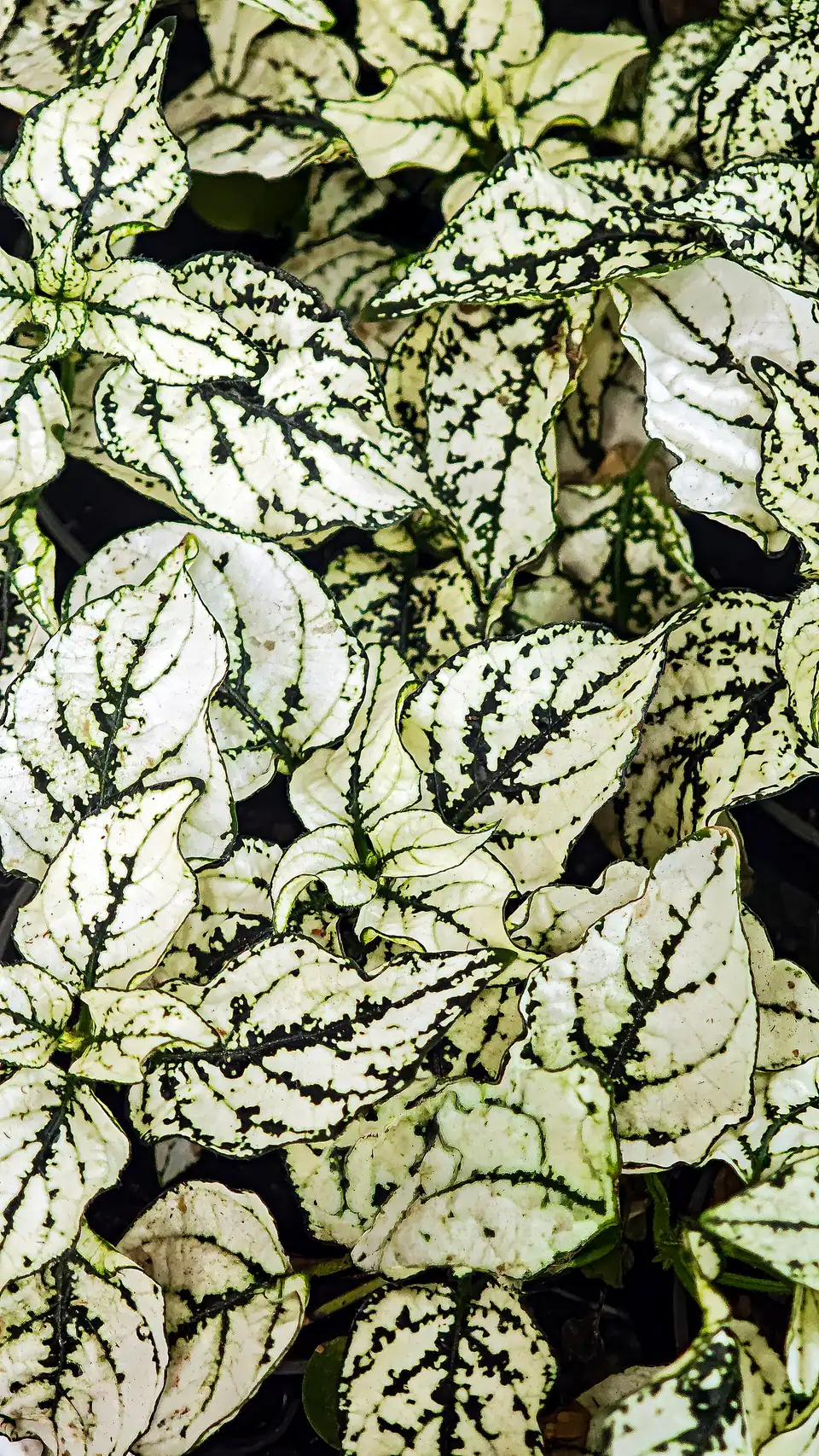


How to Grow and Care for Polka Dot Plant
Hypoestes phyllostachya
Written by Emilio Marruso · last checked
Not toxic to cats and dogs, according to the sources · Sources
At a glance
This perennial grows happily indoors or in pots, and outdoors it's grown as an annual. Its seeds can sprout in as little as 4 days, and stem cuttings root even in a glass of water. Give it bright, filtered light and plenty of water while it's growing, and pinch it back now and then to keep it nice and compact.
- Sun
Bright, filtered light; direct sun curls the leaves, low light makes them fade
- Water
Water well while growing, letting the soil dry slightly; mist indoors in winter
What the sources say (3)
Watering: Water well when growing actively, allowing the soil to dry slightly between waterings; grows better with plenty of water
water well when they are growing actively, allowing the soil to dry slightly between waterings.
— Polka Dot Plant, Hypoestes phyllostachya – Wisconsin Horticulture [2] Although it is somewhat drought tolerant, it does grow better with plenty of water.
— Polka Dot Plant, Hypoestes phyllostachya – Wisconsin Horticulture [2] Watering notes: Prefers a humid environment; may need periodic misting indoors during the winter
It prefers a humid environment, so should be quite happy outdoors in the Midwest in summer, but may need periodic misting indoors during the winter.
— Polka Dot Plant, Hypoestes phyllostachya – Wisconsin Horticulture [2] - Cold
Survives winters down to 30 °F (−1.1 °C)
Half hardy: mild winters or an unheated greenhouse · USDA 10a · RHS H3 · Z10
What the sources say (2)
Hardiness, coldest zone: 10a [winter low −1.1 to 1.7 °C (30 to 35 °F)]
USDA Plant Hardiness Zone: 10a, 10b, 11a, 11b
— Hypoestes phyllostachya (Baby’s Tears, Flamingo Plant, Freckle Face, Measles Plant, Pink Splash, Polka Dot Plant) | North Carolina Extension Gardener Plant Toolbox [1] Hardiness, warmest zone: 11b [winter low 7.2 to 10 °C (45 to 50 °F)]
USDA Plant Hardiness Zone: 10a, 10b, 11a, 11b
— Hypoestes phyllostachya (Baby’s Tears, Flamingo Plant, Freckle Face, Measles Plant, Pink Splash, Polka Dot Plant) | North Carolina Extension Gardener Plant Toolbox [1] - Planting
Plant outdoors when temperatures stay above 50 °F (10 °C)
What the sources say (1)
Planting: Outdoors when temperatures are consistently above 50°F [10 °C]
Wait until temperatures are consistently above 50°F to plant outdoors; it doesn’t grow well until temperatures are over 60°F
— Polka Dot Plant, Hypoestes phyllostachya – Wisconsin Horticulture [2] - Pruning
Pinch back leggy stems to keep the plant compact
- Pests
Aphids, mealybugs, whiteflies, powdery mildew and root rot; use insecticidal soap if needed
What the sources say (2)
Pests: aphids, mealybugs, whiteflies
Aphids, mealybugs, and whiteflies can also affect this plant.
— Hypoestes phyllostachya (Baby’s Tears, Flamingo Plant, Freckle Face, Measles Plant, Pink Splash, Polka Dot Plant) | North Carolina Extension Gardener Plant Toolbox [1] Diseases: powdery mildew, root rot
Hypoestes has few pest problems, but is susceptible to powdery mildew and root rot, and may become infested with whiteflies, aphids, and mealybugs.
— Polka Dot Plant, Hypoestes phyllostachya – Wisconsin Horticulture [2] - Size
1 to 2 ft tall
What the sources say (1)
Mature height: 30-61 cm (1 ft - 2 ft)
Dimensions: Height: 1 ft. 0 in. - 2 ft. 0 in. Width: 0 ft. 9 in. - 1 ft. 0 in.
— Hypoestes phyllostachya (Baby’s Tears, Flamingo Plant, Freckle Face, Measles Plant, Pink Splash, Polka Dot Plant) | North Carolina Extension Gardener Plant Toolbox [1] - Propagation
Stem cuttings rooted in water or moist potting mix, or seed
What the sources say (3)
Propagation: Stem cuttings (rooted in water or moist potting mix, sand or vermiculite) or seed
Propagation is easily accomplished through stem cuttings. Place the cutting in water and place it in a bright location.
— Hypoestes phyllostachya (Baby’s Tears, Flamingo Plant, Freckle Face, Measles Plant, Pink Splash, Polka Dot Plant) | North Carolina Extension Gardener Plant Toolbox [1] Stem cuttings are easily rooted to create new plants.
— Polka Dot Plant, Hypoestes phyllostachya – Wisconsin Horticulture [2] Sow Hypoestes seed 8-10 weeks before the average last date of frost for plants intended for the garden.
— Polka Dot Plant, Hypoestes phyllostachya – Wisconsin Horticulture [2] - Sowing
Indoors anytime; for the garden, 8–10 weeks before last frost; sprouts in 4 days at 68 °F (20 °C)
What the sources say (4)
Sowing: 8-10 weeks before the average last date of frost for garden plants; anytime for houseplants
plants intended for the garden: Sow Hypoestes seed 8-10 weeks before the average last date of frost for plants intended for the garden. (Sow anytime for houseplants.)
— Polka Dot Plant, Hypoestes phyllostachya – Wisconsin Horticulture [2] houseplants: Sow Hypoestes seed 8-10 weeks before the average last date of frost for plants intended for the garden. (Sow anytime for houseplants.)
— Polka Dot Plant, Hypoestes phyllostachya – Wisconsin Horticulture [2] Sow Hypoestes seed 8-10 weeks before the average last date of frost for plants intended for the garden. (Sow anytime for houseplants.)
— Polka Dot Plant, Hypoestes phyllostachya – Wisconsin Horticulture [2] Days to germination: as quickly as 4 days at 20 C (68 F)
Seeds will germinate as quickly as 4 days when held at 68°F.
— Polka Dot Plant, Hypoestes phyllostachya – Wisconsin Horticulture [2] - Containers
Grows well in containers and as a houseplant
What the sources say (2)
In containers: Yes
In addition to being an indoor houseplant, Hypoestes can be used as an accent plant in dish gardens, window boxes or patio containers
— Polka Dot Plant, Hypoestes phyllostachya – Wisconsin Horticulture [2] Indoors: Yes
In addition to being an indoor houseplant, Hypoestes can be used as an accent plant in dish gardens, window boxes or patio containers
— Polka Dot Plant, Hypoestes phyllostachya – Wisconsin Horticulture [2] - Safety
Not toxic to cats, dogs or horses
Overview
Polka dot plant is an herbaceous perennial native to Madagascar, with ovate green leaves dotted with splotches of rose, pink, or white. [1] It is grown as a houseplant and, increasingly, as an annual outdoors in borders and container plantings. [2] It grows best in bright, filtered light and is not grown for its small flowers. [2][1]
Polka Dot Plant care
Measurements in square brackets are our conversion into the other unit system; the quoted text is unchanged.
How to water Polka Dot Plant
Watering
Water well when growing actively, allowing the soil to dry slightly between waterings; grows better with plenty of water
What the sources say (2)
water well when they are growing actively, allowing the soil to dry slightly between waterings.Although it is somewhat drought tolerant, it does grow better with plenty of water.Watering notes
Prefers a humid environment; may need periodic misting indoors during the winter
What the sources say (1)
It prefers a humid environment, so should be quite happy outdoors in the Midwest in summer, but may need periodic misting indoors during the winter.How much light Polka Dot Plant needs
The sources give different values depending on region, zone or growing conditions.
What each source says
potted house or greenhouse plant: Bright light
bedding plant outdoors: Partially shaded areas
According to University of Illinois Extension: Full sun; partial sun/shade
What the sources say (5)
potted house or greenhouse plant: Place the potted plant in a location that receives bright lightbedding plant outdoors: grown as a bedding plant to add some color in partially shaded areas.According to University of Illinois Extension: Exposure/Light Requirements
Full Sun
Partial Sun/ShadeHypoestes grows best in bright, filtered light, but tolerates some sun.The plants have better color in partial shade than full sun, but the leaves also fade out in very low light.How much cold Polka Dot Plant can take
Hardiness, coldest zone
10a [winter low −1.1 to 1.7 °C (30 to 35 °F)]
What the sources say (1)
USDA Plant Hardiness Zone:
10a, 10b, 11a, 11bHardiness, warmest zone
11b [winter low 7.2 to 10 °C (45 to 50 °F)]
What the sources say (1)
USDA Plant Hardiness Zone:
10a, 10b, 11a, 11bWhere to grow Polka Dot Plant
Indoors
Yes
What the sources say (1)
In addition to being an indoor houseplant, Hypoestes can be used as an accent plant in dish gardens, window boxes or patio containersIn containers
Yes
What the sources say (1)
In addition to being an indoor houseplant, Hypoestes can be used as an accent plant in dish gardens, window boxes or patio containersHow to propagate Polka Dot Plant
Stem cuttings (rooted in water or moist potting mix, sand or vermiculite) or seed
What the sources say (3)
Propagation is easily accomplished through stem cuttings. Place the cutting in water and place it in a bright location.Stem cuttings are easily rooted to create new plants.Sow Hypoestes seed 8-10 weeks before the average last date of frost for plants intended for the garden.How to grow Polka Dot Plant
The plant
Life cycle
perennial (grown as an annual outdoors)
What the sources say (2)
The polka dot plant is an herbaceous perennial and native to Madagascar.It has gained more popularity as an annual outdoors, brightening borders and adding to container plantings.Family
Acanthaceae
What the sources say (1)
Genus: Hypoestes Species: phyllostachya Family: Acanthaceae Uses (Ethnobotany): Container or houseplantMature height
30-61 cm (1 ft - 2 ft)
What the sources say (1)
Dimensions: Height: 1 ft. 0 in. - 2 ft. 0 in. Width: 0 ft. 9 in. - 1 ft. 0 in.Sowing and growth
Days to germination
as quickly as 4 days at 20 C (68 F)
What the sources say (1)
Seeds will germinate as quickly as 4 days when held at 68°F.Pests and diseases
Pests
aphids, mealybugs, whiteflies
What the sources say (1)
Aphids, mealybugs, and whiteflies can also affect this plant.Diseases
powdery mildew, root rot
What the sources say (1)
Hypoestes has few pest problems, but is susceptible to powdery mildew and root rot, and may become infested with whiteflies, aphids, and mealybugs.Fertilizing
Mineral fertilizers
The sources give different values depending on region, zone or growing conditions.
What each source says
as a house or greenhouse plant: Dilute liquid fertilizer, applied periodically once plants are established
What the sources say (1)
as a house or greenhouse plant: Once established, plants should be fertilized periodically with dilute liquid fertilizer. They can also be grown under artificial light.Polka Dot Plant pests and problems
Root rot and powdery mildew
Symptom: Root rot and powdery mildew can occur
What the sources say (1)
No significant insects or disease problems. Root rot and powdery mildew can occur.
— Hypoestes phyllostachya (Baby’s Tears, Flamingo Plant, Freckle Face, Measles Plant, Pink Splash, Polka Dot Plant) | North Carolina Extension Gardener Plant Toolbox [1] Aphids, mealybugs and whiteflies
Symptom: These pests can affect the plant
What to do: Treat with an insecticidal soap or neem oil if needed
What the sources say (1)
Aphids, mealybugs, and whiteflies can also affect this plant. If needed, treat the plants with an insecticidal soap or neem oil.
— Hypoestes phyllostachya (Baby’s Tears, Flamingo Plant, Freckle Face, Measles Plant, Pink Splash, Polka Dot Plant) | North Carolina Extension Gardener Plant Toolbox [1] Too much direct sun
Symptom: Leaves crinkle and curl
What to do: Locate the plant in bright, filtered lighting
What the sources say (1)
Too much direct sunlight can cause the leaves to crinkle and curl.
— Hypoestes phyllostachya (Baby’s Tears, Flamingo Plant, Freckle Face, Measles Plant, Pink Splash, Polka Dot Plant) | North Carolina Extension Gardener Plant Toolbox [1] Leggy growth in low light
Symptom: Leaves fade and the plant becomes leggy as it reaches for brighter light
What to do: Pinch back leggy plants to keep them compact
What the sources say (1)
Too little lighting can result in the leaves fading as well as a plant that becomes leggy as they reach for brighter lighting. Pinching back leggy plants can maintain a more compact plant.
— Hypoestes phyllostachya (Baby’s Tears, Flamingo Plant, Freckle Face, Measles Plant, Pink Splash, Polka Dot Plant) | North Carolina Extension Gardener Plant Toolbox [1]
Remedies
Each remedy shows what official sources say about it; traditional remedies without an official source are marked as such. Harmful ones are listed so you know to avoid them.
Treating the plant
aphids, mealybugs and whiteflies
neem oil Partly works
How: If needed, treat the plants with an insecticidal soap or neem oil.
If needed, treat the plants with an insecticidal soap or neem oil.
— Hypoestes phyllostachya (Baby’s Tears, Flamingo Plant, Freckle Face, Measles Plant, Pink Splash, Polka Dot Plant) | North Carolina Extension Gardener Plant Toolbox [1] What the evidence says However, neem oil is not effective against every insect and disease, and often must be frequently reapplied to reach the desired outcome.
— extension.unh.edu [4]
Is Polka Dot Plant poisonous?
Reported by the source, quoted verbatim. This is not medical or veterinary advice: if a person or an animal may have eaten this plant, contact a poison control centre or a veterinarian.
#non-toxic for cats #non-toxic for horses #non-toxic for dogs
[1]The source flags the risk for this animal but does not explain why.
Calendar
Sowing
8-10 weeks before the average last date of frost for garden plants; anytime for houseplants
What each source says
plants intended for the garden: 8-10 weeks before the average last date of frost
houseplants: Anytime
What the sources say (3)
plants intended for the garden: Sow Hypoestes seed 8-10 weeks before the average last date of frost for plants intended for the garden. (Sow anytime for houseplants.)houseplants: Sow Hypoestes seed 8-10 weeks before the average last date of frost for plants intended for the garden. (Sow anytime for houseplants.)Sow Hypoestes seed 8-10 weeks before the average last date of frost for plants intended for the garden. (Sow anytime for houseplants.)Planting
Outdoors when temperatures are consistently above 50°F [10 °C]
What the sources say (1)
Wait until temperatures are consistently above 50°F to plant outdoors; it doesn’t grow well until temperatures are over 60°FMonths as given by the sources, which are mostly from the United States (northern hemisphere). In the southern hemisphere they shift by about six months.
Relative to frost
Less precise estimate: there is no weather station within 300 km.
Find frost dates by ZIP code or city
Sow indoors: 8 to 10 weeks before the last frost
Sow Hypoestes seed 8-10 weeks before the average last date of frost for plants intended for the garden.
— Polka Dot Plant, Hypoestes phyllostachya – Wisconsin Horticulture [2]
Count from the average frost dates where you live.
Indicative values
Values from a secondary source, not checked word for word like the rest of this page. Use them as a starting point.
- Hours of sun
- 4-5 hoursIndicative value, adapt it to your climate · Secondary source
- Soil
- Well-drainedIndicative value, adapt it to your climate · Secondary source
- Soil pH
- 5.5-6.5Indicative value, adapt it to your climate · Secondary source
- Care level
- ModerateIndicative value, adapt it to your climate · Secondary source
- Growth rate
- HighIndicative value, adapt it to your climate · Secondary source
- Pruning
- May, June, JulyIndicative value, adapt it to your climate · Secondary source
Similar plants
- American Water-willow Dianthera americana
- Bear's Breeches Acanthus mollis
- Bear's Breeches Acanthus spinosus
- Bengal clock vine Thunbergia grandiflora
- Black-eyed Susan Vine Thunbergia alata
- Caricature-plant Graptophyllum pictum
- Carolina Wild-petunia Ruellia caroliniensis
- Crossandra Crossandra infundibuliformis
Sources
Every value above is quoted from these documents. Links lead to the original publisher.
- Hypoestes phyllostachya (Baby’s Tears, Flamingo Plant, Freckle Face, Measles Plant, Pink Splash, Polka Dot Plant) | North Carolina Extension Gardener Plant Toolbox · plants.ces.ncsu.edu, consulted
- Polka Dot Plant, Hypoestes phyllostachya – Wisconsin Horticulture · hort.extension.wisc.edu, consulted
- Hypoestes (Hypoestes phyllostachya)-Hort Answers - University of Illinois Extension · web.extension.illinois.edu, consulted
- extension.unh.edu · extension.unh.edu
Written by Emilio Marruso · last checked