
How to Grow and Care for Goji berry
Lycium barbarum
Written by Emilio Marruso · last checked
At a glance
Goji berry is a generous, easygoing shrub: once settled, it handles dry spells well and needs little or no feeding. Give it full sun or partial shade and soil that never stays soggy, and it fills with red or orange berries rich in vitamins, delicious fresh, dried, or in jellies and juices. It even grows happily in containers.
- Sun
Full sun to partial shade
What the sources say (2)
- Water
Water often while young; once settled, 1 inch of water a week is enough
What the sources say (4)
Watering: Fairly drought-tolerant once established; 1 inch [2.5 cm] of water per week after establishment
Although fairly drought-tolerant once established, more frequent irrigation is needed to establish new transplants.
— 1 [2] In general, approximately 1 inch of irrigation water per week may be sufficient
— HS1391 [3] Watering notes: More frequent irrigation is needed to establish new transplants; susceptible to waterlogging, do not plant in poorly drained lowlands
more frequent irrigation is needed to establish new transplants.
— 1 [2] Goji berry is susceptible to waterlogging and should not be planted in lowlands that do not drain well.
— HS1391 [3] - Soil
Well-drained soil: it suffers in soggy, low-lying ground
What the sources say (2)
Watering notes: More frequent irrigation is needed to establish new transplants; susceptible to waterlogging, do not plant in poorly drained lowlands
more frequent irrigation is needed to establish new transplants.
— 1 [2] Goji berry is susceptible to waterlogging and should not be planted in lowlands that do not drain well.
— HS1391 [3] - Spacing
3–5 ft between plants, 6–8 ft between rows
What the sources say (1)
Spacing: 91.4-152.4 cm (3-5 ft) in the row; 182.9-243.8 cm (6-8 ft) between rows
Goji berry in-row plant spacing is 3 to 5 feet apart, with between-row spacing of 6 to 8 feet
— HS1391 [3] - Feeding
Feed lightly in spring; too much gives lots of leaves and poorer fruit
What the sources say (4)
When: In spring
Fertilizers have the greatest impact on goji berry growth when applied in springtime.
— HS1391 [3] Avoid: Over-fertilizing: established plants do well with little or no fertilization
Too much fertility results in excess vegetation, shading, and reduced fruit quality.
— 1 [2] There is some evidence suggesting that established goji perform very well with little or no fertilization.
— 1 [2] Signs of excess: Excess vegetation, shading and reduced fruit quality
Too much fertility results in excess vegetation, shading, and reduced fruit quality.
— 1 [2] - Pruning
Shorten branches in early spring; remove unwanted stems in winter and thin the top in summer
What the sources say (2)
Pruning: Early spring (shortening branches, second year); winter (cleaning unwanted stems) and summer (controlling canopy), third year
trim off spindly stems, remove dead and damaged branches, improve plant shape, and shorten branches in early spring.
— HS1391 [3] In the third year, clean unwanted stems in winter, and control structure and canopy growth in summer.
— HS1391 [3] - Harvest
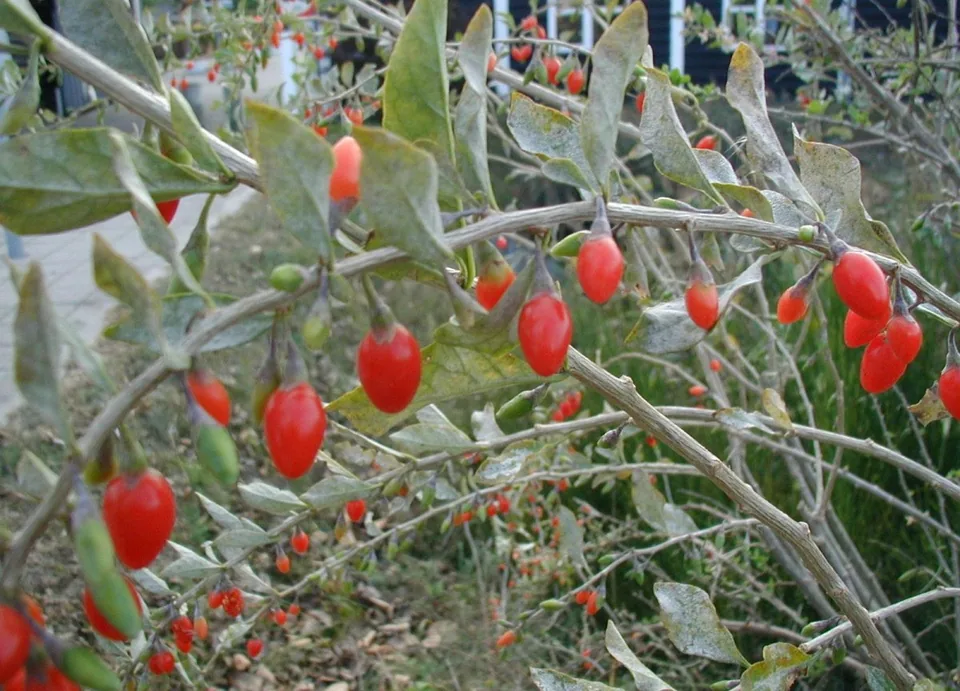
Pick by hand when berries turn red or orange and the stem loosens; eat fresh or dried
What the sources say (1)
How to harvest: Harvest by hand when the berries turn red or orange and the peduncle loosens
Berries can be harvested when they turn red or orange (Figure 5A, B; Figure 6A, B) and the peduncle loosens
— HS1391 [3] - Pests
Aphids, mites, leaf beetles and powdery mildew; good airflow helps keep mildew away
What the sources say (2)
Pests: aphids, goji berry mites, goji berry leaf beetles
Goji berry hosts pests such as aphids, goji berry mites, and goji berry leaf beetles
— HS1391 [3] Diseases: powdery mildew, runny gum disease, root rot
The main diseases occurring on goji berry include powdery mildew, runny gum disease, and root rot.
— HS1391 [3] - Size
3–6 ft tall when pruned, up to 12 ft if left alone; 4 ft wide
What the sources say (2)
Mature height: 91-183 cm (3-6 ft) when pruned; up to 366 cm (12 ft) if left without cultivation
When pruned, plants are typically 3 to 6 feet tall but if left without cultivation they can reach 12 feet.
— 1 [2] Mature width: 122 cm (4 ft)
Goji berry is a deciduous woody shrub that can naturally reach 12 feet tall with a spread of approximately 4 feet.
— HS1391 [3] - Propagation
Easiest from cuttings; also from seed or by moving suckers
What the sources say (2)
Propagation: Cuttings (most common and easiest), seeds; suckers can be removed and transplanted
Goji berry propagation can be started from seeds or cuttings, but cuttings are the most common and easiest way to propagate.
— HS1391 [3] Suckers begin to form after 3 to 4 years. These should be removed and can be transplanted.
— 1 [2] - Containers
Grows in containers too
What the sources say (1)
In containers: Yes
goji berry can be grown in containers as an ornamental plant.
— HS1391 [3]
Overview
Goji berry grows best in full sun and tolerates relatively harsh conditions. [3][2] It is propagated mostly by cuttings and needs well-drained soil, as it is susceptible to waterlogging. [3] Berries are harvested when they turn red or orange. [3]
This record is incomplete: the sources we read do not cover every field yet.
Not yet covered by our sources: Planting
Goji berry care
Measurements in square brackets are our conversion into the other unit system; the quoted text is unchanged.
How to water Goji berry
Watering
Fairly drought-tolerant once established; 1 inch [2.5 cm] of water per week after establishment
Watering notes
More frequent irrigation is needed to establish new transplants; susceptible to waterlogging, do not plant in poorly drained lowlands
How much light Goji berry needs
How much cold Goji berry can take
The sources give different values depending on region, zone or growing conditions.
What each source says
Arizona (cultivars): 4-7 [winter low −34.4 to −12.2 °C (−30 to 10 °F)]
According to UF/IFAS Extension: 4b-9b [winter low −31.7 to −1.1 °C (−25 to 30 °F)]
According to University of Wisconsin: 3-10 [winter low −40 to 4.4 °C (−40 to 40 °F)]
What the sources say (3)
Arizona (cultivars): Multiple hardy Goji berry cultivars are available for USDA Plant Hardiness Zones 4 - 7.According to UF/IFAS Extension: This crop can be grown in Plant Hardiness Zones 4b to 9b as defined by the US Department of AgricultureAccording to University of Wisconsin: Hardiness zone – 3-10 (some cultivars only 5-9)Where to grow Goji berry
In containers
Yes
What the sources say (1)
goji berry can be grown in containers as an ornamental plant.Spacing
91.4-152.4 cm (3-5 ft) in the row; 182.9-243.8 cm (6-8 ft) between rows
What the sources say (1)
Goji berry in-row plant spacing is 3 to 5 feet apart, with between-row spacing of 6 to 8 feetHow to propagate Goji berry
Cuttings (most common and easiest), seeds; suckers can be removed and transplanted
How to grow Goji berry
The plant
Family
Solanaceae
What the sources say (1)
is a native shrub to China belonging to the Solanaceae family.Mature height
91-183 cm (3-6 ft) when pruned; up to 366 cm (12 ft) if left without cultivation
What the sources say (1)
When pruned, plants are typically 3 to 6 feet tall but if left without cultivation they can reach 12 feet.Mature width
122 cm (4 ft)
What the sources say (1)
Goji berry is a deciduous woody shrub that can naturally reach 12 feet tall with a spread of approximately 4 feet.Harvest and storage
How to harvest
Harvest by hand when the berries turn red or orange and the peduncle loosens
What the sources say (1)
Berries can be harvested when they turn red or orange (Figure 5A, B; Figure 6A, B) and the peduncle loosensStorage
Fresh berries keep about one week at room temperature or a couple of weeks in the refrigerator; dried berries keep at least one year in a dark, dry, cool place
Pests and diseases
Pests
aphids, goji berry mites, goji berry leaf beetles
What the sources say (1)
Goji berry hosts pests such as aphids, goji berry mites, and goji berry leaf beetlesDiseases
powdery mildew, runny gum disease, root rot
What the sources say (1)
The main diseases occurring on goji berry include powdery mildew, runny gum disease, and root rot.Fertilizing
When
In spring
What the sources say (1)
Fertilizers have the greatest impact on goji berry growth when applied in springtime.Natural fertilizers
Organic materials and compost on sandy and loam soils, which hold moisture and nutrients and reduce the need for chemical fertilizers
What the sources say (1)
Adding organic materials and compost to sandy and loam soils may help the soil better retain moisture and nutrients and improve the soil environment by reducing the need for the excessive ap-plication of chemical fertilizers.Mineral fertilizers
Nitrogen fertilizer first, then phosphate and potassium: urea, ammonium sulfate, ammonium nitrate or UAN-32 for nitrogen; triple or double superphosphate for phosphate; potassium sulfate or potassium chloride for potassium; soil-test recommendations for Solanaceae crops apply
What the sources say (4)
Especially beneficial is nitrogen fertilizer, followed by phosphate and potassium.Recommended nitrogen fertilizers include urea, ammonium sulfate, ammonium nitrate, and UAN-32 (50% urea and 50% ammonium nitrate).Recommended phosphate fertilizers include triple superphosphate and double superphosphate. Recommended potassium fertilizers include potassium sulfate and potassium chloride.In addition, the Solanaceae fertilizer recommendations based on soil testing for other Solanaceae crops are likely to work well for goji berry.Avoid
Over-fertilizing: established plants do well with little or no fertilization
Signs of excess
Excess vegetation, shading and reduced fruit quality
What the sources say (1)
Too much fertility results in excess vegetation, shading, and reduced fruit quality.Goji berry pests and problems
Powdery mildew
Symptom: Listed among the main diseases of goji berry
What to do: Good air circulation prevents infection
Aphids
Symptom: Goji berry hosts aphids among other pests
What to do: Spraying agricultural soap on the leaves
Remedies
Each remedy shows what official sources say about it; traditional remedies without an official source are marked as such. Harmful ones are listed so you know to avoid them.
Treating the plant
aphids
agricultural soap spray Works
Certain plants are sensitive to insecticidal soap sprays and may be injured. When in doubt, test soap-detergent sprays for phytotoxicity problems on a small area a day or two before an extensive area is treated.
— extension.colostate.edu [6] How: Spraying agricultural soap on the leaves is also effective to control aphids.
Spraying agricultural soap on the leaves is also effective to control aphids
— edis.ifas.ufl.edu [5] What the evidence says Spraying agricultural soap on the leaves is also effective to control aphids
— HS1391 [3]
Calendar
Planting
Not stated in the sources we read.
Harvest
When berries turn red or orange and the peduncle loosens
What each source says
China: August - October
California: Berries begin to ripen in midsummer
What the sources say (3)
China: In China, the goji berry harvest period begins in August and ends in October.California: Plants grown in California first bloom in late spring to early summer, and berries begin to ripen in midsummer.Berries can be harvested when they turn red or orange (Figure 5A, B; Figure 6A, B) and the peduncle loosensPruning
Early spring (shortening branches, second year); winter (cleaning unwanted stems) and summer (controlling canopy), third year
Months as given by the sources, which are mostly from the United States (northern hemisphere). In the southern hemisphere they shift by about six months.
Edibility
Reported by the source, quoted verbatim. Do not eat a plant on the basis of this page alone: identification mistakes can be dangerous.
Indicative values
Values from a secondary source, not checked word for word like the rest of this page. Use them as a starting point.
- Life cycle
- PerennialIndicative value, adapt it to your climate · Secondary source
- Hours of sun
- 6-7 hoursIndicative value, adapt it to your climate · Secondary source
- Drought tolerant
- yesIndicative value, adapt it to your climate · Secondary source
- Soil pH
- 6.5-7.5Indicative value, adapt it to your climate · Secondary source
- Care level
- MediumIndicative value, adapt it to your climate · Secondary source
- Growth rate
- LowIndicative value, adapt it to your climate · Secondary source
Similar plants
- Chinese desert-thorn Lycium chinense
- Angel's-tears Brugmansia suaveolens
- Ashwagandha Withania somnifera
- Bladder cherry Alkekengi officinarum
- Brazilian nightshade Solanum seaforthianum
- Brunfelsia Brunfelsia pauciflora
- Cayenne Pepper Capsicum annuum
- Clammy Ground Cherry Physalis heterophylla
Sources
Every value above is quoted from these documents. Links lead to the original publisher.
- Wolfberry - Lycium | North Carolina Extension Gardener Plant Toolbox · plants.ces.ncsu.edu, consulted
- 1 · extension.arizona.edu, consulted
- HS1391 · edis.ifas.ufl.edu, consulted
- Gogi (Wolfberry) – Uncommon Fruit · uncommonfruit.cias.wisc.edu, consulted
- edis.ifas.ufl.edu · edis.ifas.ufl.edu
- extension.colostate.edu · extension.colostate.edu
Written by Emilio Marruso · last checked