
How to Grow and Care for Mandevilla splendens
Mandevilla splendens
Written by Emilio Marruso · last checked
At a glance
Mandevilla splendens is a sun lover that can grow 10 feet tall or more, bringing real height to a sunny spot. Give it full sun and it will grow happily in the garden or in a container on a patio or balcony. Just keep an eye out for mealybugs, spider mites and whiteflies, and you'll have a striking plant to enjoy.
- Sun
Full sun
What the sources say (1)
Light: Full sun
Hardiness Rating: Zone 11: (above 4 °C) Exposure: Full sun
— shining mandevilla - KPU Plant DB [2] - Cold
Survives winters down to 40 °F (4.4 °C)
Tender: needs a frost-free greenhouse · USDA 11 · RHS H2 · Z11
What the sources say (2)
Hardiness, coldest zone: 11 [winter low 4.4 to 10 °C (40 to 50 °F)]
Origin: South America (Brazil) Hardiness Rating: Zone 11: (above 4 °C)
— shining mandevilla - KPU Plant DB [2] Hardiness, warmest zone: 11 [winter low 4.4 to 10 °C (40 to 50 °F)]
Origin: South America (Brazil) Hardiness Rating: Zone 11: (above 4 °C)
— shining mandevilla - KPU Plant DB [2] - Pests
Watch for mealybugs, spider mites, whiteflies and aphids
What the sources say (1)
Pests: mealybugs, red spider mites, glasshouse whitefly
Check plants regularly for insects, including: - mealybugs - red spider mites , which cause the leaves to appear speckled or bleached - glasshouse whitefly
— How to grow mandevillas / RHS Growing Guide [1] - Size
10 ft tall or more
What the sources say (1)
Mature height: 300+ (10 ft [3 m] or more)
Established mandevillas can grow quite large (3m/10ft or more over time), so annual pruning helps to keep them to a more manageable size.
— How to grow mandevillas / RHS Growing Guide [1] - Containers
Grows in containers too
What the sources say (1)
In containers: Yes
Landscape Uses: Attract birds, Attract butterflies, Container planting, Summer interest (Caution: poisonous parts)
— shining mandevilla - KPU Plant DB [2]
Overview
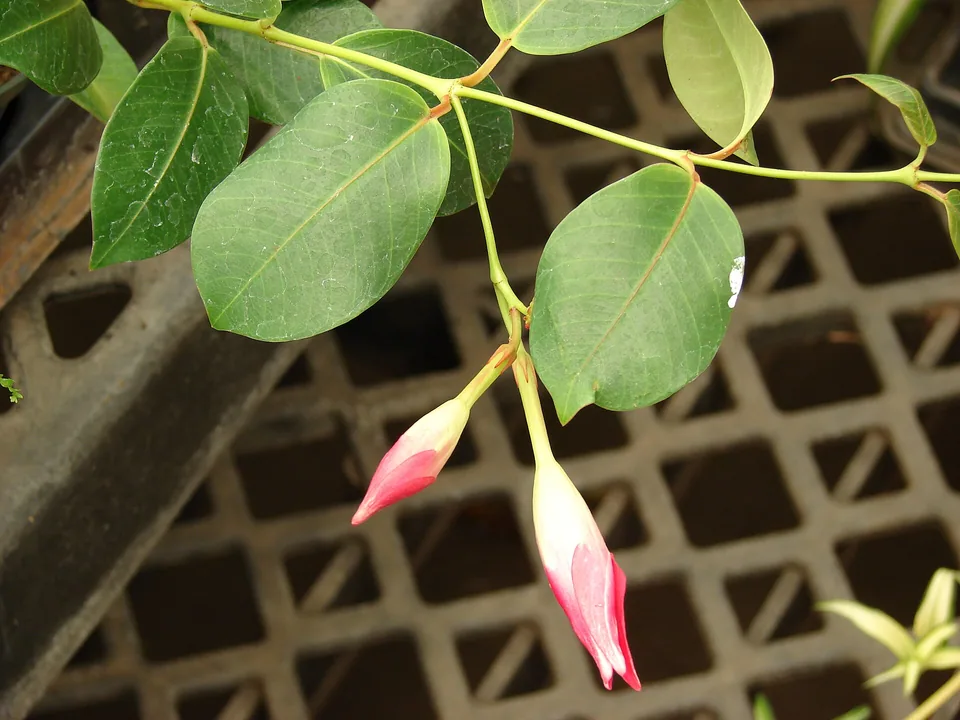
Mandevilla splendens is a twining woody climber from Brazil with glossy evergreen leaves and clusters of rose-pink funnel-shaped flowers with a yellow throat. [2] It is grown in full sun in humus-rich, well-drained soil and is used in container planting. [2] It holds the RHS Award of Garden Merit. [1]
This record is incomplete: the sources we read do not cover every field yet.
Not yet covered by our sources: Watering, Pruning, Propagation
Mandevilla splendens care
How to water Mandevilla splendens
Not stated in the sources we read.
How much light Mandevilla splendens needs
Full sun
What the sources say (1)
Hardiness Rating:
Zone 11: (above 4 °C)
Exposure:
Full sunHow much cold Mandevilla splendens can take
Hardiness, coldest zone
11 [winter low 4.4 to 10 °C (40 to 50 °F)]
What the sources say (1)
Origin:
South America (Brazil)
Hardiness Rating:
Zone 11: (above 4 °C)Hardiness, warmest zone
11 [winter low 4.4 to 10 °C (40 to 50 °F)]
What the sources say (1)
Origin:
South America (Brazil)
Hardiness Rating:
Zone 11: (above 4 °C)Where to grow Mandevilla splendens
Yes
What the sources say (1)
Landscape Uses:
Attract birds, Attract butterflies, Container planting, Summer interest (Caution: poisonous parts)How to propagate Mandevilla splendens
Not stated in the sources we read.
How to grow Mandevilla splendens
The plant
Mature height
300+ (10 ft [3 m] or more)
What the sources say (1)
Established mandevillas can grow quite large (3m/10ft or more over time), so annual pruning helps to keep them to a more manageable size.Pests and diseases
Pests
mealybugs, red spider mites, glasshouse whitefly
What the sources say (1)
Check plants regularly for insects, including: - mealybugs - red spider mites , which cause the leaves to appear speckled or bleached - glasshouse whiteflyMandevilla splendens pests and problems
Aphids, mites, whitefly
What the sources say (1)
Maintenance: Medium Pest Susceptibility: Aphids, Mites, Whitefly (Pest resistant, Disease resistant)
— shining mandevilla - KPU Plant DB [2]
Remedies
The sources we checked give no remedies for this plant.
Calendar
Pruning
Not stated in the sources we read.
Months as given by the sources, which are mostly from the United States (northern hemisphere). In the southern hemisphere they shift by about six months.
Indicative values
Values from a secondary source, not checked word for word like the rest of this page. Use them as a starting point.
- Life cycle
- PerennialIndicative value, adapt it to your climate · Secondary source
- Hours of sun
- 4-6 hoursIndicative value, adapt it to your climate · Secondary source
- Watering
- AverageIndicative value, adapt it to your climate · Secondary source
- Drought tolerant
- yesIndicative value, adapt it to your climate · Secondary source
- Soil
- Humus rich, Well-drainedIndicative value, adapt it to your climate · Secondary source
- Soil pH
- 6-7Indicative value, adapt it to your climate · Secondary source
- Care level
- MediumIndicative value, adapt it to your climate · Secondary source
- Growth rate
- ModerateIndicative value, adapt it to your climate · Secondary source
- Pruning
- June, July, AugustIndicative value, adapt it to your climate · Secondary source
- Propagation
- Stem Propagation, Layering Propagation, Grafting Propagation, Division, Air Layering PropagationIndicative value, adapt it to your climate · Secondary source
Similar plants
- Mandevilla Mandevilla sanderi
- Mandevilla boliviensis Mandevilla boliviensis
- Abies grandis Abies grandis
- Abraham Trachystemon orientalis
- Abyssinian banana Ensete ventricosum
- Acacia longifolia Acacia longifolia
- Acanthus hungaricus Acanthus hungaricus
- Aconite Aconitum napellus
Sources
Every value above is quoted from these documents. Links lead to the original publisher.
- How to grow mandevillas / RHS Growing Guide · rhs.org.uk, consulted
- shining mandevilla - KPU Plant DB · plantdatabase.kpu.ca, consulted
Written by Emilio Marruso · last checked