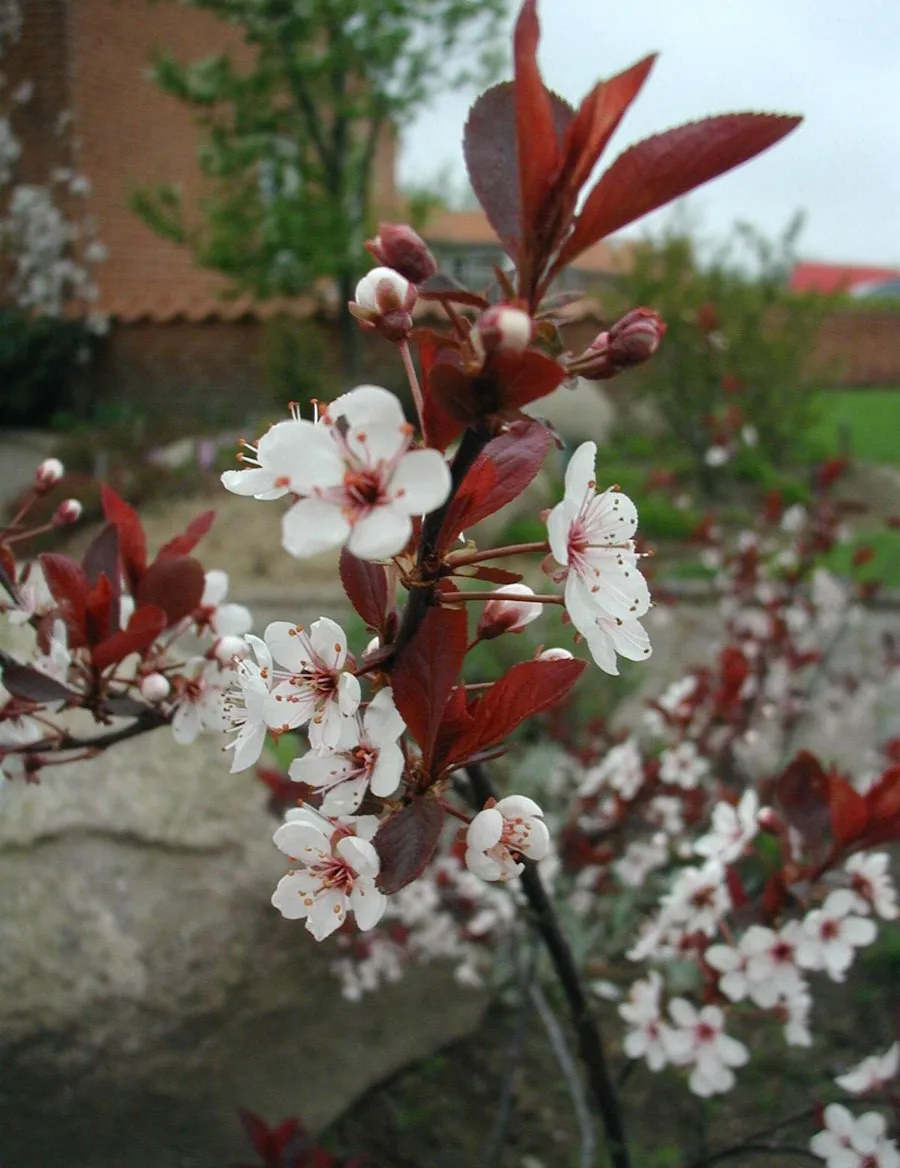

How to Grow and Care for Prunus cistena
Prunus cistena
Written by Emilio Marruso · last checked
Toxic to: People · Why
At a glance
Happy in full sun or part shade, this plant grows 7–10 feet tall and bears dark purple, cherry-like fruit you can eat raw or cooked. Care is simple: feed it once in early spring, add compost twice a year and prune right after it flowers in spring. Just leave the single large seed aside: it is not for eating.
- Sun
Full sun to part shade
- Cold
Survives winters down to −30 °F (−34.4 °C)
Very hardy · USDA 4 · RHS H7 · Z4
What the sources say (2)
Hardiness, coldest zone: 4 [winter low −34.4 to −28.9 °C (−30 to −20 °F)]
- hardy in zone 4, and warmer parts of 3
— Plant Database [2] Hardiness, warmest zone: 7 [winter low −17.8 to −12.2 °C (0 to 10 °F)]
prefers colder climates and looks, does better there than here; usually not tolerant of Zone 8 or warmer
— Purpleleaf Sand Cherry [3] - Feeding
Half-strength 12-12-12 once in early spring; up to 1 inch of compost twice a year
What the sources say (5)
When: Early spring, before new growth emerges
Feed sand cherries yearly in early spring before new growth emerges. Apply a 12-12-12 fertilizer at half strength around the base of the trunk.
— [5] How often: Once a year for mineral fertilizer; compost twice a year
Feed sand cherries yearly in early spring before new growth emerges. Apply a 12-12-12 fertilizer at half strength around the base of the trunk.
— [5] As always, I recommend feeding your shrub twice a year with up to an inch of mature compost across and beyond the drip line of the root zone.
— [6] Natural fertilizers: Mature compost, a layer up to 2.54 cm [1 in], twice a year, across and beyond the drip line
As always, I recommend feeding your shrub twice a year with up to an inch of mature compost across and beyond the drip line of the root zone.
— [6] Mineral fertilizers: 12-12-12 fertilizer at half strength, at the base of the trunk
Feed sand cherries yearly in early spring before new growth emerges. Apply a 12-12-12 fertilizer at half strength around the base of the trunk.
— [5] - Pruning
Prune in spring, right after flowering
What the sources say (1)
Pruning: After flowering in spring
- soil adaptable - prefers a well-drained soil - prune after flowering in spring
— Plant Database [2] - Harvest
Dark purple, cherry-like fruit up to 3/4 inch wide, eaten raw or cooked
- Pests
Prone to many insect and disease problems
- Watch out
A short-lived plant: don't expect it to last for many years
- Size
7–10 ft tall
What the sources say (1)
Mature height: 213-305 cm (7-10 ft)
Plant Type Shrub Minimum Height Height Value 7.00 Height Unit Feet Maximum Height Height Value 10.00 Height Unit Feet
— Purple-leaf Sand Cherry | Drush Site-Install [1] - Propagation
From soft green cuttings; also from seed, half-ripe cuttings and layering
- Safety
Don't eat the seed or young shoots: they contain poisonous compounds
Overview
Purple-leaf sand cherry is a shrub or small tree of hybrid origin with red-purple leaves all season and fragrant pinkish-white flowers in spring. [1] It needs full sun to part shade and moist, well-drained soil, and tends to be short-lived. [3][1] Its seeds and young shoots contain cyanogenic glycosides. [4]
This record is incomplete: the sources we read do not cover every field yet.
Not yet covered by our sources: Watering
Prunus cistena care
How to water Prunus cistena
Not stated in the sources we read.
How much light Prunus cistena needs
How much cold Prunus cistena can take
Hardiness, coldest zone
4 [winter low −34.4 to −28.9 °C (−30 to −20 °F)]
What the sources say (1)
- hardy in zone 4, and warmer parts of 3Hardiness, warmest zone
7 [winter low −17.8 to −12.2 °C (0 to 10 °F)]
What the sources say (1)
prefers colder climates and looks, does better there than here; usually not tolerant
of Zone 8 or warmerHow to propagate Prunus cistena
How to grow Prunus cistena
The plant
Family
Rosaceae
What the sources say (1)
Prunus x cistena ## Purpleleaf Sand Cherry ## Rosaceae Expand Habitat - hybrid between P. pumila and P. cerasifera 'Autropurpurea'Mature height
213-305 cm (7-10 ft)
What the sources say (1)
Plant Type Shrub Minimum Height Height Value 7.00 Height Unit Feet Maximum Height Height Value 10.00 Height Unit FeetFertilizing
When
Early spring, before new growth emerges
What the sources say (1)
Feed sand cherries yearly in early spring before new growth emerges. Apply a 12-12-12 fertilizer at half strength around the base of the trunk.How often
Once a year for mineral fertilizer; compost twice a year
What the sources say (2)
Feed sand cherries yearly in early spring before new growth emerges. Apply a 12-12-12 fertilizer at half strength around the base of the trunk.As always, I recommend feeding your shrub twice a year with up to an inch of mature compost across and beyond the drip line of the root zone.Natural fertilizers
Mature compost, a layer up to 2.54 cm [1 in], twice a year, across and beyond the drip line
What the sources say (1)
As always, I recommend feeding your shrub twice a year with up to an inch of mature compost across and beyond the drip line of the root zone.Mineral fertilizers
12-12-12 fertilizer at half strength, at the base of the trunk
What the sources say (1)
Feed sand cherries yearly in early spring before new growth emerges. Apply a 12-12-12 fertilizer at half strength around the base of the trunk.Prunus cistena pests and problems
Short life and pests/diseases
Symptom: Short-lived with many insect and disease problems.
What the sources say (1)
- short-lived - many insect and disease problems
— Plant Database [2]
Remedies
Each remedy shows what official sources say about it; traditional remedies without an official source are marked as such. Harmful ones are listed so you know to avoid them.
Treating the plant
black knot
prune out and destroy knots Works
How: Prune out and destroy all visible knots before new growth starts in the spring. The cuts should be made at least 6-8 inches below the lowest part of the knot.
Prune out and destroy all visible knots before new growth starts in the spring. The cuts should be made at least 6-8 inches below the lowest part of the knot.
— uaex.uada.edu [7] What the evidence says Control starts with pruning. Prune out and destroy all visible knots before new growth starts in the spring.
— uaex.uada.edu [7] burn or bury the clippings Official source, not independently tested
How: All clippings should be burned, buried, or otherwise removed from the property.
All clippings should be burned, buried, or otherwise removed from the property.
— uaex.uada.edu [7]
borers
shallow mulch kept away from the trunk Official source, not independently tested
How: Mulch should be no more than 2-3” deep and keep it 6” away from the base of the trunk to prevent vole damage, borer problems, and trunk diseases.
Mulch should be no more than 2-3” deep and keep it 6” away from the base of the trunk to prevent vole damage, borer problems, and trunk diseases.
— extension.umd.edu [8]
Is Prunus cistena poisonous?
Reported by the source, quoted verbatim. This is not medical or veterinary advice: if a person or an animal may have eaten this plant, contact a poison control centre or a veterinarian.
The plant (especially the seed and young shoots) contains cyanogenic glycosides, especially amygdalin and prunasin.
[4]- Poisonous parts
The plant (especially the seed and young shoots) contains cyanogenic glycosides, especially amygdalin and prunasin.
[4]- Toxic principle
When injested, these compounds break down in the digestive tract to release cyanide.
[4]- Symptoms
cyanide can cause gasping, weakness, excitement, pupil dilation, spasms, convulsions, coma and respiratory failure leading to death
[4]
Calendar
Pruning
After flowering in spring
What the sources say (1)
- soil adaptable
- prefers a well-drained soil
- prune after flowering in springMonths as given by the sources, which are mostly from the United States (northern hemisphere). In the southern hemisphere they shift by about six months.
Edibility
Reported by the source, quoted verbatim. Do not eat a plant on the basis of this page alone: identification mistakes can be dangerous.
Fruit - raw or cooked. The dark purple, cherry-like fruit is up to 18mm in diameter; it contains a single large seed
[4]
Indicative values
Values from a secondary source, not checked word for word like the rest of this page. Use them as a starting point.
- Life cycle
- PerennialIndicative value, adapt it to your climate · Secondary source
- Hours of sun
- 6-8 hoursIndicative value, adapt it to your climate · Secondary source
- Watering
- AverageIndicative value, adapt it to your climate · Secondary source
- Drought tolerant
- yesIndicative value, adapt it to your climate · Secondary source
- Soil pH
- 6-7.5Indicative value, adapt it to your climate · Secondary source
- Care level
- MediumIndicative value, adapt it to your climate · Secondary source
- Growth rate
- LowIndicative value, adapt it to your climate · Secondary source
Similar plants
- Afghan Cherry Prunus jacquemontii
- American Plum Prunus americana
- Amur chokecherry Prunus maackii
- Apricot Prunus armeniaca
- Black Cherry Prunus serotina
- Carolina Cherry Laurel Prunus caroliniana
- Cherry Laurel Prunus laurocerasus
- Chickasaw Plum Prunus angustifolia
Sources
Every value above is quoted from these documents. Links lead to the original publisher.
- Purple-leaf Sand Cherry | Drush Site-Install · selectors.extension.illinois.edu, consulted
- Plant Database · plantdatabase.uconn.edu, consulted
- Purpleleaf Sand Cherry · ag.missouristate.edu, consulted
- Prunus × cistena - Useful Temperate Plants · temperate.theferns.info, consulted
- ask.extension.org · ask.extension.org
- ask.extension.org · ask.extension.org
- uaex.uada.edu · uaex.uada.edu
- extension.umd.edu · extension.umd.edu
Written by Emilio Marruso · last checked