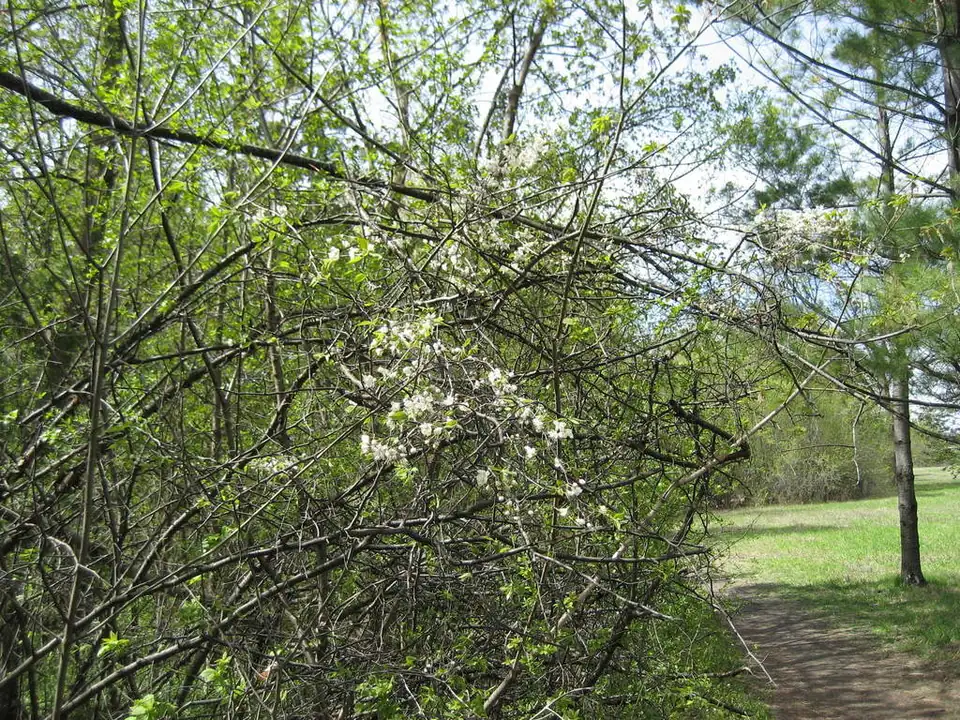
How to Grow and Care for Canadian plum
Prunus nigra
Written by Emilio Marruso · last checked
Toxic to: People · Why
At a glance
The Canada plum rewards you with edible plums in the latter part of August, delicious eaten fresh or turned into preserves and jellies. It asks only for medium watering in evenly moist, well-drained soil, and you can start new trees from cuttings, seed or root sprouts. Just remember to remove the stones before eating: they are poisonous.
- Water
Medium watering; keep the soil evenly moist but well drained
What the sources say (1)
Watering: Medium water requirement; grows best in evenly moist, well-drained soil
Soil Water Requirements: - Medium 244 Soil Notes: Grows best in evenly moist, well-drained soil
— Prunus nigra (Canadian plum) – Purdue Arboretum Explorer [1] - Cold
Survives winters down to −50 °F (−45.6 °C)
Very hardy · USDA 2 · RHS H7 · Z2
- Soil
Slightly alkaline soil, pH 7.2 or higher
What the sources say (1)
Soil pH, minimum: 7.2
Soil pH: Alkaline (pH>7.2) CaCO3 Tolerance: High
— Lady Bird Johnson Wildflower Center - The University of Texas at Austin [5] - Harvest
Plums ripen in late August; eat them fresh or make preserves and jellies
What the sources say (1)
Harvest: Fruit ripens in the latter part of August
The Canada plum’s fruit, which ripens in the latter part of August, is edible.
— PLUM [3] - Pests
Black knot, a fungus that twists and deforms twigs and branches
- Propagation
From cuttings, seed or root sprouts
What the sources say (2)
Propagation: Cuttings (dormant hardwood, softwood, semi-hardwood or root cuttings), seed after cold stratification, root sprouts
Prunus species may be rooted from dormant hardwood, softwood, semi-hardwood, or root cuttings. Semi-hardwood and softwood cuttings taken in summer root easiest. Germination of most seeds requires cold stratification.
— Lady Bird Johnson Wildflower Center - The University of Texas at Austin [5] Thickets are formed from root sprouts. These plums are eaten fresh and made into preserves and jellies.
— Lady Bird Johnson Wildflower Center - The University of Texas at Austin [5] - Sowing
Sow in fall right after picking the seed, or in spring after a cold period
What the sources say (2)
Sowing: Fall, immediately after seed collection; or spring after stratification
Seeds to be sown immediately in fall do not need drying.
— Lady Bird Johnson Wildflower Center - The University of Texas at Austin [5] For spring sowing, stratify seeds in moist sand for 30-60 days in a greenhouse, then cold stratify (36-41 degrees) for 60-90 days. Plant well before high temperatures.
— Lady Bird Johnson Wildflower Center - The University of Texas at Austin [5] - Safety
Eat only the skin and flesh: stones and the rest of the tree are poisonous
Overview
Canada plum is a small, upright-branched deciduous tree of about 20-30 ft [6.1–9.1 m] that forms thickets from root sprouts. [5] Its fruit is eaten fresh and made into preserves and jellies. [5] All parts of the tree except the skin and flesh of the fruit contain hydrocyanic acid. [5]
This record is incomplete: the sources we read do not cover every field yet.
Not yet covered by our sources: Planting, Spacing
Canadian plum care
Measurements in square brackets are our conversion into the other unit system; the quoted text is unchanged.
How to water Canadian plum
Medium water requirement; grows best in evenly moist, well-drained soil
What the sources say (1)
Soil Water Requirements:
- Medium 244
Soil Notes:
Grows best in evenly moist, well-drained soilHow much light Canadian plum needs
The sources give different values depending on region, zone or growing conditions.
What each source says
According to Purdue Arboretum: Full Sun to Partial Shade
According to Lady Bird Johnson Wildflower Center: Part Shade, Shade
According to Minnesota Wildflowers: Part shade, sun
What the sources say (3)
According to Purdue Arboretum: Light Requirements:
- Full Sun to Partial ShadeAccording to Lady Bird Johnson Wildflower Center: Light Requirement: Part Shade , Shade
Soil Moisture: MoistAccording to Minnesota Wildflowers: | Habitat: | part shade, sun; open woods, forest edges and openingsHow much cold Canadian plum can take
Best soil for Canadian plum
7.2
What the sources say (1)
Soil pH: Alkaline (pH>7.2)
CaCO3 Tolerance: HighWhere to grow Canadian plum
Not stated in the sources we read.
How to propagate Canadian plum
Cuttings (dormant hardwood, softwood, semi-hardwood or root cuttings), seed after cold stratification, root sprouts
What the sources say (2)
Prunus species may be rooted from dormant hardwood, softwood, semi-hardwood, or root cuttings. Semi-hardwood and softwood cuttings taken in summer root easiest. Germination of most seeds requires cold stratification.Thickets are formed from root sprouts. These plums are eaten fresh and made into preserves and jellies.How to grow Canadian plum
The plant
Family
Rosaceae
What the sources say (1)
Family:
- Rosaceae (Rose Family) 217
Genus:Canadian plum pests and problems
Black knot
Symptom: Twigs and branches of cherry and plum trees are distorted by the black knot fungus, Apiosporina morbosa
What the sources say (1)
The twigs and branches of cherry and plum trees are distorted by the black knot fungus, Apiosporina morbosa.
— PLUM [3]
Remedies
Each remedy shows what official sources say about it; traditional remedies without an official source are marked as such. Harmful ones are listed so you know to avoid them.
Treating the plant
black knot
pruning out galls in winter Partly works
Warning: Risky ingredient
Fungicides are not recommended, as they are not effective in most situations, and must be used in conjunction with the aforementioned cultural controls anyway.
— hort.extension.wisc.edu [7] How: The branch should be cut 6 to 8 inches below the symptomatic tissue since the fungus grows beyond the edge of the knot itself. Disinfect the pruning tools between cuts (dip in 10% bleach or alcohol solution) and destroy the prunings by burning or burying, or remove from the site, to prevent new infections.
Disease management is focused on removing sources of inoculum. This means monitoring susceptible trees for knots and pruning out any visible knots in the winter, before ascospore discharge begins in the spring.
— hort.extension.wisc.edu [7] What the evidence says Since the galls remain very small the first year and are often overlooked , it may take 2 years of pruning to completely remove all existing infections.
— hort.extension.wisc.edu [7]
Is Canadian plum poisonous?
Reported by the source, quoted verbatim. This is not medical or veterinary advice: if a person or an animal may have eaten this plant, contact a poison control centre or a veterinarian.
CAUTION: Children have died from eating too many plums without removing the stones. As with other plums, all parts of this tree , except the skin and flesh of the fruits, contain the toxin hydrocyanic acid.
[5]
Calendar
Fall, immediately after seed collection; or spring after stratification
What the sources say (2)
Seeds to be sown immediately in fall do not need drying.For spring sowing, stratify seeds in moist sand for 30-60 days in a greenhouse, then cold stratify (36-41 degrees) for 60-90 days. Plant well before high temperatures.Not stated in the sources we read.
Fruit ripens in the latter part of August
What the sources say (1)
The Canada plum’s fruit, which ripens in the latter part of August, is edible.Months as given by the sources, which are mostly from the United States (northern hemisphere). In the southern hemisphere they shift by about six months.
Edibility
Reported by the source, quoted verbatim. Do not eat a plant on the basis of this page alone: identification mistakes can be dangerous.
Indicative values
Values from a secondary source, not checked word for word like the rest of this page. Use them as a starting point.
- Life cycle
- PerennialIndicative value, adapt it to your climate · Secondary source
- Drought tolerant
- yesIndicative value, adapt it to your climate · Secondary source
- Soil
- Sandy, Loamy, ClayIndicative value, adapt it to your climate · Secondary source
- Care level
- MediumIndicative value, adapt it to your climate · Secondary source
- Growth rate
- LowIndicative value, adapt it to your climate · Secondary source
- Pruning
- May, June, JulyIndicative value, adapt it to your climate · Secondary source
Similar plants
- Afghan Cherry Prunus jacquemontii
- American Plum Prunus americana
- Amur chokecherry Prunus maackii
- Apricot Prunus armeniaca
- Bird cherry Prunus padus
- Black Cherry Prunus serotina
- Carolina Cherry Laurel Prunus caroliniana
- Cherry Laurel Prunus laurocerasus
Sources
Every value above is quoted from these documents. Links lead to the original publisher.
- Prunus nigra (Canadian plum) – Purdue Arboretum Explorer · arboretum.purdue.edu, consulted
- Prunus nigra (Canada Plum): Minnesota Wildflowers · minnesotawildflowers.info, consulted
- PLUM · maine.gov, consulted
- Prunus nigra - Trees and Shrubs Online · treesandshrubsonline.org, consulted
- Lady Bird Johnson Wildflower Center - The University of Texas at Austin · wildflower.org, consulted
- Canada plum (Prunus nigra) - Tree Canada · treecanada.ca, consulted
- hort.extension.wisc.edu · hort.extension.wisc.edu
Written by Emilio Marruso · last checked