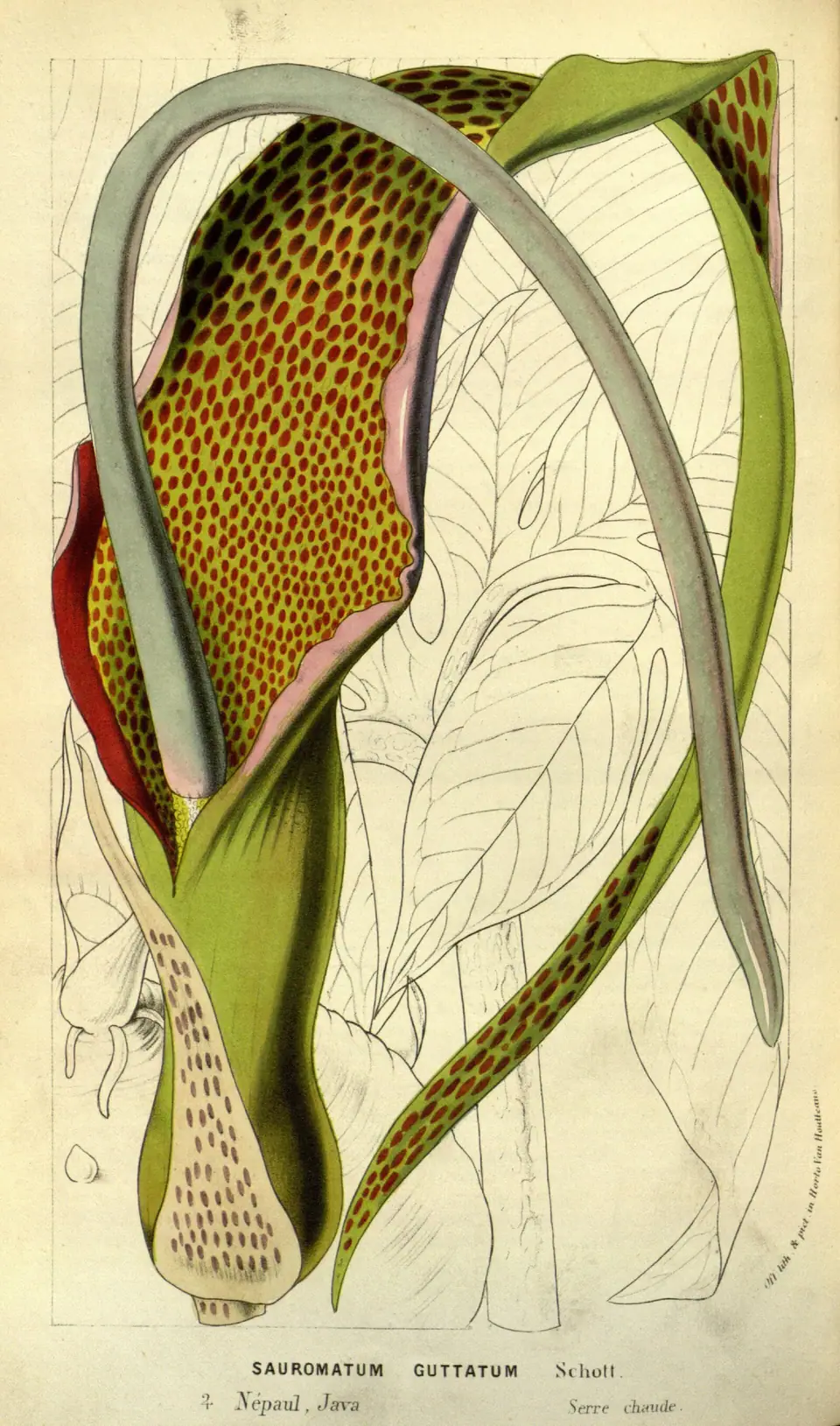

How to Grow and Care for Voodoo Lily
Sauromatum venosum
Written by Emilio Marruso · last checked
At a glance
This perennial from the arum family comes back year after year, so a single planting keeps on giving. You can start new plants from seed or from the offsets that form beside the bulb, then share them with friends. Its one weak spot is bulb rot, so a little care keeps the bulbs healthy and ready to return every season.
- Pests
Watch out for bulb rot
What the sources say (1)
Diseases: bulb rot
Insects, Diseases, and Other Plant Problems: No significant problems. Bulbs can rot if grown in poorly drained soil
— Voodoo Lily - Sauromatum | North Carolina Extension Gardener Plant Toolbox [1]
Overview
Sauromatum venosum grows from a corm that can produce annual offshoots and reach up to 30 inches [76 cm] in height. [4] The plant is dormant in winter and flowers in early spring. [2] The flowers attract flies and give off a strong foul smell. [3]
This record is incomplete: the sources we read do not cover every field yet.
Not yet covered by our sources: Watering, Light, Hardiness, coldest zone, Hardiness, warmest zone, Pruning
Voodoo Lily care
Measurements in square brackets are our conversion into the other unit system; the quoted text is unchanged.
How to water Voodoo Lily
Not stated in the sources we read.
How much light Voodoo Lily needs
Not stated in the sources we read.
How much cold Voodoo Lily can take
Hardiness, coldest zone
Not stated in the sources we read.
Hardiness, warmest zone
Not stated in the sources we read.
How to propagate Voodoo Lily
How to grow Voodoo Lily
The plant
Life cycle
perennial
What the sources say (1)
Plant Type:
Bulb
Herbaceous Perennial
PoisonousFamily
Araceae
What the sources say (1)
This genus consists of about 9 tuberous flowering plants in the arum family (Araceae) that are native to tropical Africa, tropical Asia and the Arabian Peninsula.Pests and diseases
Diseases
bulb rot
What the sources say (1)
Insects, Diseases, and Other Plant Problems: No significant problems. Bulbs can rot if grown in poorly drained soilRemedies
Each remedy shows what official sources say about it; traditional remedies without an official source are marked as such. Harmful ones are listed so you know to avoid them.
First aid
First aid: not a substitute for a doctor
calcium oxalate ingestion
wipe out the mouth and offer a cool drink or snack Official source, not independently tested
If there is swelling that prevents the child taking anything by mouth or causes difficulty breathing, go to the nearest emergency department immediately.
— chop.edu [5] How: If a child eats any part of an oxalate-containing plant, wipe out the residue of the plant from the mouth and offer a cool drink or snack such as a popsicle, applesauce or yogurt.
If a child eats any part of an oxalate-containing plant, wipe out the residue of the plant from the mouth and offer a cool drink or snack such as a popsicle, applesauce or yogurt.
— chop.edu [5]
Treating the plant
bulb rot
perlite or coarse sand in the potting soil Not verified
Traditional remedy, not verified by an official source.
How: If worried about overwatering, mix perlite and/or coarse sand into the potting soil to improve drainage.
no watering during winter dormancy Not verified
Traditional remedy, not verified by an official source.
How: Do not water it at all during the winter while it’s dormant; consistent overwatering can cause the bulb to rot.
Calendar
Pruning
Not stated in the sources we read.
Months as given by the sources, which are mostly from the United States (northern hemisphere). In the southern hemisphere they shift by about six months.
Indicative values
Values from a secondary source, not checked word for word like the rest of this page. Use them as a starting point.
- Mature height
- 61-76.2 cm (2-2.5 ft)Indicative value, adapt it to your climate · Secondary source
- Light
- Part shadeIndicative value, adapt it to your climate · Secondary source
- Hours of sun
- 4-6 hoursIndicative value, adapt it to your climate · Secondary source
- Watering
- AverageIndicative value, adapt it to your climate · Secondary source
- Drought tolerant
- yesIndicative value, adapt it to your climate · Secondary source
- Soil pH
- 6-7Indicative value, adapt it to your climate · Secondary source
- USDA hardiness zones
- 6-10 [winter low −23.3 to 4.4 °C (−10 to 40 °F)]Indicative value, adapt it to your climate · Secondary source
- Care level
- MediumIndicative value, adapt it to your climate · Secondary source
- Growth rate
- HighIndicative value, adapt it to your climate · Secondary source
- Pruning
- August, March, AprilIndicative value, adapt it to your climate · Secondary source
Similar plants
- Anthurium Anthurium andraeanum
- Arrowleaf elephant's ear Xanthosoma sagittifolium
- Arum Arum maculatum
- Black Calla Arum palaestinum
- Caladium Caladium bicolor
- Calla Lily Zantedeschia aethiopica
- Chinese Evergreen Aglaonema commutatum
- Cobra Lily Arisaema ringens
Sources
Every value above is quoted from these documents. Links lead to the original publisher.
- Voodoo Lily - Sauromatum | North Carolina Extension Gardener Plant Toolbox · plants.ces.ncsu.edu, consulted
- Sauromatum | Pacific Bulb Society · pacificbulbsociety.org, consulted
- International Aroid Society · aroid.org, consulted
- Voodoo Lily (Sauromatum venosum) | Connecticut's Beardsley Zoo · beardsleyzoo.org, consulted
- chop.edu · chop.edu
Written by Emilio Marruso · last checked