
How to Grow and Care for Arrowleaf elephant's ear
Xanthosoma sagittifolium
Written by Emilio Marruso · last checked
Toxic to: People · Why
At a glance
Tannia is a generous crop: its tubers are delicious roasted or boiled, and the young leaves can be eaten like spinach. Plant pieces of the corm in spring, after the last frost, give it at least 1 inch of water a week, and keep weeds away for the first 6 months. Just remember to always cook the tubers well.
- Water
At least 1 inch of water a week; water and weed well for the first 6 months
What the sources say (2)
Watering: Minimum 2.54 cm per week (1 in/week)
Requisito de agua: mínimo 2.54 cm / semana (1 pulgada/semana). CUIDADOS DEL CULTIVO El control del agua y las malezas es fundamental durante los primeros 6 meses.
— MALANGA [8] Watering notes: Water and weed control are essential during the first 6 months
CUIDADOS DEL CULTIVO El control del agua y las malezas es fundamental durante los primeros 6 meses.
— MALANGA [8] - Soil
Acidic to neutral soil, pH 5.5–7.0
- Spacing
16–24 in between plants, 3–4 ft between rows
What the sources say (1)
Spacing: 90-130 cm between rows (0.9 to 1.3 m) and 40-60 cm between plants (15.7 to 23.6 in)
La distancia de siembra es de 0.9 a 1.3m (3 a 4.4 pies) entre hileras y de 40 a 60 cm (15.7 a 23.6 pulgadas) entre plantas.
— MALANGA [8] - Planting
Plant in spring, after the last frost
What the sources say (1)
Planting: Spring, after the last frost
PERIODO Primavera (después de la última helada) PROPAGACIÓN Establecer por propagación vegetativa ya que la formación de semillas es muy rara.
— MALANGA [8] - Harvest
Eat the tubers roasted or boiled; cook young leaves like spinach
- Pests
Root rot, dry rot and leaf blight; rotate with other crops to keep them away
- Propagation
Plant pieces of the main corm or the small side corms; it almost never makes seeds
What the sources say (2)
Propagation: Vegetatively, from pieces of the central corm or from cormels; seed formation is very rare
Establecer por propagación vegetativa ya que la formación de semillas es muy rara. Se desarrollan más rápido con el uso del cormo central o palmillo como material de propagación.
— MALANGA [8] Propagated vegetatively so that numerous cultivars exist
— Xanthosoma sagittifolium (XATSA)[Overview]| EPPO Global Database [1] - Safety
Never eat the tubers raw: cook them well first
Overview
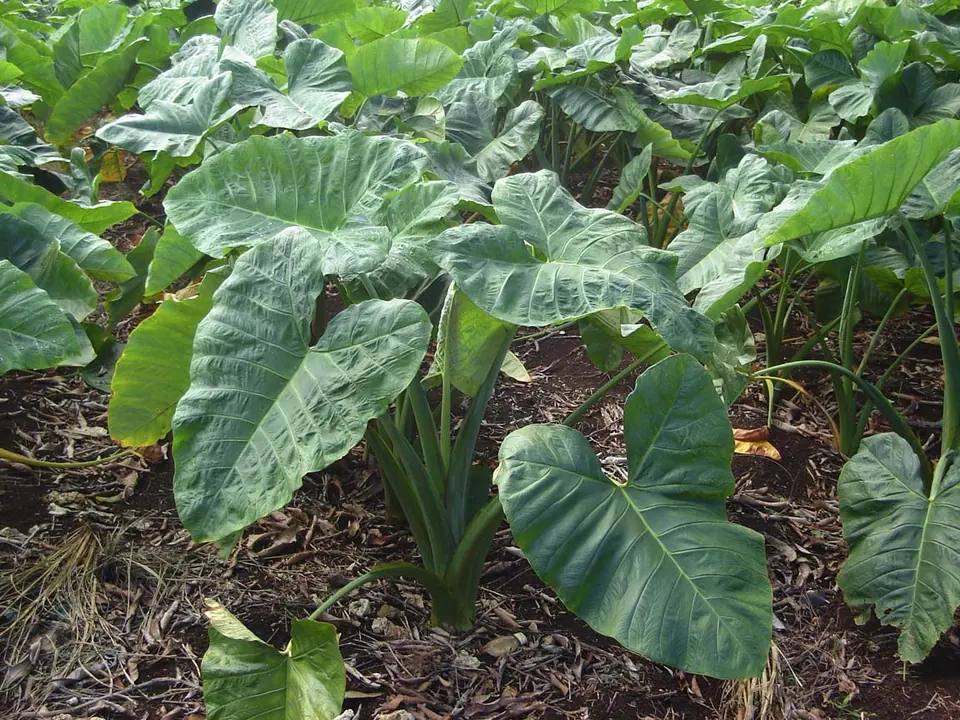
Xanthosoma sagittifolium is cultivated for its edible tubers and is propagated vegetatively. [1] It is the most widely grown Xanthosoma species for both ornament and food. [7] The tubers contain calcium oxalate and must be cooked thoroughly before eating. [7]
This record is incomplete: the sources we read do not cover every field yet.
Not yet covered by our sources: Light, Harvest
Arrowleaf elephant's ear care
How to water Arrowleaf elephant's ear
Watering
Minimum 2.54 cm per week (1 in/week)
What the sources say (1)
Requisito de agua: mínimo 2.54 cm / semana (1 pulgada/semana). CUIDADOS DEL CULTIVO El control del agua y las malezas es fundamental durante los primeros 6 meses.Watering notes
Water and weed control are essential during the first 6 months
What the sources say (1)
CUIDADOS DEL CULTIVO El control del agua y las malezas es fundamental durante los primeros 6 meses.How much light Arrowleaf elephant's ear needs
Not stated in the sources we read.
Best soil for Arrowleaf elephant's ear
Soil pH, minimum
5.5
What the sources say (1)
pH del suelo: ácido a neutro (5.5-7.0). Temperatura: debe superar los 20°C.Soil pH, maximum
7.0
What the sources say (1)
pH del suelo: ácido a neutro (5.5-7.0). Temperatura: debe superar los 20°C.Where to grow Arrowleaf elephant's ear
90-130 cm between rows (0.9 to 1.3 m) and 40-60 cm between plants (15.7 to 23.6 in)
What the sources say (1)
La distancia de siembra es de 0.9 a 1.3m (3 a 4.4 pies) entre hileras y de 40 a 60 cm (15.7 a 23.6 pulgadas) entre plantas.How to propagate Arrowleaf elephant's ear
Vegetatively, from pieces of the central corm or from cormels; seed formation is very rare
What the sources say (2)
Establecer por propagación vegetativa ya que la formación de semillas es muy rara. Se desarrollan más rápido con el uso del cormo central o palmillo como material de propagación.Propagated vegetatively so that numerous cultivars existHow to grow Arrowleaf elephant's ear
The plant
Family
Araceae
What the sources say (1)
Order
Alismatales (
1ALIO )
Family
Araceae (
1ARMF )
Subfamily
AroideaeArrowleaf elephant's ear pests and problems
Root rot blight complex (Pythium, Rhizoctonia, Fusarium)
Symptom: Listed among the diseases of the crop: dry rot, Phytophthora leaf blight and a root-rot blight complex caused by Pythium spp., Rhizoctonia spp. and Fusarium spp.
What to do: Rotate with other crops to minimise pests and diseases
Remedies
Each remedy shows what official sources say about it; traditional remedies without an official source are marked as such. Harmful ones are listed so you know to avoid them.
First aid
First aid: not a substitute for a doctor
contact with plant sap or eating parts of the plant
wash off sap and rinse eyes Official source, not independently tested
Do not make the person throw up unless poison control or a health care provider tells you to.
— medlineplus.gov [9] call the local emergency number (such as 911), or the local poison control center can be reached directly by calling the national toll-free Poison Help hotline
— medlineplus.gov [9] How: Wipe out the mouth with a cold, wet cloth. Wash off any plant sap on the skin. Rinse out the eyes.
Wipe out the mouth with a cold, wet cloth. Wash off any plant sap on the skin. Rinse out the eyes.
— medlineplus.gov [9]
Getting rid of it
unwanted spread of the plant
digging corms fully out of the soil Official source, not independently tested
The leaves contain oxalic acid, which can cause irritation and allergic reaction to skin.
— plant-directory.ifas.ufl.edu [10] How: Dig corms fully out of soil.
Cultural/Physical Replace in the landscape with native plants. Dig corms fully out of soil.
— plant-directory.ifas.ufl.edu [10]
Is Arrowleaf elephant's ear poisonous?
Reported by the source, quoted verbatim. This is not medical or veterinary advice: if a person or an animal may have eaten this plant, contact a poison control centre or a veterinarian.
Calendar
Planting
Spring, after the last frost
What the sources say (1)
PERIODO Primavera (después de la última helada) PROPAGACIÓN Establecer por propagación vegetativa ya que la formación de semillas es muy rara.Harvest
Not stated in the sources we read.
Months as given by the sources, which are mostly from the United States (northern hemisphere). In the southern hemisphere they shift by about six months.
Edibility
Reported by the source, quoted verbatim. Do not eat a plant on the basis of this page alone: identification mistakes can be dangerous.
Indicative values
Values from a secondary source, not checked word for word like the rest of this page. Use them as a starting point.
- Life cycle
- PerennialIndicative value, adapt it to your climate · Secondary source
- Mature height
- 61-121.9 cm (2-4 ft)Indicative value, adapt it to your climate · Secondary source
- Light
- part shade, part sun/part shadeIndicative value, adapt it to your climate · Secondary source
- Hours of sun
- 4-6 hoursIndicative value, adapt it to your climate · Secondary source
- Drought tolerant
- yesIndicative value, adapt it to your climate · Secondary source
- USDA hardiness zones
- 8-10 [winter low −12.2 to 4.4 °C (10 to 40 °F)]Indicative value, adapt it to your climate · Secondary source
- Care level
- MediumIndicative value, adapt it to your climate · Secondary source
- Growth rate
- LowIndicative value, adapt it to your climate · Secondary source
- Pruning
- March, April, May, September, October, NovemberIndicative value, adapt it to your climate · Secondary source
Similar plants
- Anthurium Anthurium andraeanum
- Arum Arum maculatum
- Black Calla Arum palaestinum
- Caladium Caladium bicolor
- Calla Lily Zantedeschia aethiopica
- Chinese Evergreen Aglaonema commutatum
- Cobra Lily Arisaema ringens
- Common Duckweed Lemna minor
Sources
Every value above is quoted from these documents. Links lead to the original publisher.
- Xanthosoma sagittifolium (XATSA)[Overview]| EPPO Global Database · gd.eppo.int, consulted
- Xanthosoma violaceum Schott | Plants of the World Online | Kew Science · powo.science.kew.org, consulted
- Ethnobotanical Plant Xanthosoma sagittifolium | Dr. Duke's Phytochemical and Ethnobotanical Databases · phytochem.nal.usda.gov, consulted
- View crop · ecocrop.apps.fao.org, consulted
- Data sheet · ecocrop.apps.fao.org, consulted
- Flora of New Zealand | Taxon Profile | Xanthosoma sagittifolium · nzflora.info, consulted
- How to Grow and Care for Elephant Ears (Xanthosoma) - Garden.org · garden.org, consulted
- MALANGA · pvamu.edu, consulted
- medlineplus.gov · medlineplus.gov
- plant-directory.ifas.ufl.edu · plant-directory.ifas.ufl.edu
Written by Emilio Marruso · last checked