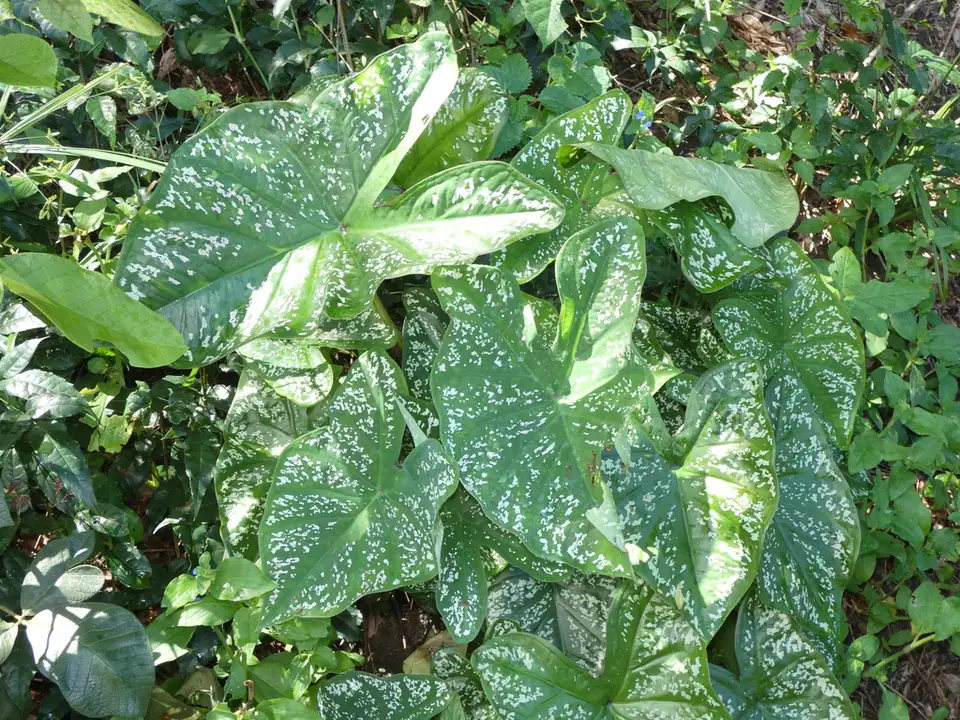
How to Grow and Care for Caladium
Caladium bicolor
Written by Emilio Marruso · last checked
Toxic to: Cats, Dogs, Horses, Livestock, People · Why
At a glance
Caladium is a tender perennial grown from tubers, and it is happy in containers and even indoors. Plant the tubers 1½–2 inches deep, keep the soil moist all summer and feed it regularly while it grows. In fall, dig up the tubers, let them dry and store them warm, above 50 °F, ready to plant again next season.
- Water
Plenty of water while growing; keep the soil moist, especially all summer
What the sources say (2)
Watering: Requires abundant water when growing; keep soils moist, especially throughout the summer
It is a water guzzler and requires abundant amounts of water when growing.
— Caladium bicolor (Angel Wings, Caladium, Candidum, Elephant's Ears, Exposition, Fancy-leaved Caladium, Mother-in-law Plant, Pai, Pink Cloud, Stoplight, Texas Wonder, Via, Via sori) | North Carolina Extension Gardener Plant Toolbox [1] Keep soils moist, especially throughout the summer, and fertilize regularly during the growing season.
— Caladium bicolor (Angel Wings, Caladium, Candidum, Elephant's Ears, Exposition, Fancy-leaved Caladium, Mother-in-law Plant, Pai, Pink Cloud, Stoplight, Texas Wonder, Via, Via sori) | North Carolina Extension Gardener Plant Toolbox [1] - Cold
Survives winters down to 20 °F (−6.7 °C)
Hardy in average winters · USDA 9a · RHS H4 · Z9
What the sources say (2)
Hardiness, coldest zone: 9a [winter low −6.7 to −3.9 °C (20 to 25 °F)]
USDA Plant Hardiness Zone: 9a, 9b, 10a, 10b
— Caladium bicolor (Angel Wings, Caladium, Candidum, Elephant's Ears, Exposition, Fancy-leaved Caladium, Mother-in-law Plant, Pai, Pink Cloud, Stoplight, Texas Wonder, Via, Via sori) | North Carolina Extension Gardener Plant Toolbox [1] Hardiness, warmest zone: 10b [winter low 1.7 to 4.4 °C (35 to 40 °F)]
USDA Plant Hardiness Zone: 9a, 9b, 10a, 10b
— Caladium bicolor (Angel Wings, Caladium, Candidum, Elephant's Ears, Exposition, Fancy-leaved Caladium, Mother-in-law Plant, Pai, Pink Cloud, Stoplight, Texas Wonder, Via, Via sori) | North Carolina Extension Gardener Plant Toolbox [1] - Soil
Acidic soil, pH up to 6.0, with plenty of compost mixed in before planting
What the sources say (2)
Soil pH, maximum: 6.0
Soil Texture: High Organic Matter Soil pH: Acid (<6.0) Soil Drainage:
— Caladium bicolor (Angel Wings, Caladium, Candidum, Elephant's Ears, Exposition, Fancy-leaved Caladium, Mother-in-law Plant, Pai, Pink Cloud, Stoplight, Texas Wonder, Via, Via sori) | North Carolina Extension Gardener Plant Toolbox [1] Natural fertilizers: Plenty of compost or other organic material worked into most soils before planting
Caladiums prefer a moist, fertile, well-drained soil , so it is best to amend most soils with plenty of compost or other organic material.
— Caladiums – Wisconsin Horticulture [2] - Feeding
Feed regularly while it grows, balanced or low in nitrogen; keep fertilizer off the leaves
What the sources say (11)
When: Regularly during the growing season
Keep soils moist, especially throughout the summer, and fertilize regularly during the growing season.
— Caladium bicolor (Angel Wings, Caladium, Candidum, Elephant's Ears, Exposition, Fancy-leaved Caladium, Mother-in-law Plant, Pai, Pink Cloud, Stoplight, Texas Wonder, Via, Via sori) | North Carolina Extension Gardener Plant Toolbox [1] Caladiums are heavy feeders so need regular fertilization during the growing season , especially container-grown plants.
— Caladiums – Wisconsin Horticulture [2] Mineral fertilizers: Low-nitrogen or balanced fertilizer, not too high in phosphorus
in containers: Fertilize caladiums growing in containers every two weeks with a liquid soluble fertilizer to promote strong foliage growth
— Caladium | Home & Garden Information Center [7] in containers, time-release option: Another fertilizer option is to use a 6-month time-release fertilizer
— Caladium | Home & Garden Information Center [7] in the ground, without a soil test: In the absence of a soil test, use a 12-6-6 fertilizer every six weeks.
— Caladium | Home & Garden Information Center [7] in the ground, on soils naturally high in phosphorus: The coastal areas of South Carolina tend to have soils naturally high in phosphorus. In that case, use a 15-0-15 fertilizer without phosphorus.
— Caladium | Home & Garden Information Center [7] Use a low-nitrogen or balanced formulation, as too much nitrogen can affect leaf color.
— Caladiums – Wisconsin Horticulture [2] Caution should be taken not to use a fertilizer too high in phosphorous, the middle number of the fertilizer analysis.
— Caladium | Home & Garden Information Center [7] Avoid: Too much nitrogen (affects leaf color), fertilizer too high in phosphorus, fertilizer left on the leaves
Use a low-nitrogen or balanced formulation, as too much nitrogen can affect leaf color.
— Caladiums – Wisconsin Horticulture [2] Caution should be taken not to use a fertilizer too high in phosphorous, the middle number of the fertilizer analysis.
— Caladium | Home & Garden Information Center [7] The burning of the edges of older leaves and scorching of leaves usually result from fertilizer touching the leaves; therefore, always wash off any fertilizer that may be on the leaves.
— Caladium | Home & Garden Information Center [7] - Pests
Slugs and snails; tuber rot and leaf spot
What the sources say (3)
Pests: slugs, snails
No serious insect or disease problems. Slugs and snails may damage foliage.
— Caladium bicolor (Angel Wings, Caladium, Candidum, Elephant's Ears, Exposition, Fancy-leaved Caladium, Mother-in-law Plant, Pai, Pink Cloud, Stoplight, Texas Wonder, Via, Via sori) | North Carolina Extension Gardener Plant Toolbox [1] Diseases: tuber rot, leaf spot
Tuber rot is a fungal decay of tubers in storage or during the growing season therefore select; disease-free tubers for planting.
— Caladium | Home & Garden Information Center [7] Leaf spot causes lower leaves to develop light tan to brown spots.
— Caladium | Home & Garden Information Center [7] - Watch out
Wind and hail can damage the fragile leaves
- Size
1–2 ft tall and 1–2½ ft wide
What the sources say (2)
Mature height: 30.5-61 cm (1 ft - 2 ft)
Dimensions: Height: 1 ft. 0 in. - 2 ft. 0 in. Width: 1 ft. 0 in. - 2 ft. 6 in.
— Caladium bicolor (Angel Wings, Caladium, Candidum, Elephant's Ears, Exposition, Fancy-leaved Caladium, Mother-in-law Plant, Pai, Pink Cloud, Stoplight, Texas Wonder, Via, Via sori) | North Carolina Extension Gardener Plant Toolbox [1] Mature width: 30.5-76.2 cm (1 ft - 2 ft 6 in)
Dimensions: Height: 1 ft. 0 in. - 2 ft. 0 in. Width: 1 ft. 0 in. - 2 ft. 6 in.
— Caladium bicolor (Angel Wings, Caladium, Candidum, Elephant's Ears, Exposition, Fancy-leaved Caladium, Mother-in-law Plant, Pai, Pink Cloud, Stoplight, Texas Wonder, Via, Via sori) | North Carolina Extension Gardener Plant Toolbox [1] - Propagation
Grows from tubers planted 1½–2 in deep; in fall, dig and store them dry and warm
What the sources say (4)
Propagation: Tubers
It is propagated by tubers, and the tubers must be dug up and stored over winter.
— Caladium bicolor (Angel Wings, Caladium, Candidum, Elephant's Ears, Exposition, Fancy-leaved Caladium, Mother-in-law Plant, Pai, Pink Cloud, Stoplight, Texas Wonder, Via, Via sori) | North Carolina Extension Gardener Plant Toolbox [1] Sowing depth: 3.8-5.1 cm (1½ to 2 in), planting depth of the tuber
Tubers should be planted 1½ to 2 inches deep and 8 to 14 inches apart with the eyes (buds) pointing up.
— Caladium | Home & Garden Information Center [7] Storage: Dig the tubers in fall, dry them for one to two weeks, pack them in dry peat moss, perlite or vermiculite without touching each other, and keep them dry and warm above 10 °C (50 °F)
Save caladium tubers for planting next year by digging the tubers in the fall before the leaves have lost all color. Spread them out and allow them to dry for one to two weeks.
— Caladium | Home & Garden Information Center [7] Cut or pull the dry foliage from the tuber remove all dry soil, and pack in dry peat moss, perlite, or vermiculite for storage. To prevent rot, the tubers should not touch each other. Store them in a dry, warm place where the temperature will not drop below 50 °F.
— Caladium | Home & Garden Information Center [7] - Containers
Grows well in containers and indoors too
What the sources say (3)
In containers: Yes
A tender perennial summer flowering bulb often grown as an annual bedding, container plant, houseplant, or Acaulescent herb grown for its colorful, arrowhead-shaped leaves
— Caladium bicolor (Angel Wings, Caladium, Candidum, Elephant's Ears, Exposition, Fancy-leaved Caladium, Mother-in-law Plant, Pai, Pink Cloud, Stoplight, Texas Wonder, Via, Via sori) | North Carolina Extension Gardener Plant Toolbox [1] It tolerates deep shade and gives a tropical feel to container gardens and borders.
— Caladium bicolor (Angel Wings, Caladium, Candidum, Elephant's Ears, Exposition, Fancy-leaved Caladium, Mother-in-law Plant, Pai, Pink Cloud, Stoplight, Texas Wonder, Via, Via sori) | North Carolina Extension Gardener Plant Toolbox [1] Indoors: Yes
A tender perennial summer flowering bulb often grown as an annual bedding, container plant, houseplant, or Acaulescent herb grown for its colorful, arrowhead-shaped leaves
— Caladium bicolor (Angel Wings, Caladium, Candidum, Elephant's Ears, Exposition, Fancy-leaved Caladium, Mother-in-law Plant, Pai, Pink Cloud, Stoplight, Texas Wonder, Via, Via sori) | North Carolina Extension Gardener Plant Toolbox [1] - Safety
Poisonous to people, cats, dogs and horses; the sap can irritate the skin
Overview
Caladium bicolor is a tender perennial summer-flowering bulb grown for its colorful, arrowhead-shaped leaves. [1] Ingestion can cause burning and swelling of lips, mouth and tongue, and contact with the sap can cause skin irritation. [1]
This record is incomplete: the sources we read do not cover every field yet.
Not yet covered by our sources: Pruning
Caladium care
Measurements in square brackets are our conversion into the other unit system; the quoted text is unchanged.
How to water Caladium
Requires abundant water when growing; keep soils moist, especially throughout the summer
What the sources say (2)
It is a water guzzler and requires abundant amounts of water when growing.Keep soils moist, especially throughout the summer, and fertilize regularly during the growing season.How much light Caladium needs
The sources give different values depending on region, zone or growing conditions.
What each source says
According to NC State Extension: Partial shade to deep shade
cooler, northern areas: Part to full sun (newer sun-tolerant varieties)
the South: Dappled or moderate shade with protection from the hot afternoon sun
What the sources say (4)
According to NC State Extension: Light:
Deep shade (Less than 2 hours to no direct sunlight)
Partial Shade (Direct sunlight only part of the day, 2-6 hours)cooler, northern areas: Newer, sun-tolerant varieties can be grown in part to full sun , especially in cooler, northern areas.the South: but all prefer dappled or moderate shade with protection from the hot afternoon sun.Light:
Deep shade (Less than 2 hours to no direct sunlight)
Partial Shade (Direct sunlight only part of the day, 2-6 hours)How much cold Caladium can take
Hardiness, coldest zone
9a [winter low −6.7 to −3.9 °C (20 to 25 °F)]
What the sources say (1)
USDA Plant Hardiness Zone:
9a, 9b, 10a, 10bHardiness, warmest zone
10b [winter low 1.7 to 4.4 °C (35 to 40 °F)]
What the sources say (1)
USDA Plant Hardiness Zone:
9a, 9b, 10a, 10bBest soil for Caladium
6.0
What the sources say (1)
Soil Texture:
High Organic Matter
Soil pH:
Acid (<6.0)
Soil Drainage:Where to grow Caladium
Indoors
Yes
What the sources say (1)
A tender perennial summer flowering bulb often grown as an annual bedding, container plant, houseplant, or Acaulescent herb grown for its colorful, arrowhead-shaped leavesIn containers
Yes
What the sources say (2)
A tender perennial summer flowering bulb often grown as an annual bedding, container plant, houseplant, or Acaulescent herb grown for its colorful, arrowhead-shaped leavesIt tolerates deep shade and gives a tropical feel to container gardens and borders.Spacing
The sources give different values depending on region, zone or growing conditions.
What each source says
According to NC State Extension: 20.3-30.5 cm (8-12 in)
According to Clemson Extension: 20.3-35.6 cm (8-14 in)
What the sources say (2)
According to NC State Extension: You should plant them 8 to 12 inches apartAccording to Clemson Extension: Tubers should be planted 1½ to 2 inches deep and 8 to 14 inches apart with the eyes (buds) pointing up.How to propagate Caladium
Tubers
What the sources say (1)
It is propagated by tubers, and the tubers must be dug up and stored over winter.How to grow Caladium
The plant
Life cycle
perennial (tender; often grown as an annual)
What the sources say (1)
Caladiums are tender, tropical perennials with colorful, heart-shaped leaves native to forests in South and Central AmericaFamily
Araceae
What the sources say (1)
Caladium bicolor , a Brazilian species, is the most common of several species in this genus in the arum family (Araceae)Mature height
30.5-61 cm (1 ft - 2 ft)
What the sources say (1)
Dimensions: Height: 1 ft. 0 in. - 2 ft. 0 in. Width: 1 ft. 0 in. - 2 ft. 6 in.Mature width
30.5-76.2 cm (1 ft - 2 ft 6 in)
What the sources say (1)
Dimensions: Height: 1 ft. 0 in. - 2 ft. 0 in. Width: 1 ft. 0 in. - 2 ft. 6 in.Sowing and growth
Sowing depth
3.8-5.1 cm (1½ to 2 in), planting depth of the tuber
What the sources say (1)
Tubers should be planted 1½ to 2 inches deep and 8 to 14 inches apart with the eyes (buds) pointing up.Harvest and storage
Storage
Dig the tubers in fall, dry them for one to two weeks, pack them in dry peat moss, perlite or vermiculite without touching each other, and keep them dry and warm above 10 °C (50 °F)
What the sources say (2)
Save caladium tubers for planting next year by digging the tubers in the fall before the leaves have lost all color. Spread them out and allow them to dry for one to two weeks.Cut or pull the dry foliage from the tuber remove all dry soil, and pack in dry peat moss, perlite, or vermiculite for storage. To prevent rot, the tubers should not touch each other. Store them in a dry, warm place where the temperature will not drop below 50 °F.Pests and diseases
Pests
slugs, snails
What the sources say (1)
No serious insect or disease problems. Slugs and snails may damage foliage.Diseases
tuber rot, leaf spot
What the sources say (2)
Tuber rot is a fungal decay of tubers in storage or during the growing season therefore select; disease-free tubers for planting.Leaf spot causes lower leaves to develop light tan to brown spots.Fertilizing
When
Regularly during the growing season
What the sources say (2)
Keep soils moist, especially throughout the summer, and fertilize regularly during the growing season.Caladiums are heavy feeders so need regular fertilization during the growing season , especially container-grown plants.How often
The sources give different values depending on region, zone or growing conditions.
What each source says
in containers: Every two weeks with a liquid soluble fertilizer
in the ground, without a soil test: Every six weeks
What the sources say (2)
in containers: Fertilize caladiums growing in containers every two weeks with a liquid soluble fertilizer to promote strong foliage growthin the ground, without a soil test: In the absence of a soil test, use a 12-6-6 fertilizer every six weeks.Natural fertilizers
Plenty of compost or other organic material worked into most soils before planting
What the sources say (1)
Caladiums prefer a moist, fertile, well-drained soil , so it is best to amend most soils with plenty of compost or other organic material.Mineral fertilizers
Low-nitrogen or balanced fertilizer, not too high in phosphorus
What each source says
in containers: Liquid soluble fertilizer every two weeks
in containers, time-release option: A 6-month time-release fertilizer
in the ground, without a soil test: 12-6-6 every six weeks
in the ground, on soils naturally high in phosphorus: 15-0-15 without phosphorus
What the sources say (6)
in containers: Fertilize caladiums growing in containers every two weeks with a liquid soluble fertilizer to promote strong foliage growthin containers, time-release option: Another fertilizer option is to use a 6-month time-release fertilizerin the ground, without a soil test: In the absence of a soil test, use a 12-6-6 fertilizer every six weeks.in the ground, on soils naturally high in phosphorus: The coastal areas of South Carolina tend to have soils naturally high in phosphorus. In that case, use a 15-0-15 fertilizer without phosphorus.Use a low-nitrogen or balanced formulation, as too much nitrogen can affect leaf color.Caution should be taken not to use a fertilizer too high in phosphorous, the middle number of the fertilizer analysis.Avoid
Too much nitrogen (affects leaf color), fertilizer too high in phosphorus, fertilizer left on the leaves
What the sources say (3)
Use a low-nitrogen or balanced formulation, as too much nitrogen can affect leaf color.Caution should be taken not to use a fertilizer too high in phosphorous, the middle number of the fertilizer analysis.The burning of the edges of older leaves and scorching of leaves usually result from fertilizer touching the leaves; therefore, always wash off any fertilizer that may be on the leaves.Signs of excess
Altered leaf color from too much nitrogen; burned edges of older leaves and leaf scorch where fertilizer touches the leaves
What the sources say (2)
Use a low-nitrogen or balanced formulation, as too much nitrogen can affect leaf color.The burning of the edges of older leaves and scorching of leaves usually result from fertilizer touching the leavesCaladium pests and problems
Slugs and snails
Symptom: May damage foliage.
What to do: Not given in the sources.
What the sources say (1)
No serious insect or disease problems. Slugs and snails may damage foliage.
— Caladium bicolor (Angel Wings, Caladium, Candidum, Elephant's Ears, Exposition, Fancy-leaved Caladium, Mother-in-law Plant, Pai, Pink Cloud, Stoplight, Texas Wonder, Via, Via sori) | North Carolina Extension Gardener Plant Toolbox [1] Wind and hail damage
Symptom: Fragile leaves can be damaged by wind or hail.
What to do: Not given in the sources.
What the sources say (1)
Slugs and snails may damage foliage. Fragile leaves can be damaged by wind or hail.
— Caladium bicolor (Angel Wings, Caladium, Candidum, Elephant's Ears, Exposition, Fancy-leaved Caladium, Mother-in-law Plant, Pai, Pink Cloud, Stoplight, Texas Wonder, Via, Via sori) | North Carolina Extension Gardener Plant Toolbox [1] Leaf die-back indoors
Symptom: Difficult to grow as interior landscape plants as leaves die back during winter.
What to do: Not given in the sources.
What the sources say (1)
Difficult to grow as interior landscape plants as leaves die back during winter
— Caladium bicolor (Angel Wings, Caladium, Candidum, Elephant's Ears, Exposition, Fancy-leaved Caladium, Mother-in-law Plant, Pai, Pink Cloud, Stoplight, Texas Wonder, Via, Via sori) | North Carolina Extension Gardener Plant Toolbox [1]
Remedies
Each remedy shows what official sources say about it; traditional remedies without an official source are marked as such. Harmful ones are listed so you know to avoid them.
First aid
First aid: not a substitute for a doctor
ingestion
wipe mouth and give milk Official source, not independently tested
give the person milk to drink. Call poison control for more treatment information.
— medlineplus.gov [9] How: If the plant was eaten, wipe out the mouth with a cold, wet cloth, and give the person milk to drink.
If the plant was eaten, wipe out the mouth with a cold, wet cloth, and give the person milk to drink.
— medlineplus.gov [9]
eye or skin contact
rinse with water Official source, not independently tested
How: If the eyes or skin touched the plant, rinse them well with water.
If the eyes or skin touched the plant, rinse them well with water.
— medlineplus.gov [9]
Treating the plant
aphids
hose spray Works
How: Wash them off with the hose.
Aphids can be bothersome, although they generally do not pose real threats to the plants. Wash them off with the hose or, if necessary, use horticultural soap or neem oil to control them.
— gardeningknowhow.com [10] What the evidence says During warm weather, take infested plants outside and hose them off with a stream of water.
— extension.missouri.edu [11] horticultural soap Works
How: If necessary, use horticultural soap to control them.
Aphids can be bothersome, although they generally do not pose real threats to the plants. Wash them off with the hose or, if necessary, use horticultural soap or neem oil to control them.
— gardeningknowhow.com [10] What the evidence says Apply an insecticidal soap. - Use the botanical insecticides pyrethrins or neem.
— extension.missouri.edu [11] neem oil Works
How: If necessary, use neem oil to control them.
Aphids can be bothersome, although they generally do not pose real threats to the plants. Wash them off with the hose or, if necessary, use horticultural soap or neem oil to control them.
— gardeningknowhow.com [10] What the evidence says Apply an insecticidal soap. - Use the botanical insecticides pyrethrins or neem.
— extension.missouri.edu [11]
caterpillars
hand picking Not verified
Traditional remedy, not verified by an official source.
How: If you see ragged margins on foliage, look for the creatures and hand pick them off the plants.
tuber rot fungi
hot water tuber soak Not verified
Traditional remedy, not verified by an official source.
How: Immerse the tubers in water heated to 122 degrees Fahrenheit (50 C.) prior to planting or storing, for 30 minutes; make sure the tubers thoroughly dry.
slugs and snails
crushed eggshells barrier Not verified
Traditional remedy, not verified by an official source.
How: Wash and dry the peels well, grind them into small pieces, distribute around the base of plants; renew after rain.
Is Caladium toxic to pets?
Reported by the source, quoted verbatim. This is not medical or veterinary advice: if a person or an animal may have eaten this plant, contact a poison control centre or a veterinarian.
Animals
contact with cell sap can cause skin irritation. Ingestion by livestock or pets may cause death.
[1]- Poisonous parts
Poison Part: Bark Flowers Fruits Leaves Roots Sap/Juice
[1]- Toxic principle
Poison Toxic Principle: Calcium oxalate crystals and unidentified compounds
[1]- Symptoms
Burning and swelling of lips, mouth, tongue; also nausea, vomiting, and diarrhea may occur
[1]- Severity
Poison Severity: Medium
[1]
Problems: Poisonous to Humans Problem for Cats Problem for Children Problem for Dogs Problem for Horses
[1]- Poisonous parts
Poison Part: Bark Flowers Fruits Leaves Roots Sap/Juice
[1]- Toxic principle
Poison Toxic Principle: Calcium oxalate crystals and unidentified compounds
[1]- Symptoms
Burning and swelling of lips, mouth, tongue; also nausea, vomiting, and diarrhea may occur
[1]- Severity
Poison Severity: Medium
[1]
People
Burning and swelling of lips, mouth, tongue; also nausea, vomiting, and diarrhea may occur; contact with cell sap can cause skin irritation.
[1]- Poisonous parts
Poison Part: Bark Flowers Fruits Leaves Roots Sap/Juice
[1]- Toxic principle
Poison Toxic Principle: Calcium oxalate crystals and unidentified compounds
[1]- Symptoms
Burning and swelling of lips, mouth, tongue; also nausea, vomiting, and diarrhea may occur
[1]- Severity
Poison Severity: Medium
[1]
Calendar
Planting
The sources give different values depending on region, zone or growing conditions.
What each source says
the Midwest: Indoors in spring 4 to 6 weeks before the average last frost
the Midwest: Outdoors after the last frost
According to Clemson Extension: When the soil temperature reaches 70 °F [21 °C]
According to NC State Extension: In the spring after the last chance of frost, when the soil has warmed
What the sources say (4)
the Midwest: In the Midwest, plant caladium corms indoors in spring 4 to 6 weeks before the average last frost or purchase potted plants.the Midwest: Move the growing plants outdoors – either keep in the containers above ground or sunk into the ground, or transplant into the ground so the tuber is 1½ to 2 inches deep – after the last frost.According to Clemson Extension: Do not plant the tubers or plants until the soil temperature reaches 70 °F.According to NC State Extension: replant in the spring after the last chance of frost and the soil has warmed.Pruning
Not stated in the sources we read.
Months as given by the sources, which are mostly from the United States (northern hemisphere). In the southern hemisphere they shift by about six months.
Relative to frost
Less precise estimate: there is no weather station within 300 km.
Find frost dates by ZIP code or city
Sow indoors: 4 to 6 weeks before the last frost
plant caladium corms indoors in spring 4 to 6 weeks before the average last frost
— Caladiums – Wisconsin Horticulture [2] Transplant: around the last frost
Move the growing plants outdoors – either keep in the containers above ground or sunk into the ground, or transplant into the ground so the tuber is 1½ to 2 inches deep – after the last frost.
— Caladiums – Wisconsin Horticulture [2]
Count from the average frost dates where you live.
Indicative values
Values from a secondary source, not checked word for word like the rest of this page. Use them as a starting point.
- Hours of sun
- 4-8 hoursIndicative value, adapt it to your climate · Secondary source
- Care level
- MediumIndicative value, adapt it to your climate · Secondary source
- Growth rate
- LowIndicative value, adapt it to your climate · Secondary source
- Pruning
- March, April, May, June, July, August, September, March, AprilIndicative value, adapt it to your climate · Secondary source
Similar plants
- Anthurium Anthurium andraeanum
- Arrowhead Plant Syngonium podophyllum
- Arrowleaf elephant's ear Xanthosoma sagittifolium
- Arum Arum maculatum
- Black Calla Arum palaestinum
- Blushing Philodendron Philodendron erubescens
- Calla Lily Zantedeschia aethiopica
- Chinese Evergreen Aglaonema commutatum
Sources
Every value above is quoted from these documents. Links lead to the original publisher.
- Caladium bicolor (Angel Wings, Caladium, Candidum, Elephant's Ears, Exposition, Fancy-leaved Caladium, Mother-in-law Plant, Pai, Pink Cloud, Stoplight, Texas Wonder, Via, Via sori) | North Carolina Extension Gardener Plant Toolbox · plants.ces.ncsu.edu, consulted
- Caladiums – Wisconsin Horticulture · hort.extension.wisc.edu, consulted
- Exposition - Caladium bicolor | North Carolina Extension Gardener Plant Toolbox · plants.ces.ncsu.edu, consulted
- Fancy-leaved Caladium - Caladium bicolor | North Carolina Extension Gardener Plant Toolbox · plants.ces.ncsu.edu, consulted
- Caladium (Angel Wings, Caladium, Elephant's Ear) | North Carolina Extension Gardener Plant Toolbox · plants.ces.ncsu.edu, consulted
- Pink Cloud - Caladium bicolor | North Carolina Extension Gardener Plant Toolbox · plants.ces.ncsu.edu, consulted
- Caladium | Home & Garden Information Center · hgic.clemson.edu, consulted
- Stoplight - Caladium bicolor | North Carolina Extension Gardener Plant Toolbox · plants.ces.ncsu.edu, consulted
- medlineplus.gov · medlineplus.gov
- gardeningknowhow.com · gardeningknowhow.com
- extension.missouri.edu · extension.missouri.edu
Written by Emilio Marruso · last checked