
How to Grow and Care for Indian almond
Terminalia catappa
Written by Emilio Marruso · last checked
At a glance
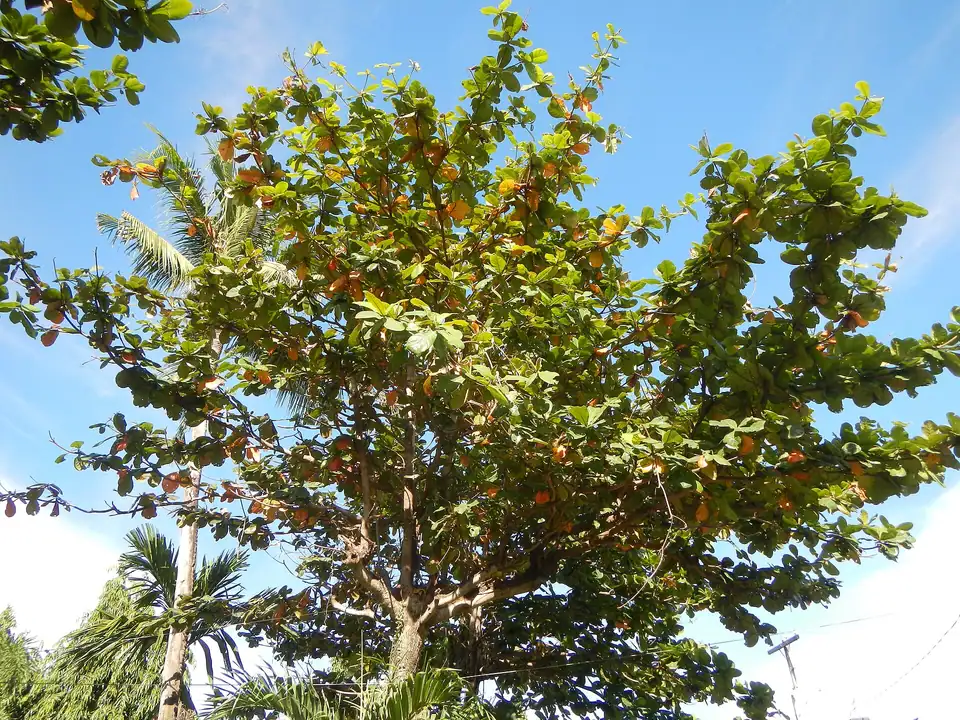
The tropical almond is a big, generous tree, 30–55 feet tall and 30–50 feet wide. It loves full sun and shrugs off wind, salt and drought, which makes it a natural for coastal parks and shade. Inside each fruit hides an edible kernel that tastes like almond, delicious raw or roasted.
- Sun
Full sun
What the sources say (2)
Light: Full sun
West Indian-almond should be grown in full sun on any well-drained soil.
— ENH-784/ST626: Terminalia catappa: West Indian-Almond [4] Site the young tree in a full sun location. It accepts almost any soil as long as it well draining.
— Indian Almond Cultivation: Learn How To Grow Tropical Almond Trees | Gardening Know How [7] - Water
Handles drought well; a layer of mulch helps it do its best
What the sources say (3)
Watering: Drought tolerant
Site the young tree in a full sun location. It accepts almost any soil as long as it well draining. The tree is drought tolerant.
— Indian Almond Cultivation: Learn How To Grow Tropical Almond Trees | Gardening Know How [7] Watering notes: Quite tolerant of wind, salt and drought; needs protection from freezing temperatures; performs best if mulched and regularly fertilized
Plants are quite tolerant of wind, salt, and drought but do need protection from freezing temperatures.
— ENH-784/ST626: Terminalia catappa: West Indian-Almond [4] Trees perform best if mulched and regularly fertilized. Propagation is by seed.
— ENH-784 [3] - Cold
Survives winters down to 35 °F (1.7 °C)
Tender: needs a frost-free greenhouse · USDA 10b · RHS H2 · Z10
What the sources say (2)
Hardiness, coldest zone: 10b [winter low 1.7 to 4.4 °C (35 to 40 °F)]
Family: Combretaceae USDA hardiness zones: 10B through 11 (Figure 2) Origin: native to Asia
— ENH-784 [3] Hardiness, warmest zone: 11 [winter low 4.4 to 10 °C (40 to 50 °F)]
Family: Combretaceae USDA hardiness zones: 10B through 11 (Figure 2) Origin: native to Asia
— ENH-784 [3] - Feeding
Feed it regularly for the best growth
What the sources say (3)
How often: Regularly
Plants are quite tolerant of wind, salt, and drought but do need protection from freezing temperatures. Trees perform best if mulched and regularly fertilized.
— ENH-784/ST626: Terminalia catappa: West Indian-Almond [4] Watering notes: Quite tolerant of wind, salt and drought; needs protection from freezing temperatures; performs best if mulched and regularly fertilized
Plants are quite tolerant of wind, salt, and drought but do need protection from freezing temperatures.
— ENH-784/ST626: Terminalia catappa: West Indian-Almond [4] Trees perform best if mulched and regularly fertilized. Propagation is by seed.
— ENH-784 [3] - Harvest
The kernel inside the fruit is edible raw or roasted and tastes like almond
- Pests
Thrips and leaf spot
- Watch out
Fallen fruit stains cars and sidewalks and makes a mess: plant it away from them
- Size
30–55 ft tall and 30–50 ft wide
What the sources say (2)
Mature height: 914.4-1676.4 cm (30-55 ft)
Description Height: 30 to 55 feet Spread: 30 to 50 feet Crown uniformity: symmetrical Crown shape: pyramidal, spreading
— ENH-784 [3] Mature width: 914.4-1524 cm (30-50 ft)
Description Height: 30 to 55 feet Spread: 30 to 50 feet Crown uniformity: symmetrical Crown shape: pyramidal, spreading
— ENH-784 [3] - Propagation
Grows from seed
What the sources say (1)
Propagation: Seed
Trees perform best if mulched and regularly fertilized. Propagation is by seed.
— ENH-784 [3]
Overview
West Indian-almond is a deciduous tiered tree suited to coastal shade and park planting. [4] It should be grown in full sun on well-drained soil and is tolerant of wind, salt and drought but not of freezing temperatures. [4] The fruit is high in tannic acid and causes litter, which can stain cars and pavement. [4]
This record is incomplete: the sources we read do not cover every field yet.
Not yet covered by our sources: Pruning
Indian almond care
How to water Indian almond
Watering
Drought tolerant
What the sources say (1)
Site the young tree in a full sun location. It accepts almost any soil as long as it well draining. The tree is drought tolerant.Watering notes
Quite tolerant of wind, salt and drought; needs protection from freezing temperatures; performs best if mulched and regularly fertilized
How much light Indian almond needs
Full sun
What the sources say (2)
West Indian-almond should be grown in full sun on any well-drained soil.Site the young tree in a full sun location. It accepts almost any soil as long as it well draining.How much cold Indian almond can take
Hardiness, coldest zone
10b [winter low 1.7 to 4.4 °C (35 to 40 °F)]
What the sources say (1)
Family: Combretaceae USDA hardiness zones: 10B through 11 (Figure 2) Origin: native to AsiaHardiness, warmest zone
11 [winter low 4.4 to 10 °C (40 to 50 °F)]
What the sources say (1)
Family: Combretaceae USDA hardiness zones: 10B through 11 (Figure 2) Origin: native to AsiaHow to propagate Indian almond
Seed
What the sources say (1)
Trees perform best if mulched and regularly fertilized. Propagation is by seed.How to grow Indian almond
The plant
Family
Combretaceae
What the sources say (1)
Common name(s): West Indian-almond, sea-almond, tropical-almond, India-almond Family: Combretaceae USDA hardiness zones: 10B through 11Mature height
914.4-1676.4 cm (30-55 ft)
What the sources say (1)
Description Height: 30 to 55 feet Spread: 30 to 50 feet Crown uniformity: symmetrical Crown shape: pyramidal, spreadingMature width
914.4-1524 cm (30-50 ft)
What the sources say (1)
Description Height: 30 to 55 feet Spread: 30 to 50 feet Crown uniformity: symmetrical Crown shape: pyramidal, spreadingPests and diseases
Pests
thrips
What the sources say (1)
Pests Thrips are a pest of this tree. Diseases Leaf spot disease is a problem with this tree.Diseases
leaf spot
What the sources say (1)
Pests Thrips are a pest of this tree. Diseases Leaf spot disease is a problem with this tree.Fertilizing
How often
Regularly
What the sources say (1)
Plants are quite tolerant of wind, salt, and drought but do need protection from freezing temperatures. Trees perform best if mulched and regularly fertilized.Indian almond pests and problems
Thrips and leaf spot
Symptom: Thrips are a pest of this tree; leaf spot disease is a problem
What the sources say (1)
Pests Thrips are a pest of this tree. Diseases Leaf spot disease is a problem with this tree.
— ENH-784 [3] Fruit staining and litter
Symptom: Fruit high in tannic acid can stain cars, pavement and sidewalks and causes litter
What to do: Site away from parked cars and sidewalks; best suited to coastal parks or shade
What the sources say (1)
The fruit is high in tannic acid and this could stain cars, pavement and sidewalks. It also causes significant litter on the ground.
— ENH-784/ST626: Terminalia catappa: West Indian-Almond [4]
Remedies
The sources we checked give no remedies for this plant.
Calendar
Pruning
Not stated in the sources we read.
Months as given by the sources, which are mostly from the United States (northern hemisphere). In the southern hemisphere they shift by about six months.
Edibility
Reported by the source, quoted verbatim. Do not eat a plant on the basis of this page alone: identification mistakes can be dangerous.
Indicative values
Values from a secondary source, not checked word for word like the rest of this page. Use them as a starting point.
- Life cycle
- PerennialIndicative value, adapt it to your climate · Secondary source
- Hours of sun
- 6-8 hoursIndicative value, adapt it to your climate · Secondary source
- Drought tolerant
- yesIndicative value, adapt it to your climate · Secondary source
- Soil pH
- 5.5-7.5Indicative value, adapt it to your climate · Secondary source
- Indoors
- yesIndicative value, adapt it to your climate · Secondary source
- Care level
- MediumIndicative value, adapt it to your climate · Secondary source
- Growth rate
- HighIndicative value, adapt it to your climate · Secondary source
- Pruning
- February, March, April, MayIndicative value, adapt it to your climate · Secondary source
Similar plants
- Abies grandis Abies grandis
- Abraham Trachystemon orientalis
- Abyssinian banana Ensete ventricosum
- Acacia longifolia Acacia longifolia
- Acanthus hungaricus Acanthus hungaricus
- Aconite Aconitum napellus
- Adam's Needle Yucca flaccida
- Adriatic lizard orchid Himantoglossum adriaticum
Sources
Every value above is quoted from these documents. Links lead to the original publisher.
- Plants of Hawai'i | Bishop Museum · plantsofhawaii.org, consulted
- Terminalia catappa - Leon Levy Native Plant Preserve · levypreserve.org, consulted
- ENH-784 · edis.ifas.ufl.edu, consulted
- ENH-784/ST626: Terminalia catappa: West Indian-Almond · ask.ifas.ufl.edu, consulted
- Terminalia catappa L. Almendra, Indian almond · npn.rngr.net, consulted
- Terminalia catappa · apps.worldagroforestry.org, consulted
- Indian Almond Cultivation: Learn How To Grow Tropical Almond Trees | Gardening Know How · gardeningknowhow.com, consulted
Written by Emilio Marruso · last checked