
How to Grow and Care for European mistletoe
Viscum album
Written by Emilio Marruso · last checked
Toxic to: People · Why
At a glance
Mistletoe is a charming plant that lives on the branches of a host tree, happy in full sun or partial shade. Give it moderate, steady watering, because it does not like drought. It is generally free of pests and diseases, and with a little care you can enjoy its flowers and berries. Keep it away from children and pets, and wear gloves.
- Sun
Full sun to partial shade
- Water
Moderate watering; it does not tolerate drought
What the sources say (2)
Watering: Moderate
Water moderate Hardiness Zone 7+ Soil textures sandy, loamy, clay Soil pH acid, neutral, alkaline Tolerates Nutritionally Poor Soil No Drought intolerant
— Mistletoe (Viscum album) — Practical Plants [3] Watering notes: Drought intolerant
Water moderate Hardiness Zone 7+ Soil textures sandy, loamy, clay Soil pH acid, neutral, alkaline Tolerates Nutritionally Poor Soil No Drought intolerant
— Mistletoe (Viscum album) — Practical Plants [3] - Cold
Survives winters down to 0 °F (−17.8 °C)
Hardy in very cold winters · USDA 7 · RHS H6 · Z7
What the sources say (1)
Hardiness, coldest zone: 7 [winter low −17.8 to −12.2 °C (0 to 10 °F)]
Water moderate Hardiness Zone 7+ Soil textures sandy, loamy, clay
— Mistletoe (Viscum album) — Practical Plants [3] - Pruning
Established plants can be cut back quite hard without harm
- Harvest
The ripe fruit is edible, but take care: the whole plant is mildly poisonous
- Pollination
Flowers but no berries? Put more seeds on the branches to balance male and female plants
- Pests
Generally free of pests and diseases
What the sources say (2)
Pests: none reported (generally free of pests and diseases)
Mistletoe is generally free of pests and diseases.
— Mistletoe | RHS Advice [1] Diseases: none reported (generally free of pests and diseases)
Mistletoe is generally free of pests and diseases.
— Mistletoe | RHS Advice [1] - Watch out
Large colonies can badly weaken the host tree
- Safety
All parts are poisonous: wear gloves and keep it away from children and pets
Overview
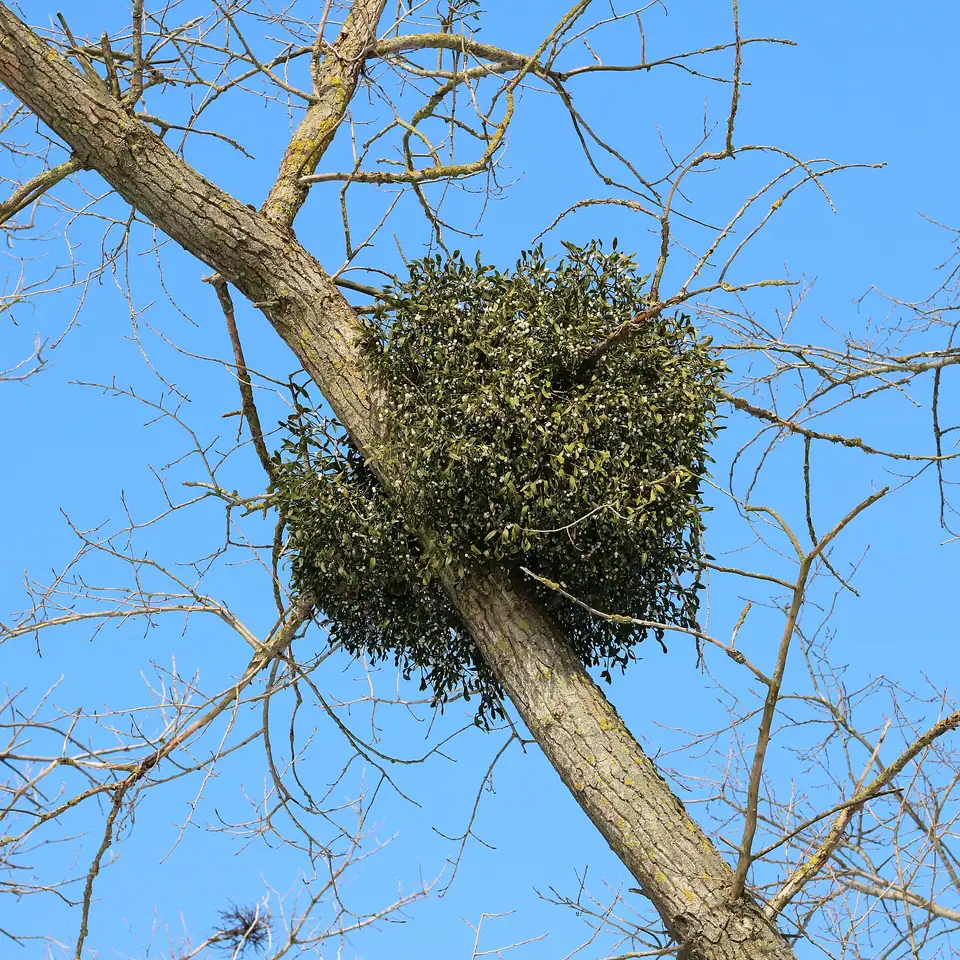
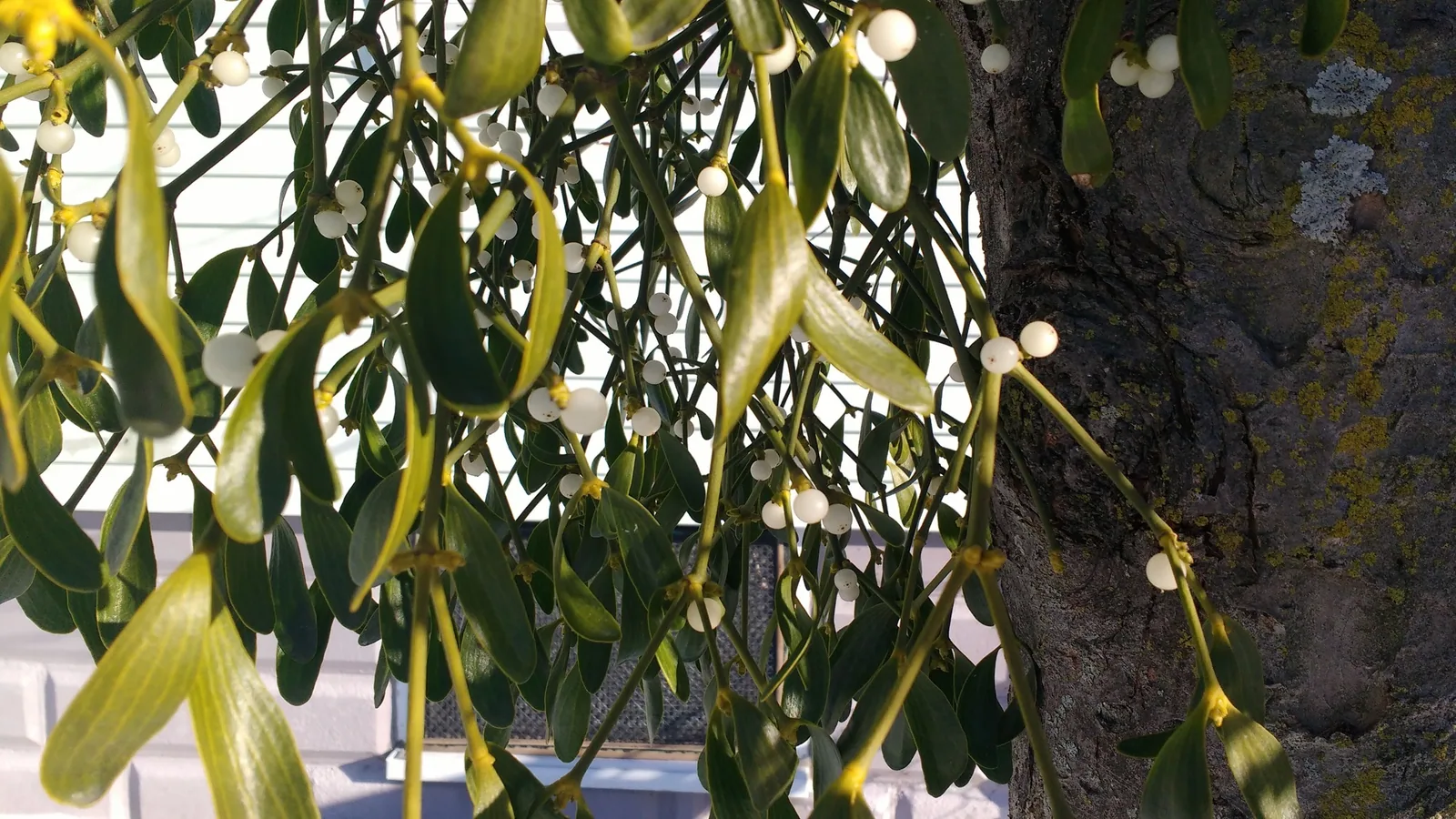
Mistletoe is a semi-parasitic evergreen shrub that takes water and nutrients from its host while also photosynthesising. [4] It can be grown by placing ripe berry seed on a host tree branch, but growth is very slow and fruiting can take up to seven years. [1] Apple is the most common host in the UK, with lime, hawthorn and poplar also frequent hosts. [1]
This record is incomplete: the sources we read do not cover every field yet.
Not yet covered by our sources: Hardiness, warmest zone, Pruning
European mistletoe care
How to water European mistletoe
Watering
Moderate
What the sources say (1)
Water
moderate
Hardiness
Zone 7+
Soil textures
sandy, loamy, clay
Soil pH
acid, neutral, alkaline
Tolerates Nutritionally Poor Soil
No
Drought
intolerantWatering notes
Drought intolerant
What the sources say (1)
Water
moderate
Hardiness
Zone 7+
Soil textures
sandy, loamy, clay
Soil pH
acid, neutral, alkaline
Tolerates Nutritionally Poor Soil
No
Drought
intolerantHow much light European mistletoe needs
How much cold European mistletoe can take
Hardiness, coldest zone
7 [winter low −17.8 to −12.2 °C (0 to 10 °F)]
What the sources say (1)
Water
moderate
Hardiness
Zone 7+
Soil textures
sandy, loamy, clayHardiness, warmest zone
Not stated in the sources we read.
How to propagate European mistletoe
The sources disagree:
possible to grow mistletoe yourself by harvesting the seeds from fresh berries in spring, then placing them underneath bark flaps
[5]
What the sources say (2)
Simply wipe the seed onto the underside of the branch, where dew collects naturally.To grow it you need to obtain berries and squash them onto the branches of host trees in late autumn and early winterHow to grow European mistletoe
Pests and diseases
Pests
none reported (generally free of pests and diseases)
What the sources say (1)
Mistletoe is generally free of pests and diseases.Diseases
none reported (generally free of pests and diseases)
What the sources say (1)
Mistletoe is generally free of pests and diseases.European mistletoe pests and problems
Weakened host tree
Symptom: Large colonies can significantly weaken host trees.
What to do: Established plants can be safely cut back quite hard.
Flowers but no berries
Symptom: Propagated mistletoe produces flowers but no berries.
What to do: Put more seeds on the branches to even out the balance between male and female plants.
What the sources say (1)
If your propagated mistletoe produces flowers but no berries it is either a male plant, or a female with no males within insect-pollinating distance. Where this appears to be the case, try putting more seeds on the branches to see if you can even out the balance between male and female plants.
— Mistletoe | RHS Advice [1]
Remedies
Each remedy shows what official sources say about it; traditional remedies without an official source are marked as such. Harmful ones are listed so you know to avoid them.
First aid
First aid: not a substitute for a doctor
mistletoe berries or leaves swallowed
drink and snack, then call poison center Official source, not independently tested
If you think someone might have swallowed mistletoe, use the web POISON CONTROL online tool to get help right away, or call your poison center at 1-800-222-1222
— poison.org [8] How: The poison center recommended giving a snack and something to drink.
The poison center recommended giving a snack and something to drink
— poison.org [8]
skin rash from touching mistletoe
Getting rid of it
mistletoe infestation
pruning infested branches Works
severe heading (topping) that is often used to remove heavy mistletoe infestations weakens a tree
— ipm.ucanr.edu [11] How: Prune out infested branches as soon as possible, cutting at least one foot below the point of mistletoe attachment.
as these hosts are pruned regularly, preventing further damage and slowing its spread
— blogs.cdfa.ca.gov [10] What the evidence says Mechanical control through pruning tree branches is the most effective method for mistletoe removal.
— ipm.ucanr.edu [11] cutting out mistletoe each winter Partly works
How: Cut the mistletoe plants out of the infested tree each winter.
Simply cutting mistletoe plants out of an infested tree each winter, even without wrapping, is better than doing nothing at all.
— ipm.ucanr.edu [11] What the evidence says Simply cutting mistletoe plants out of an infested tree each winter, even without wrapping, is better than doing nothing at all.
— ipm.ucanr.edu [11] black polyethylene wrap Partly works
Use twine or tape to secure the plastic to the limb, but do not wrap it too tightly or the branch may be damaged.
— ipm.ucanr.edu [11] How: Cut the mistletoe flush with the limb or trunk, then wrap the area with a few layers of wide black polyethylene to exclude light.
cutting off the mistletoe flush with the limb or trunk and then wrapping the area with a few layers of wide, black polyethylene to exclude light
— ipm.ucanr.edu [11] What the evidence says Nevertheless, it may be necessary to repeat this treatment, especially if the wrapping becomes detached or if the mistletoe does not die.
— ipm.ucanr.edu [11]
Is European mistletoe poisonous?
Reported by the source, quoted verbatim. This is not medical or veterinary advice: if a person or an animal may have eaten this plant, contact a poison control centre or a veterinarian.
Mistletoe contains toxic compounds, so it’s safest to wear gloves when handling it, and to keep it out of reach of children and pets.
[1]- Poisonous parts
Da die Mistel in allen Teilen, insbesondere den Beeren, giftige Stoffe enthält
[6]
All parts of the plant are poisonous [2] [6] , though the toxicity level is very slight [15] .
[3]
Calendar
Sowing
The sources give different values depending on region, zone or growing conditions.
What each source says
According to RHS: February to March (late winter to early spring)
According to Practical Plants: Late autumn and early winter
According to BBC Gardeners World: Spring
What the sources say (3)
According to RHS: Use mistletoe berries when they’re soft and squishy, typically in late winter to early spring (February to March).According to Practical Plants: To grow it you need to obtain berries and squash them onto the branches of host trees in late autumn and early winterAccording to BBC Gardeners World: possible to grow mistletoe yourself by harvesting the seeds from fresh berries in spring, then placing them underneath bark flapsPruning
Not stated in the sources we read.
Months as given by the sources, which are mostly from the United States (northern hemisphere). In the southern hemisphere they shift by about six months.
Edibility
Reported by the source, quoted verbatim. Do not eat a plant on the basis of this page alone: identification mistakes can be dangerous.
The ripe fruit is edible [11] . Some caution is advised, see notes above on toxicity[K].
[3]
Similar plants
- Abies grandis Abies grandis
- Abraham Trachystemon orientalis
- Abyssinian banana Ensete ventricosum
- Acacia longifolia Acacia longifolia
- Acanthus hungaricus Acanthus hungaricus
- Achlys triphylla Achlys triphylla
- Aconite Aconitum napellus
- Adam's Needle Yucca flaccida
Sources
Every value above is quoted from these documents. Links lead to the original publisher.
- Mistletoe | RHS Advice · rhs.org.uk, consulted
- Viscum album - Useful Temperate Plants · temperate.theferns.info, consulted
- Mistletoe (Viscum album) — Practical Plants · practicalplants.org, consulted
- Viscum album | mistletoe · rhs.org.uk, consulted
- Mistletoe (Viscum album) | BBC Gardeners World Magazine · gardenersworld.com, consulted
- `Unter dem Mistelzweig´ · archiv.botanischer-garten.fau.de, consulted
- Highlights: 21.12.07 – Botanics Stories · stories.rbge.org.uk, consulted
- poison.org · poison.org
- nnepc.org · nnepc.org
- blogs.cdfa.ca.gov · blogs.cdfa.ca.gov
- ipm.ucanr.edu · ipm.ucanr.edu
Written by Emilio Marruso · last checked