
How to Grow and Care for Balsamorhiza sagittata
Balsamorhiza sagittata
Written by Emilio Marruso · last checked
Toxic to: Animals · Why
At a glance
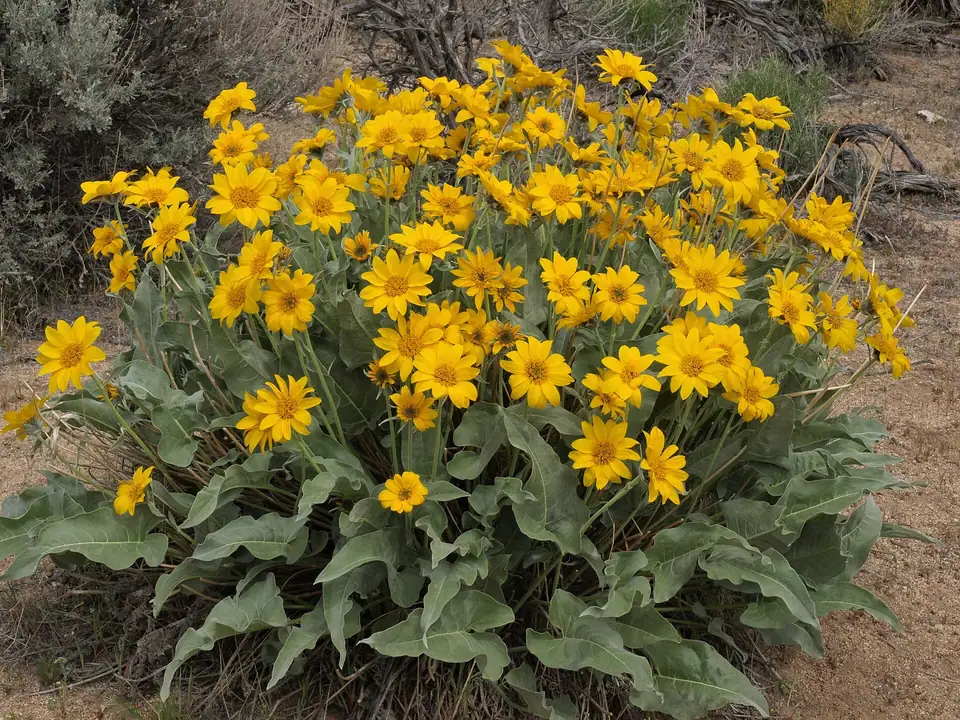
Arrowleaf balsamroot is a tough perennial that shrugs off drought: once settled in, it needs little or no watering. Sow the seeds outdoors in fall and let winter do the work of waking them up. It grows 30 inches tall, and Native Americans once ate its fleshy roots raw or boiled, along with its seeds and tender young shoots.
- Water
Very drought tolerant: little or no watering once settled in
What the sources say (2)
Watering: Strongly drought resistant; moderate to no watering once established
It is strongly drought resistant, has good winter-hardiness, tolerates semi-shade, and is strongly tolerant of grazing and trampling.
— Arrowleaf Balsamroot | USU [1] Moderate to no watering after it is established.
— Plant Data Sheet [6] - Cold
Survives winters down to −20 °F (−28.9 °C)
Very hardy · USDA 5 · RHS H7 · Z5
What the sources say (1)
Hardiness, coldest zone: 5 [winter low −28.9 to −23.3 °C (−20 to −10 °F)]
Hardiness Zone 5+
— Oregon Sunflower (Balsamorhiza sagittata) — Practical Plants [5] - Soil
Slightly acidic to alkaline soil, pH 6.5–8
- Planting
Plant out seedlings raised indoors in summer
What the sources say (1)
Planting: Summer (seedlings raised in a greenhouse)
plant them out into their permanent positions in the summer [3] .
— Oregon Sunflower (Balsamorhiza sagittata) — Practical Plants [5] - Harvest
The fleshy roots are edible raw or boiled; seeds and young shoots were eaten too
- Size
Grows 30 inches tall
What the sources say (1)
Mature height: 75 cm (2.5 ft)
Plants are strongly tufted, densely leafy from the base, and large (up to 2.5 ft [75 cm] tall when flowering)
— Western Forbs [2] - Propagation
From seed, which needs a long cool, moist spell; dividing the plant is very hard
What the sources say (2)
Propagation: Seed, which requires prolonged cool-moist stratification; division is very difficult
The plant takes poorly to transplanting, thus seeds should be used for propagation.
— Lady Bird Johnson Wildflower Center - The University of Texas at Austin [4] Seed Treatment: Seeds require prolonged cool-moist stratification and then incubation at cold temperatures for germination.
— Lady Bird Johnson Wildflower Center - The University of Texas at Austin [4] - Sowing
Sow outdoors in fall so winter readies the seeds, or in a greenhouse in early spring
What the sources say (3)
Sowing: Fall (outdoor seeding gives natural stratification); early spring in a greenhouse
According to USDA Forest Service (outdoors): but are less effective than fall seeding to provide natural stratification.
— Western Forbs [2] According to Plants For A Future (greenhouse): Seed - sow early spring in a greenhouse and only just cover the seed.
— Oregon Sunflower (Balsamorhiza sagittata) — Practical Plants [5] but are less effective than fall seeding to provide natural stratification.
— Western Forbs [2] - Safety
Toxic to some animals
Overview
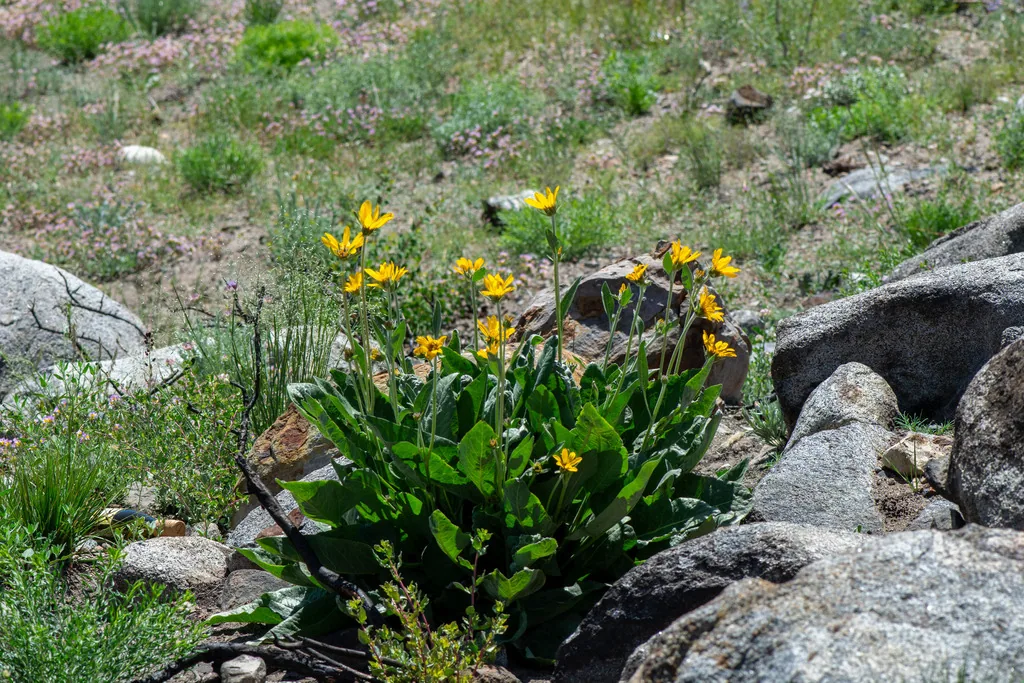
Arrowleaf balsamroot is a native perennial forb growing from a thickened woody taproot, found in open, fairly dry sites. [1] It is strongly drought resistant and takes poorly to transplanting, so seeds are used for propagation. [1][4]
This record is incomplete: the sources we read do not cover every field yet.
Not yet covered by our sources: Hardiness, warmest zone, Pruning
Balsamorhiza sagittata care
How to water Balsamorhiza sagittata
Strongly drought resistant; moderate to no watering once established
How much light Balsamorhiza sagittata needs
The sources disagree:
Shade tolerance no shade
[5]
How much cold Balsamorhiza sagittata can take
Hardiness, coldest zone
5 [winter low −28.9 to −23.3 °C (−20 to −10 °F)]
What the sources say (1)
Hardiness
Zone 5+Hardiness, warmest zone
Not stated in the sources we read.
Best soil for Balsamorhiza sagittata
Soil pH, minimum
6.5
What the sources say (1)
Plants do best in soils that are only weakly acidic or alkaline (pH 6.5–8) and have low salinitySoil pH, maximum
8
What the sources say (1)
Plants do best in soils that are only weakly acidic or alkaline (pH 6.5–8) and have low salinityHow to propagate Balsamorhiza sagittata
Seed, which requires prolonged cool-moist stratification; division is very difficult
What the sources say (2)
The plant takes poorly to transplanting, thus seeds should be used for propagation.Seed Treatment: Seeds require prolonged cool-moist stratification and then incubation at cold temperatures for germination.How to grow Balsamorhiza sagittata
The plant
Life cycle
perennial
What the sources say (1)
Arrowleaf balsamroot is a large, leafy, long –lived perennial with striking early season yellow flowersFamily
Asteraceae
What the sources say (1)
Family Asteraceae – Aster family Genus Balsamorhiza Species sagittata NRCS Plant Code BASA3 (USDA NRCS 2024Mature height
75 cm (2.5 ft)
What the sources say (1)
Plants are strongly tufted, densely leafy from the base, and large (up to 2.5 ft [75 cm] tall when flowering) Remedies
The sources we checked give no remedies for this plant.
Is Balsamorhiza sagittata toxic to pets?
Reported by the source, quoted verbatim. This is not medical or veterinary advice: if a person or an animal may have eaten this plant, contact a poison control centre or a veterinarian.
toxic for some animals
[3]The source flags the risk for this animal but does not explain why.
Calendar
Sowing
Fall (outdoor seeding gives natural stratification); early spring in a greenhouse
What each source says
According to USDA Forest Service (outdoors): Fall
According to Plants For A Future (greenhouse): Early spring
What the sources say (3)
According to USDA Forest Service (outdoors): but are less effective than fall seeding to provide natural stratification.According to Plants For A Future (greenhouse): Seed - sow early spring in a greenhouse and only just cover the seed.but are less effective than fall seeding to provide natural stratification.Planting
Summer (seedlings raised in a greenhouse)
What the sources say (1)
plant them out into their permanent positions in the summer [3] .Pruning
Not stated in the sources we read.
Months as given by the sources, which are mostly from the United States (northern hemisphere). In the southern hemisphere they shift by about six months.
Edibility
Reported by the source, quoted verbatim. Do not eat a plant on the basis of this page alone: identification mistakes can be dangerous.
Indicative values
Values from a secondary source, not checked word for word like the rest of this page. Use them as a starting point.
- Drought tolerant
- yesIndicative value, adapt it to your climate · Secondary source
- Soil
- LoamIndicative value, adapt it to your climate · Secondary source
- Care level
- MediumIndicative value, adapt it to your climate · Secondary source
- Growth rate
- LowIndicative value, adapt it to your climate · Secondary source
- Pruning
- February, March, AprilIndicative value, adapt it to your climate · Secondary source
Similar plants
- African Daisy Dimorphotheca pluvialis
- African Marigold Tagetes erecta
- Ageratum Ageratum houstonianum
- Alpine aster Aster alpinus
- Appalachian Blazing Star Liatris squarrulosa
- Appalachian Ironweed Vernonia glauca
- Appalachian Sunflower Helianthus atrorubens
- Aromatic Aster Symphyotrichum oblongifolium
Sources
Every value above is quoted from these documents. Links lead to the original publisher.
- Arrowleaf Balsamroot | USU · extension.usu.edu, consulted
- Western Forbs · fs.usda.gov, consulted
- Balsamorhiza sagittata | EcoRestore Portal · ecorestore.arizona.edu, consulted
- Lady Bird Johnson Wildflower Center - The University of Texas at Austin · wildflower.org, consulted
- Oregon Sunflower (Balsamorhiza sagittata) — Practical Plants · practicalplants.org, consulted
- Plant Data Sheet · depts.washington.edu, consulted
Written by Emilio Marruso · last checked