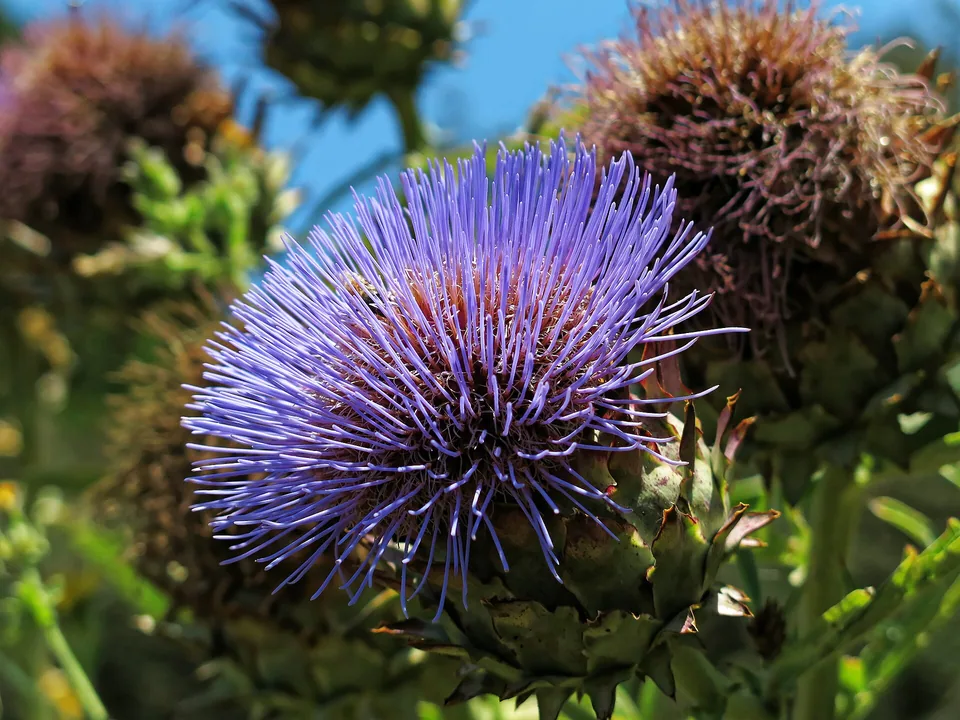


How to Grow and Care for Cardoon
Cynara cardunculus
Written by Emilio Marruso · last checked
At a glance
Cardoon is an ornamental edible: a perennial that looks striking in the garden and gives you tender leaf stalks to cook as a vegetable. Give it full sun and rich, moist soil that drains well. Tie the plants up and cover them for a few weeks to blanch the stalks, which are ready in September; even the roots can be cooked.
- Sun
Full sun
What the sources say (2)
Light: Full sun
Light: Full sun (6 or more hours of direct sunlight a day)
— Cynara cardunculus (Artichoke Thistle, Cardoon, Cardoons, Desert Artichoke, European Cardoon, Globe Artichoke, Scotch Thistle, Scottish Thistle, Spanish Artichoke, Wild Artichoke, Wild Cardoon) | North Carolina Extension Gardener Plant Toolbox [1] This plant grows best in full sun in well-drained soil in a site protected from strong winds.
— Cardoon, Cynara cardunculus – Wisconsin Horticulture [2] - Water
Keep the soil moist, but never waterlogged
What the sources say (1)
Watering: Grow in rich, well-drained but moist soil
Cardoons need rich, well-drained but moist soil and full sun to grow.
— Cynara cardunculus (Artichoke Thistle, Cardoon, Cardoons, Desert Artichoke, European Cardoon, Globe Artichoke, Scotch Thistle, Scottish Thistle, Spanish Artichoke, Wild Artichoke, Wild Cardoon) | North Carolina Extension Gardener Plant Toolbox [1] - Cold
Survives winters down to 0 °F (−17.8 °C)
Hardy in very cold winters · USDA 7a · RHS H6 · Z7
What the sources say (4)
Hardiness, coldest zone: 7a [winter low −17.8 to −15 °C (0 to 5 °F)]
USDA Plant Hardiness Zone: 7a, 7b, 8a, 8b, 9a, 9b, 10a, 10b
— Cynara cardunculus (Artichoke Thistle, Cardoon, Cardoons, Desert Artichoke, European Cardoon, Globe Artichoke, Scotch Thistle, Scottish Thistle, Spanish Artichoke, Wild Artichoke, Wild Cardoon) | North Carolina Extension Gardener Plant Toolbox [1] It is hardy only in zones 7a to 10b , so is treated as an annual in cold climates .
— Cardoon, Cynara cardunculus – Wisconsin Horticulture [2] Hardiness, warmest zone: 10b [winter low 1.7 to 4.4 °C (35 to 40 °F)]
USDA Plant Hardiness Zone: 7a, 7b, 8a, 8b, 9a, 9b, 10a, 10b
— Cynara cardunculus (Artichoke Thistle, Cardoon, Cardoons, Desert Artichoke, European Cardoon, Globe Artichoke, Scotch Thistle, Scottish Thistle, Spanish Artichoke, Wild Artichoke, Wild Cardoon) | North Carolina Extension Gardener Plant Toolbox [1] It is hardy only in zones 7a to 10b , so is treated as an annual in cold climates .
— Cardoon, Cynara cardunculus – Wisconsin Horticulture [2] - Soil
Rich soil that drains well
What the sources say (1)
Watering: Grow in rich, well-drained but moist soil
Cardoons need rich, well-drained but moist soil and full sun to grow.
— Cynara cardunculus (Artichoke Thistle, Cardoon, Cardoons, Desert Artichoke, European Cardoon, Globe Artichoke, Scotch Thistle, Scottish Thistle, Spanish Artichoke, Wild Artichoke, Wild Cardoon) | North Carolina Extension Gardener Plant Toolbox [1] - Planting
Plant out once the danger of frost has passed
What the sources say (1)
Planting: Transplant to the garden after the danger of frost is past
Transplant to the garden after the danger of frost is past.
— Cardoon, Cynara cardunculus – Wisconsin Horticulture [2] - Harvest
Tie up and cover the young stalks for a few weeks to blanch them; they're ready in September
What the sources say (3)
Harvest: Plant hearts blanched like celery stalks mature in September
The plant hearts are sometimes blanched like celery stalks (maturing in September).
— POTW: Cardoon | Hort in the Home Landscape | Illinois Extension | Illinois [4] How to harvest: Young leaf stalks are blanched for a few weeks before harvest by tying plants up and excluding sunlight with a cloth, paper, or cardboard covering
Stems are often blanched for a few weeks before harvest by tying plants up and excluding sunlight with a cloth, paper, or cardboard covering.
— Cardoon, Cynara cardunculus – Wisconsin Horticulture [2] Instead, the young, emerging leaf stalks are blanched, harvested, cooked, and eaten as a vegetable.
— Cynara cardunculus (Artichoke Thistle, Cardoon, Cardoons, Desert Artichoke, European Cardoon, Globe Artichoke, Scotch Thistle, Scottish Thistle, Spanish Artichoke, Wild Artichoke, Wild Cardoon) | North Carolina Extension Gardener Plant Toolbox [1] - Pests
Snails, slugs, aphids and Japanese beetles; also root rot, gray mold and powdery mildew
What the sources say (3)
Pests: snails, slugs, aphids, Japanese beetle
Diseases that may damage this plant include root rot, gray mold and powdery mildew. Insect problems include snails, slugs and aphids.
— Cynara cardunculus (Artichoke Thistle, Cardoon, Cardoons, Desert Artichoke, European Cardoon, Globe Artichoke, Scotch Thistle, Scottish Thistle, Spanish Artichoke, Wild Artichoke, Wild Cardoon) | North Carolina Extension Gardener Plant Toolbox [1] When grown as an annual, cardoon has few pests (although in the eastern U.S. there are reports of it being attacked by Japanese beetle) and is not favored by deer.
— Cardoon, Cynara cardunculus – Wisconsin Horticulture [2] Diseases: root rot, gray mold, powdery mildew
Diseases that may damage this plant include root rot, gray mold and powdery mildew. Insect problems include snails, slugs and aphids.
— Cynara cardunculus (Artichoke Thistle, Cardoon, Cardoons, Desert Artichoke, European Cardoon, Globe Artichoke, Scotch Thistle, Scottish Thistle, Spanish Artichoke, Wild Artichoke, Wild Cardoon) | North Carolina Extension Gardener Plant Toolbox [1] - Watch out
It can spread into colonies: dig out the big root; shelter it from strong winds
- Propagation
From seed, by dividing the plant or from root cuttings
What the sources say (2)
Propagation: Seed, division and root cuttings
Recommended Propagation Strategy: Division Root Cutting Seed Country Or Region Of Origin:
— Cynara cardunculus (Artichoke Thistle, Cardoon, Cardoons, Desert Artichoke, European Cardoon, Globe Artichoke, Scotch Thistle, Scottish Thistle, Spanish Artichoke, Wild Artichoke, Wild Cardoon) | North Carolina Extension Gardener Plant Toolbox [1] Cardoon can be started from seed sown indoors 6 to 8 weeks before the last frost.
— Cardoon, Cynara cardunculus – Wisconsin Horticulture [2] - Sowing
Sow indoors 6–8 weeks before the last frost
What the sources say (4)
Sowing: Indoors 6 to 8 weeks before the last frost; late January or early February in Illinois
According to University of Wisconsin Extension: Cardoon can be started from seed sown indoors 6 to 8 weeks before the last frost.
— Cardoon, Cynara cardunculus – Wisconsin Horticulture [2] Illinois: Seeds of cardoon can be ordered online and started indoors in Late January or early February.
— POTW: Cardoon | Hort in the Home Landscape | Illinois Extension | Illinois [4] Cardoon can be started from seed sown indoors 6 to 8 weeks before the last frost.
— Cardoon, Cynara cardunculus – Wisconsin Horticulture [2] Seeds of cardoon can be ordered online and started indoors in Late January or early February.
— POTW: Cardoon | Hort in the Home Landscape | Illinois Extension | Illinois [4] - Containers
Grows in containers too
What the sources say (1)
In containers: Yes
Cardoon can be grown as a container plant, but it requires a very large container.
— Cardoon, Cynara cardunculus – Wisconsin Horticulture [2]
Overview
Cardoon is a Mediterranean perennial grown for its blanched leaf stalks and ornamental silvery, spiny foliage. [2][1] It needs full sun and rich, well-drained but moist soil. [1] It is listed as an invasive species in North Carolina and is considered weedy in some areas. [1]
This record is incomplete: the sources we read do not cover every field yet.
Not yet covered by our sources: Spacing
Cardoon care
How to water Cardoon
Grow in rich, well-drained but moist soil
What the sources say (1)
Cardoons need rich, well-drained but moist soil and full sun to grow.How much light Cardoon needs
Full sun
What the sources say (2)
Light:
Full sun (6 or more hours of direct sunlight a day)This plant grows best in full sun in well-drained soil in a site protected from strong winds.How much cold Cardoon can take
Hardiness, coldest zone
7a [winter low −17.8 to −15 °C (0 to 5 °F)]
What the sources say (2)
USDA Plant Hardiness Zone:
7a, 7b, 8a, 8b, 9a, 9b, 10a, 10bIt is hardy only in zones 7a to 10b , so is treated as an annual in cold climates .Hardiness, warmest zone
10b [winter low 1.7 to 4.4 °C (35 to 40 °F)]
What the sources say (2)
USDA Plant Hardiness Zone:
7a, 7b, 8a, 8b, 9a, 9b, 10a, 10bIt is hardy only in zones 7a to 10b , so is treated as an annual in cold climates .Where to grow Cardoon
In containers
Yes
What the sources say (1)
Cardoon can be grown as a container plant, but it requires a very large container.Spacing
Not stated in the sources we read.
How to propagate Cardoon
Seed, division and root cuttings
What the sources say (2)
Recommended Propagation Strategy:
Division
Root Cutting
Seed
Country Or Region Of Origin:Cardoon can be started from seed sown indoors 6 to 8 weeks before the last frost.How to grow Cardoon
The plant
Life cycle
perennial
What the sources say (3)
This fast-growing, tender herbaceous perennial in the aster family (Asteraceae) is native to the western and central Mediterranean where it was domesticated in ancient times.While it is a perennial, it is often grown as a half-hardy annual.The Cardoon ( Cynara cardunculus ) is a perennial, hardy to zone 7, which is closely related to globe artichoke.Family
Asteraceae
What the sources say (1)
This fast-growing, tender herbaceous perennial in the aster family (Asteraceae) is native to the western and central Mediterranean where it was domesticated in ancient times.Mature height
Sowing and growth
Days to maturity
The sources give different values depending on region, zone or growing conditions.
What each source says
cultivar 'Bianco Avorio':
cultivar 'Gobbo di Nizza':
cultivar 'Porto Spineless':
What the sources say (3)
cultivar 'Bianco Avorio': ‘Bianco Avorio’ has thin stalks and matures 110 days from transplant.cultivar 'Gobbo di Nizza': ‘Gobbo di Nizza’ (“hunchback of Nice” in Italian) features thick stalks with few spines. Matures 110 days from transplant.cultivar 'Porto Spineless': ‘Porto Spineless’ is a spineless variety with a compact habit, growing 3 to 4 feet tall. Matures 100 days from transplant.Harvest and storage
How to harvest
Young leaf stalks are blanched for a few weeks before harvest by tying plants up and excluding sunlight with a cloth, paper, or cardboard covering
What the sources say (2)
Stems are often blanched for a few weeks before harvest by tying plants up and excluding sunlight with a cloth, paper, or cardboard covering.Instead, the young, emerging leaf stalks are blanched, harvested, cooked, and eaten as a vegetable.Pests and diseases
Pests
snails, slugs, aphids, Japanese beetle
What the sources say (2)
Diseases that may damage this plant include root rot, gray mold and powdery mildew. Insect problems include snails, slugs and aphids.When grown as an annual, cardoon has few pests (although in the eastern U.S. there are reports of it being attacked by Japanese beetle) and is not favored by deer.Diseases
root rot, gray mold, powdery mildew
What the sources say (1)
Diseases that may damage this plant include root rot, gray mold and powdery mildew. Insect problems include snails, slugs and aphids.Cardoon pests and problems
Diseases
Symptom: Root rot, gray mold and powdery mildew
What to do: No control method given in the documents
What the sources say (1)
Diseases that may damage this plant include root rot, gray mold and powdery mildew.
— Cynara cardunculus (Artichoke Thistle, Cardoon, Cardoons, Desert Artichoke, European Cardoon, Globe Artichoke, Scotch Thistle, Scottish Thistle, Spanish Artichoke, Wild Artichoke, Wild Cardoon) | North Carolina Extension Gardener Plant Toolbox [1] Snails, slugs and aphids
Symptom: Insect and mollusc damage
What to do: No control method given in the documents
What the sources say (1)
Diseases that may damage this plant include root rot, gray mold and powdery mildew. Insect problems include snails, slugs and aphids.
— Cynara cardunculus (Artichoke Thistle, Cardoon, Cardoons, Desert Artichoke, European Cardoon, Globe Artichoke, Scotch Thistle, Scottish Thistle, Spanish Artichoke, Wild Artichoke, Wild Cardoon) | North Carolina Extension Gardener Plant Toolbox [1] Wind damage
Symptom: Strong winds damage the plant
What to do: Site in a position protected from strong winds
What the sources say (2)
The large taproot must be removed to avoid new sprouting. Strong winds can damage this plant.
— Cynara cardunculus (Artichoke Thistle, Cardoon, Cardoons, Desert Artichoke, European Cardoon, Globe Artichoke, Scotch Thistle, Scottish Thistle, Spanish Artichoke, Wild Artichoke, Wild Cardoon) | North Carolina Extension Gardener Plant Toolbox [1] This plant grows best in full sun in well-drained soil in a site protected from strong winds.
— Cardoon, Cynara cardunculus – Wisconsin Horticulture [2] Weediness
Symptom: Spreads to form colonies in some locations
What to do: Remove the large taproot to avoid new sprouting
What the sources say (1)
The large taproot must be removed to avoid new sprouting.
— Cynara cardunculus (Artichoke Thistle, Cardoon, Cardoons, Desert Artichoke, European Cardoon, Globe Artichoke, Scotch Thistle, Scottish Thistle, Spanish Artichoke, Wild Artichoke, Wild Cardoon) | North Carolina Extension Gardener Plant Toolbox [1]
Remedies
Each remedy shows what official sources say about it; traditional remedies without an official source are marked as such. Harmful ones are listed so you know to avoid them.
Treating the plant
aphids
neem oil Partly works
How: Use neem oil as soon as you see an aphid.
Try and prevent aphids from getting a hold in the first place. Use neem oil as soon as you see an aphid.
— morningchores.com [5] What the evidence says However, neem oil is not effective against every insect and disease, and often must be frequently reapplied to reach the desired outcome.
— extension.unh.edu [6] strong water jet Not verified
Traditional remedy, not verified by an official source.
How: Spray plants with a strong jet of water to dislodge colonies.
insecticidal soap Works
For example, spraying home remedies that contain dish detergent on plants on a sunny day can injure the plant, essentially burning it.
— extension.psu.edu [9] How: After a strong jet of water, use insecticidal soap, ensuring full coverage of leaf undersides and buds.
Spray plants with a strong jet of water to dislodge colonies, then use insecticidal soap or a light horticultural oil, ensuring full coverage of leaf undersides and buds.
— botanapp.com [7] What the evidence says For example, insecticidal soap is a safe, effective organic insecticide with minimal environmental impact.
— extension.psu.edu [8]
powdery mildew
milk spray Not verified
Traditional remedy, not verified by an official source.
How: A weekly foliar spray of milk (1:9 dilution) helps keep it at bay.
slugs
grit barrier Not verified
Traditional remedy, not verified by an official source.
How: Create a 5–8 cm wide dry barrier of sharp horticultural grit or crushed, baked clay around the crown and check it weekly, topping up where rain has flattened it.
artichoke plume moth
removing and burning infested parts Not verified
Traditional remedy, not verified by an official source.
How: Remove the affected part of the plant straight away and burn it; you can also seal it in the household trash.
Getting rid of it
cardoon invasive spread
removing the taproot Official source, not independently tested
How: The large taproot must be removed to avoid new sprouting.
The large taproot must be removed to avoid new sprouting.
— Cynara cardunculus (Artichoke Thistle, Cardoon, Cardoons, Desert Artichoke, European Cardoon, Globe Artichoke, Scotch Thistle, Scottish Thistle, Spanish Artichoke, Wild Artichoke, Wild Cardoon) | North Carolina Extension Gardener Plant Toolbox [1] pulling out seedlings and deadheading Works
How: Deadhead flower heads before seed set and remove any seedlings that appear outside the planting area.
To control it, deadhead flower heads before seed set and remove any seedlings that appear outside the planting area.
— thegreenserenity.com [10] What the evidence says Regularly pulling, hoeing or mowing weeds and encouraging grass to grow and out-compete the weeds is an excellent solution.
— extension.usu.edu [11]
Calendar
Indoors 6 to 8 weeks before the last frost; late January or early February in Illinois
What each source says
According to University of Wisconsin Extension: Indoors 6 to 8 weeks before the last frost
Illinois: Indoors in late January or early February
What the sources say (4)
According to University of Wisconsin Extension: Cardoon can be started from seed sown indoors 6 to 8 weeks before the last frost.Illinois: Seeds of cardoon can be ordered online and started indoors in Late January or early February.Cardoon can be started from seed sown indoors 6 to 8 weeks before the last frost.Seeds of cardoon can be ordered online and started indoors in Late January or early February.Transplant to the garden after the danger of frost is past
What the sources say (1)
Transplant to the garden after the danger of frost is past.Plant hearts blanched like celery stalks mature in September
What the sources say (1)
The plant hearts are sometimes blanched like celery stalks (maturing in September).Months as given by the sources, which are mostly from the United States (northern hemisphere). In the southern hemisphere they shift by about six months.
Relative to frost
Less precise estimate: there is no weather station within 300 km.
Find frost dates by ZIP code or city
Sow indoors: 6 to 8 weeks before the last frost
Cardoon can be started from seed sown indoors 6 to 8 weeks before the last frost.
— Cardoon, Cynara cardunculus – Wisconsin Horticulture [2] Transplant: around the last frost
Transplant to the garden after the danger of frost is past.
— Cardoon, Cynara cardunculus – Wisconsin Horticulture [2]
Count from the average frost dates where you live.
Edibility
Reported by the source, quoted verbatim. Do not eat a plant on the basis of this page alone: identification mistakes can be dangerous.
Instead, the young, emerging leaf stalks are blanched, harvested, cooked, and eaten as a vegetable.
[1]Leaf stalks are blanched, harvested, and cooked as a vegetable. Roots may also be cooked and eaten.
[1]The flowers can be cut or dried and, while edible, are not considered as suitable for eating as Scolymus Group artichokes.
[1]Cardoon is an ornamental edible , as the blanched stems can be eaten, although doing so would ruin the ornamental appeal of the plant.
[2]The young tender leaf mid-ribs and immature flower stalks are used.
[4]
Indicative values
Values from a secondary source, not checked word for word like the rest of this page. Use them as a starting point.
- Drought tolerant
- yesIndicative value, adapt it to your climate · Secondary source
- Soil pH
- 6-7.5Indicative value, adapt it to your climate · Secondary source
- Care level
- MediumIndicative value, adapt it to your climate · Secondary source
- Growth rate
- HighIndicative value, adapt it to your climate · Secondary source
- Pruning
- March, AprilIndicative value, adapt it to your climate · Secondary source
Similar plants
- African Daisy Dimorphotheca pluvialis
- African Marigold Tagetes erecta
- Ageratum Ageratum houstonianum
- Alpine aster Aster alpinus
- American Burnweed Erechtites hieraciifolius
- Appalachian Blazing Star Liatris squarrulosa
- Appalachian Ironweed Vernonia glauca
- Appalachian Sunflower Helianthus atrorubens
Sources
Every value above is quoted from these documents. Links lead to the original publisher.
- Cynara cardunculus (Artichoke Thistle, Cardoon, Cardoons, Desert Artichoke, European Cardoon, Globe Artichoke, Scotch Thistle, Scottish Thistle, Spanish Artichoke, Wild Artichoke, Wild Cardoon) | North Carolina Extension Gardener Plant Toolbox · plants.ces.ncsu.edu, consulted
- Cardoon, Cynara cardunculus – Wisconsin Horticulture · hort.extension.wisc.edu, consulted
- European Cardoon - Cynara cardunculus | North Carolina Extension Gardener Plant Toolbox · plants.ces.ncsu.edu, consulted
- POTW: Cardoon | Hort in the Home Landscape | Illinois Extension | Illinois · extension.illinois.edu, consulted
- morningchores.com · morningchores.com
- extension.unh.edu · extension.unh.edu
- botanapp.com · botanapp.com
- extension.psu.edu · extension.psu.edu
- extension.psu.edu · extension.psu.edu
- thegreenserenity.com · thegreenserenity.com
- extension.usu.edu · extension.usu.edu
Written by Emilio Marruso · last checked