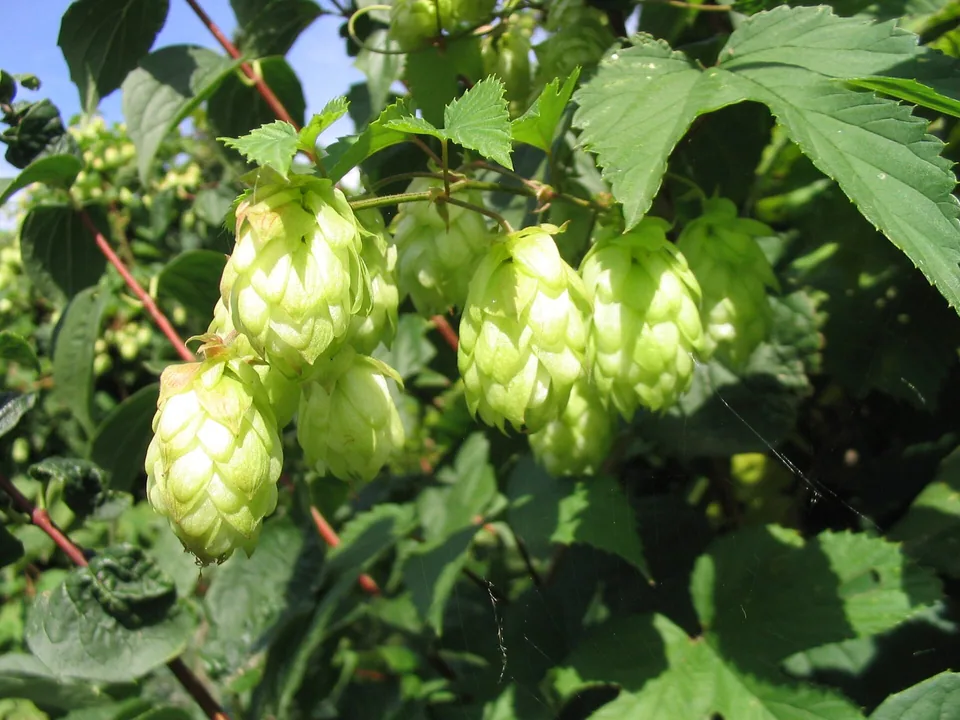


How to Grow and Care for Common hop
Humulus lupulus
Written by Emilio Marruso · last checked
Toxic to: Dogs, People · Why
At a glance
Hops are a perennial vine that climbs 15 to 20 feet and fills your trellis with fragrant cones used for brewing beer. Give them full sun to partial shade, steady moisture and slightly acidic to neutral soil. From mid-August to mid-September, pick the cones when they turn dry, papery and springy, with a golden, sticky, fragrant powder inside.
- Sun
Full sun to partial shade
What the sources say (2)
Light: Full sun to partial shade
Full sun to partial shade; moist, well drained soil is best but the plant will tolerate some dryness.
— Hops, Common (Humulus lupulus)-Hort Answers - University of Illinois Extension [2] They prefer well-drained, slightly acidic soil in full sun to partial shade.
— Growing Hops at Home [5] - Water
1.5 inches of water a week, steady but never soggy; water the soil, not the leaves
What the sources say (4)
Watering: Consistent moisture throughout the growing season; 1.5 in [3.8 cm] of water equivalent per week once established
Hop plants require consistent moisture throughout the growing season.
— Growing hops in the home garden | OSU Extension Service [4] Once the plants are established, hops will require approximately 1.5" of water equivalent per week.
— Growing Hops in the Backyard | Rutgers Cooperative Extension [6] Watering notes: Do not overwater (hops do not like wet feet); roots do not tolerate standing water; drip irrigation or soaker hose preferred because wet foliage encourages disease
Initially, provide consistent watering while being careful to not overwater because hops do not like to have “wet feet
— Growing hops in the home garden | OSU Extension Service [4] A drip irrigation system or soaker hose is preferred to a sprinkler system. This is because wet foliage can encourage disease formation.
— Growing Hops in the Backyard | Rutgers Cooperative Extension [6] - Cold
Survives winters down to −20 °F (−28.9 °C)
Very hardy · USDA 5a · RHS H7 · Z5
What the sources say (2)
Hardiness, coldest zone: 5a [winter low −28.9 to −26.1 °C (−20 to −15 °F)]
NC Region: Coastal Piedmont USDA Plant Hardiness Zone: 5a, 5b, 6a, 6b, 7a, 7b, 8a, 8b
— Humulus lupulus (Common Hops, European Hops, Hops) | North Carolina Extension Gardener Plant Toolbox [1] Hardiness, warmest zone: 8b [winter low −9.4 to −6.7 °C (15 to 20 °F)]
NC Region: Coastal Piedmont USDA Plant Hardiness Zone: 5a, 5b, 6a, 6b, 7a, 7b, 8a, 8b
— Humulus lupulus (Common Hops, European Hops, Hops) | North Carolina Extension Gardener Plant Toolbox [1] - Soil
Slightly acidic to neutral soil, pH 6.0–7.0
What the sources say (2)
Soil pH, minimum: 6.0
Soils with a pH of 6.0 to 7.0 are best for hop production.
— Growing Hops in the Backyard | Rutgers Cooperative Extension [6] Soil pH, maximum: 7.0
Soils with a pH of 6.0 to 7.0 are best for hop production.
— Growing Hops in the Backyard | Rutgers Cooperative Extension [6] - Spacing
24–36 in between plants
What the sources say (2)
Spacing: 61.0-91.4 cm (24-36 in)
If planting two or more hop plants side by side, allow 24 to 36 inches of spacing between plants.
— Growing hops in the home garden | OSU Extension Service [4] Within each row plants are planted in hills spaced 2 to 3 feet apart.
— Growing Hops in the Backyard | Rutgers Cooperative Extension [6] - Planting
Plant in spring, once the danger of frost has passed
What the sources say (4)
Planting: Spring, once the threat of a killing frost has passed
According to Oregon State University Extension: Once the threat of a killing frost has passed in the spring, transplant the hops into the desired outdoor site.
— Growing hops in the home garden | OSU Extension Service [4] According to Rutgers NJAES: Hops can be planted in the spring as early as the ground can be worked, and the danger of frost has passed.
— Growing Hops in the Backyard | Rutgers Cooperative Extension [6] Once the threat of a killing frost has passed in the spring, transplant the hops into the desired outdoor site.
— Growing hops in the home garden | OSU Extension Service [4] Hops can be planted in the spring as early as the ground can be worked, and the danger of frost has passed.
— Growing Hops in the Backyard | Rutgers Cooperative Extension [6] - Feeding
Feed every two weeks from April to mid-July; don't overdo nitrogen
What the sources say (6)
When: Spring and early summer, from April to mid-July; not needed after mid-July
Plants may be fertilized during spring and early summer, but fertilizer is not typically required after mid-July.
— Growing hops in the home garden | OSU Extension Service [4] An easy way to fertilize individual hop plants is to sprinkle a tablespoon of either 46-0-0 or 16-16-16 fertilizer near the plant every two weeks from April through mid-July.
— Growing hops in the home garden | OSU Extension Service [4] How often: Every two weeks from April to mid-July
An easy way to fertilize individual hop plants is to sprinkle a tablespoon of either 46-0-0 or 16-16-16 fertilizer near the plant every two weeks from April through mid-July.
— Growing hops in the home garden | OSU Extension Service [4] Water deeply twice a week if the weather is dry, especially when establishing the plants. Fertilize hops several times during the growing season.
— Growing Hops at Home [5] Avoid: Excessive nitrogen (part of hop aphid control); feeding after mid-July is not needed
Promoting and releasing beneficial insects, avoiding excessive nitrogen application, and using insecticide soaps or other aphicides are all effective forms of integrated pest management.
— Growing hops in the home garden | OSU Extension Service [4] Plants may be fertilized during spring and early summer, but fertilizer is not typically required after mid-July.
— Growing hops in the home garden | OSU Extension Service [4] - Pruning
Cut the vines down to the ground at the end of the season, in fall
What the sources say (10)
Pruning: End of the growing season (fall), cut to the ground; in Western Oregon also the first two weeks of April
According to Illinois Extension: This vine can be pruned to the ground in fall.
— Hops, Common (Humulus lupulus)-Hort Answers - University of Illinois Extension [2] According to Rutgers NJAES: the hops should be pruned back at the end of the season.
— Growing Hops in the Backyard | Rutgers Cooperative Extension [6] Western Oregon: In Western Oregon, hop growth can be pruned back to the soil surface during the first two weeks of April.
— Growing hops in the home garden | OSU Extension Service [4] This vine can be pruned to the ground in fall.
— Hops, Common (Humulus lupulus)-Hort Answers - University of Illinois Extension [2] the hops should be pruned back at the end of the season.
— Growing Hops in the Backyard | Rutgers Cooperative Extension [6] In Western Oregon, hop growth can be pruned back to the soil surface during the first two weeks of April.
— Growing hops in the home garden | OSU Extension Service [4] When to prune: At the end of the season (autumn), when the bines can be cut back to the ground.
western Oregon, downy mildew control: In Western Oregon, hop growth can be pruned back to the soil surface during the first two weeks of April.
— Growing hops in the home garden | OSU Extension Service [4] This vine can be pruned to the ground in fall.
— Hops, Common (Humulus lupulus)-Hort Answers - University of Illinois Extension [2] No matter which method you use, the hops should be pruned back at the end of the season.
— Growing Hops in the Backyard | Rutgers Cooperative Extension [6] Hard pruning: Tolerates being cut back to the ground.
This vine can be pruned to the ground in fall.
— Hops, Common (Humulus lupulus)-Hort Answers - University of Illinois Extension [2] - Harvest
Mid-August to mid-September, when cones are dry and papery; none the first year
What the sources say (9)
Harvest: Mid-August to mid-September (cones dry and papery); no cones harvested in the first growing season
According to University of Wisconsin Extension: Hop is harvested from mid-August to mid-September depending on the variety.
— Hops – Crops and Soils [3] Western and Central Oregon: In both Western and Central Oregon, hops typically mature between August 15 and September 15
— Growing hops in the home garden | OSU Extension Service [4] Hop is harvested from mid-August to mid-September depending on the variety.
— Hops – Crops and Soils [3] In both Western and Central Oregon, hops typically mature between August 15 and September 15
— Growing hops in the home garden | OSU Extension Service [4] Wait until the cones are dry and papery to harvest.
— Growing Hops at Home [5] How to harvest: Harvest when the cones are dry, papery and springy, with golden-yellow, sticky, fragrant lupulin. Either cut the bines from the trellis when most cones are mature (cutting the lower end of the bine 3 ft / 91 cm from the ground to protect roots and crown), or pick the cones individually as they ripen.
Mature cones will have a dry, papery feel, and the lupulin inside of the cone will be golden yellow and have a pleasant “hoppy” aroma (Figure 5).
— Growing hops in the home garden | OSU Extension Service [4] Wait until the cones are dry and papery to harvest. At this point, you should be able to smell and feel the sticky, yellow lupulin when you squeeze the cones.
— Growing Hops at Home [5] Two methods you can follow to harvest your hops are: to cut the bines from their trellis when most of the cones are mature. When cutting bines to pick first, cut the lower end of the bine three feet from the ground.
— Growing Hops in the Backyard | Rutgers Cooperative Extension [6] The second method is to pick the cones from the bine as they reach maturity.
— Growing Hops in the Backyard | Rutgers Cooperative Extension [6] - Pollination
Only female plants make cones, and they don't need a male plant
What the sources say (4)
Fruit set: Dioecious: male and female flowers on separate plants
Hop plants are dioecious—meaning male and female flowers are produced on separate plants.
— Growing hops in the home garden | OSU Extension Service [4] Having male and female flowers on separate plants, this plant is dioecious.
— Humulus lupulus (Common Hops, European Hops, Hops) | North Carolina Extension Gardener Plant Toolbox [1] What it needs: Only female plants produce cones, and no male plant is needed for the cones to produce lupulin; seeds form only when male and female plants grow together.
Only the female plant produces the cones used in brewing. The male plant is not necessary for the female plant to produce lupulin.
— Growing Hops in the Backyard | Rutgers Cooperative Extension [6] In order to produce seeds, both male and female plants are required. Flowers are wind pollinated.
— Humulus lupulus (Common Hops, European Hops, Hops) | North Carolina Extension Gardener Plant Toolbox [1] - Pests
Spider mites, aphids and Japanese beetles; downy and powdery mildew
What the sources say (6)
Pests: spider mites (two-spotted spider mite), aphids (hop aphid), Japanese beetles, potato leaf hoppers, leaf hoppers, European corn borer, hop merchant, spotted lanternfly
Aphids, Japanese beetles, potato leaf hoppers, and spider mites are the most damaging insects, while the most common pathogens are downy mildew and powdery mildew.
— Hops – Crops and Soils [3] Spider mites, leaf hoppers, aphids, Japanese beetles, European corn borer, and hop merchant are pests that have been encountered in New Jersey.
— Growing Hops in the Backyard | Rutgers Cooperative Extension [6] In Oregon, the two predominant arthropod pests affecting hop are the two-spotted spider mite ( Tetranychus urticae ) and the hop aphid ( Phorodon humuli ).
— Growing hops in the home garden | OSU Extension Service [4] But other Pennsylvania growers report enough problems with spotted lanternflies to motivate them to remove the hop plants.
— Growing Hops at Home [5] Diseases: downy mildew, powdery mildew, verticillium wilt, viruses and viroids
Diseases to which hops are susceptible include downy mildew, powdery mildew, and verticillium wilt.
— Growing Hops in the Backyard | Rutgers Cooperative Extension [6] A number of viruses and viroids (virus-like particles) also may infect hop.
— Growing hops in the home garden | OSU Extension Service [4] - Watch out
The vines climb nearby plants and structures: cut them back
- Size
15 to 20 ft tall and 3 to 6 ft wide
What the sources say (4)
Mature height: 457-610 cm (15 to 20 ft)
Dimensions: Height: 15 ft. 0 in. - 20 ft. 0 in. Width: 3 ft. 0 in. - 6 ft. 0 in.
— Humulus lupulus (Common Hops, European Hops, Hops) | North Carolina Extension Gardener Plant Toolbox [1] Hop plants normally grow 15 to 20 feet high but may grow higher, depending on the climate and available climbing support.
— Growing hops in the home garden | OSU Extension Service [4] Keep in mind that hop plants will grow 15 to 20 feet high.
— Growing Hops in the Backyard | Rutgers Cooperative Extension [6] Mature width: 91.4-182.9 cm (3 to 6 ft)
Dimensions: Height: 15 ft. 0 in. - 20 ft. 0 in. Width: 3 ft. 0 in. - 6 ft. 0 in.
— Humulus lupulus (Common Hops, European Hops, Hops) | North Carolina Extension Gardener Plant Toolbox [1] - Propagation
From rhizomes, stem cuttings or seed
What the sources say (2)
Propagation: Rhizomes; stem cuttings; seed
A hop cultivar is propagated either by rhizomes or by stem cuttings
— Growing hops in the home garden | OSU Extension Service [4] Life Cycle: Perennial Recommended Propagation Strategy: Seed Stem Cutting
— Humulus lupulus (Common Hops, European Hops, Hops) | North Carolina Extension Gardener Plant Toolbox [1] - Containers
Grows in containers too
What the sources say (1)
In containers: Yes
Some gardeners grow hops in containers—5-gallon plastic buckets are a practical choice.
— Growing Hops at Home [5] - Safety
Dangerous for dogs; touching it can irritate the skin
Overview
Hops is a perennial, herbaceous, twining vine native to Europe that is grown commercially for flavoring beer. [1] It prefers full sun to partial shade and well-drained soil, and needs a support structure to climb. [2][1] Plants are dioecious and only the female plant produces the cones used in brewing. [6]
Common hop care
Measurements in square brackets are our conversion into the other unit system; the quoted text is unchanged.
How to water Common hop
Watering
Consistent moisture throughout the growing season; 1.5 in [3.8 cm] of water equivalent per week once established
What the sources say (2)
Hop plants require consistent moisture throughout the growing season.Once the plants are established, hops will require approximately 1.5" of water equivalent per week.Watering notes
Do not overwater (hops do not like wet feet); roots do not tolerate standing water; drip irrigation or soaker hose preferred because wet foliage encourages disease
What the sources say (2)
Initially, provide consistent watering while being careful to not overwater because hops do not like to have “wet feetA drip irrigation system or soaker hose is preferred to a sprinkler system. This is because wet foliage can encourage disease formation.How much light Common hop needs
Full sun to partial shade
What the sources say (2)
Full sun to partial shade; moist, well drained soil is best but the plant will tolerate some dryness.They prefer well-drained, slightly acidic soil in full sun to partial shade.How much cold Common hop can take
Hardiness, coldest zone
5a [winter low −28.9 to −26.1 °C (−20 to −15 °F)]
What the sources say (1)
NC Region:
Coastal
Piedmont
USDA Plant Hardiness Zone:
5a, 5b, 6a, 6b, 7a, 7b, 8a, 8bHardiness, warmest zone
8b [winter low −9.4 to −6.7 °C (15 to 20 °F)]
What the sources say (1)
NC Region:
Coastal
Piedmont
USDA Plant Hardiness Zone:
5a, 5b, 6a, 6b, 7a, 7b, 8a, 8bBest soil for Common hop
Soil pH, minimum
6.0
What the sources say (1)
Soils with a pH of 6.0 to 7.0 are best for hop production.Soil pH, maximum
7.0
What the sources say (1)
Soils with a pH of 6.0 to 7.0 are best for hop production.Where to grow Common hop
In containers
Yes
What the sources say (1)
Some gardeners grow hops in containers—5-gallon plastic buckets are a practical choice.Spacing
61.0-91.4 cm (24-36 in)
What the sources say (2)
If planting two or more hop plants side by side, allow 24 to 36 inches of spacing between plants.Within each row plants are planted in hills spaced 2 to 3 feet apart.How to propagate Common hop
Rhizomes; stem cuttings; seed
What the sources say (2)
A hop cultivar is propagated either by rhizomes or by stem cuttingsLife Cycle:
Perennial
Recommended Propagation Strategy:
Seed
Stem CuttingHow to grow Common hop
The plant
Life cycle
perennial (herbaceous)
What the sources say (2)
The Common Hop is a perennial, herbaceous, twining vine native to Europe.Hop ( Humulus lupulus L. ) is a hardy, climbing, herbaceous perennial that is used principally as a bittering and flavoring agent in beer.Family
Cannabaceae
What the sources say (1)
Genus: Humulus Species: lupulus Family: Cannabaceae Uses (Ethnobotany): Extract from the fruit bracts are used as a flavoring in the production of beer.Mature height
457-610 cm (15 to 20 ft)
What the sources say (3)
Dimensions: Height: 15 ft. 0 in. - 20 ft. 0 in. Width: 3 ft. 0 in. - 6 ft. 0 in.Hop plants normally grow 15 to 20 feet high but may grow higher, depending on the climate and available climbing support.Keep in mind that hop plants will grow 15 to 20 feet high.Mature width
91.4-182.9 cm (3 to 6 ft)
What the sources say (1)
Dimensions: Height: 15 ft. 0 in. - 20 ft. 0 in. Width: 3 ft. 0 in. - 6 ft. 0 in.Sowing and growth
Harvest and storage
How to harvest
Harvest when the cones are dry, papery and springy, with golden-yellow, sticky, fragrant lupulin. Either cut the bines from the trellis when most cones are mature (cutting the lower end of the bine 3 ft / 91 cm from the ground to protect roots and crown), or pick the cones individually as they ripen.
What the sources say (4)
Mature cones will have a dry, papery feel, and the lupulin inside of the cone will be golden yellow and have a pleasant “hoppy” aroma (Figure 5).Wait until the cones are dry and papery to harvest. At this point, you should be able to smell and feel the sticky, yellow lupulin when you squeeze the cones.Two methods you can follow to harvest your hops are: to cut the bines from their trellis when most of the cones are mature. When cutting bines to pick first, cut the lower end of the bine three feet from the ground.The second method is to pick the cones from the bine as they reach maturity.Storage
Dry the cones first (do not exceed 60 °C / 140 °F), then store them in a sealed plastic bag with the air squeezed out, in a cool, dry, dark place such as a refrigerator or freezer.
What the sources say (3)
Hops should be stored in a cool, dry, and dark place such as a freezer or refrigerator. Place hop cones in a sealable plastic bag with air squeezed out.If you choose to use heat for drying your hops do not let the temperature exceed 140 degrees F.Once the cones are dry, seal them in plastic bags and remove as much air as possible to minimize chemical degradation.Pests and diseases
Pests
spider mites (two-spotted spider mite), aphids (hop aphid), Japanese beetles, potato leaf hoppers, leaf hoppers, European corn borer, hop merchant, spotted lanternfly
What the sources say (4)
Aphids, Japanese beetles, potato leaf hoppers, and spider mites are the most damaging insects, while the most common pathogens are downy mildew and powdery mildew.Spider mites, leaf hoppers, aphids, Japanese beetles, European corn borer, and hop merchant are pests that have been encountered in New Jersey.In Oregon, the two predominant arthropod pests affecting hop are the two-spotted spider mite ( Tetranychus urticae ) and the hop aphid ( Phorodon humuli ).But other Pennsylvania growers report enough problems with spotted lanternflies to motivate them to remove the hop plants.Diseases
downy mildew, powdery mildew, verticillium wilt, viruses and viroids
What the sources say (2)
Diseases to which hops are susceptible include downy mildew, powdery mildew, and verticillium wilt.A number of viruses and viroids (virus-like particles) also may infect hop.Fertilizing
When
Spring and early summer, from April to mid-July; not needed after mid-July
What the sources say (2)
Plants may be fertilized during spring and early summer, but fertilizer is not typically required after mid-July.An easy way to fertilize individual hop plants is to sprinkle a tablespoon of either 46-0-0 or 16-16-16 fertilizer near the plant every two weeks from April through mid-July.How often
Every two weeks from April to mid-July
What the sources say (2)
An easy way to fertilize individual hop plants is to sprinkle a tablespoon of either 46-0-0 or 16-16-16 fertilizer near the plant every two weeks from April through mid-July.Water deeply twice a week if the weather is dry, especially when establishing the plants. Fertilize hops several times during the growing season.Mineral fertilizers
Nitrogen first: urea (46-0-0) or 16-16-16, 14.8 mL per plant; blends higher in nitrogen and potassium than in phosphorus, such as 10-5-10 or 12-4-8
What each source says
nitrogen rate per area: 14.6 g/m²
potassium rate per area: 14.6 g/m²
What the sources say (5)
nitrogen rate per area: Nitrogen is required at a rate of approximately 150 lbs. per acre (3-lbs/ 1000 sq. ft.).potassium rate per area: Potassium is required at a rate of approximately 150 lbs. per acre (3-lbs/1000 sq. ft.).An easy way to fertilize individual hop plants is to sprinkle a tablespoon of either 46-0-0 or 16-16-16 fertilizer near the plant every two weeks from April through mid-July.Nitrogen is usually the limiting nutrient for adequate hop growth. You can apply nitrogen as urea (46-0-0) or in combination with other nutrients such as a 16-16-16 fertilizer.Information for commercial hop growers suggests that the fertilizer should be higher in nitrogen (N) and potassium (K) than in phosphorus (P). For example, 10-5-10 or 12-4-8 are appropriate fertilizer blends.Avoid
Excessive nitrogen (part of hop aphid control); feeding after mid-July is not needed
What the sources say (2)
Promoting and releasing beneficial insects, avoiding excessive nitrogen application, and using insecticide soaps or other aphicides are all effective forms of integrated pest management.Plants may be fertilized during spring and early summer, but fertilizer is not typically required after mid-July.Pollination
Fruit set
Dioecious: male and female flowers on separate plants
What the sources say (2)
Hop plants are dioecious—meaning male and female flowers are produced on separate plants.Having male and female flowers on separate plants, this plant is dioecious.What it needs
Only female plants produce cones, and no male plant is needed for the cones to produce lupulin; seeds form only when male and female plants grow together.
What the sources say (2)
Only the female plant produces the cones used in brewing. The male plant is not necessary for the female plant to produce lupulin.In order to produce seeds, both male and female plants are required. Flowers are wind pollinated.Carried by
Wind
What the sources say (1)
In order to produce seeds, both male and female plants are required. Flowers are wind pollinated.Pruning
When to prune
At the end of the season (autumn), when the bines can be cut back to the ground.
What each source says
western Oregon, downy mildew control: Spring growth cut back to the soil surface during the first two weeks of April.
What the sources say (3)
western Oregon, downy mildew control: In Western Oregon, hop growth can be pruned back to the soil surface during the first two weeks of April.This vine can be pruned to the ground in fall.No matter which method you use, the hops should be pruned back at the end of the season.Hard pruning
Tolerates being cut back to the ground.
What the sources say (1)
This vine can be pruned to the ground in fall.Common hop pests and problems
Downy mildew
Symptom: Common disease in wetter climates, a problem in April and May
What to do: Pruning back in early April, cultural practices and fungicides such as copper
What the sources say (1)
Downy mildew (caused by the fungus-like organism Pseudoperonospora humuli ) is common in wetter climates, such as in Western Oregon, and poses a significant problem in April and May.
— Growing hops in the home garden | OSU Extension Service [4] Powdery mildew
Symptom: Attacks foliage and developing cones; cone tissue becomes necrotic and deformed
What to do: Spring pruning, sulfur, resistant varieties such as Cascade and Crystal
What the sources say (1)
Powdery mildew (caused by the fungus Podosphaera macularis ) lesions may appear on hop plant foliage any time during the spring and summer.
— Growing hops in the home garden | OSU Extension Service [4] Spider mites and hop aphids
Symptom: Foliage damage, reduced cone yield and quality
What to do: Beneficial insects, adequate but not excessive water and fertilizer, insecticidal soaps
What the sources say (1)
In Oregon, the two predominant arthropod pests affecting hop are the two-spotted spider mite ( Tetranychus urticae ) and the hop aphid ( Phorodon humuli ).
— Growing hops in the home garden | OSU Extension Service [4] Japanese beetles
Symptom: Feed on leaves and cones
What to do: Handpick into soapy water, prune damaged material
What the sources say (1)
Japanese beetles also seem to have a strong affinity for hops, feeding on both leaves and cones.
— Growing Hops at Home [5] Excessive spreading
Symptom: Bines climb nearby plants and structures
What to do: Cut them back or grow in containers
What the sources say (1)
Excessive spreading is the most common problem cited by hop growers.
— Growing Hops at Home [5]
Remedies
Each remedy shows what official sources say about it; traditional remedies without an official source are marked as such. Harmful ones are listed so you know to avoid them.
Treating the plant
aphids
insecticidal soap Works
When “oils and soaps” are mentioned in UC IPM publications, we are referring to commercially available oils and soaps that are formulated specifically for use as pesticides- not household oils and soaps meant for cooking, cleaning, or other purposes.
— ucanr.edu [9] For example, spraying home remedies that contain dish detergent on plants on a sunny day can injure the plant, essentially burning it.
— extension.psu.edu [10] How: tackle the aphids with insecticidal soap
Treating this hops plant problem means tackling the aphids with insecticidal soap.
— gardeningknowhow.com [7] What the evidence says For example, insecticidal soap is a safe, effective organic insecticide with minimal environmental impact.
— extension.psu.edu [8]
japanese beetles
hand-picking into soapy water Works
How: handpick the beetles, knocking them into a jar of soapy water to kill them; prune off damaged plant material, since the beetles attract their kin to feeding areas
Control measures for Japanese beetles on hops are the same as controlling them on other plants: if possible, site them in morning rather than afternoon sun; prune off plant material they have already damaged, since Japanese beetles secrete pheromones to attract their kin to feeding areas; and handpick Japanese beetles, knocking them into a jar of soapy water to kill them.
— Growing Hops at Home [5] What the evidence says Many insect and disease issues can be solved in the home garden by hand-picking insects or clipping and disposing of diseased plant parts.
— extension.unh.edu [11]
downy mildew
removing diseased shoots Works
How: remove diseased shoots that emerge later by hand and discard them as they appear
Diseased shoots that emerge later can be removed by hand and discarded as they appear.
— Growing hops in the home garden | OSU Extension Service [4] What the evidence says Many insect and disease issues can be solved in the home garden by hand-picking insects or clipping and disposing of diseased plant parts.
— extension.unh.edu [11] stripping lower leaves Official source, not independently tested
How: strip the lower 2 to 3 feet (61-91 cm) of foliage once the bines reach the top of the trellis, carefully so as not to damage the main stem
Once the bines reach the top of the trellis and begin producing side branches, the lower 2 to 3 feet of foliage can be stripped. Removal of the lower foliage aids in air circulation and reduces the possibility of disease.
— Growing Hops in the Backyard | Rutgers Cooperative Extension [6]
excessive spreading
cutting back climbing bines Official source, not independently tested
How: cut back the bines that climb on nearby plants, shrubs and structures; growing in containers avoids unwanted root spread
The bines, however, do tend to climb on nearby plants, shrubs, and garden structures. Simply cut them back.
— Growing Hops at Home [5]
Is Common hop toxic to pets?
Reported by the source, quoted verbatim. This is not medical or veterinary advice: if a person or an animal may have eaten this plant, contact a poison control centre or a veterinarian.
Animals
Dogs: panting, high body temperature, seizures, death.
[1]
People
Calendar
Planting
Spring, once the threat of a killing frost has passed
What each source says
According to Oregon State University Extension: Spring, once the threat of a killing frost has passed
According to Rutgers NJAES: Spring, as early as the ground can be worked and danger of frost has passed
What the sources say (4)
According to Oregon State University Extension: Once the threat of a killing frost has passed in the spring, transplant the hops into the desired outdoor site.According to Rutgers NJAES: Hops can be planted in the spring as early as the ground can be worked, and the danger of frost has passed.Once the threat of a killing frost has passed in the spring, transplant the hops into the desired outdoor site.Hops can be planted in the spring as early as the ground can be worked, and the danger of frost has passed.Harvest
Mid-August to mid-September (cones dry and papery); no cones harvested in the first growing season
What each source says
According to University of Wisconsin Extension: Mid-August to mid-September, depending on the variety
Western and Central Oregon: Mature between August 15 and September 15
What the sources say (5)
According to University of Wisconsin Extension: Hop is harvested from mid-August to mid-September depending on the variety.Western and Central Oregon: In both Western and Central Oregon, hops typically mature between August 15 and September 15Hop is harvested from mid-August to mid-September depending on the variety.In both Western and Central Oregon, hops typically mature between August 15 and September 15Wait until the cones are dry and papery to harvest.Pruning
End of the growing season (fall), cut to the ground; in Western Oregon also the first two weeks of April
What each source says
According to Illinois Extension: Pruned to the ground in fall
According to Rutgers NJAES: Pruned back at the end of the season
Western Oregon: First two weeks of April (prune back to the soil surface)
What the sources say (6)
According to Illinois Extension: This vine can be pruned to the ground in fall.According to Rutgers NJAES: the hops should be pruned back at the end of the season.Western Oregon: In Western Oregon, hop growth can be pruned back to the soil surface during the first two weeks of April.This vine can be pruned to the ground in fall.the hops should be pruned back at the end of the season.In Western Oregon, hop growth can be pruned back to the soil surface during the first two weeks of April.Months as given by the sources, which are mostly from the United States (northern hemisphere). In the southern hemisphere they shift by about six months.
Relative to frost
Less precise estimate: there is no weather station within 300 km.
Find frost dates by ZIP code or city
Transplant: around the last frost
Once the threat of a killing frost has passed in the spring, transplant the hops into the desired outdoor site.
— Growing hops in the home garden | OSU Extension Service [4] Plant: around the last frost
Hops can be planted in the spring as early as the ground can be worked, and the danger of frost has passed.
— Growing Hops in the Backyard | Rutgers Cooperative Extension [6]
Count from the average frost dates where you live.
Edibility
Reported by the source, quoted verbatim. Do not eat a plant on the basis of this page alone: identification mistakes can be dangerous.
Indicative values
Values from a secondary source, not checked word for word like the rest of this page. Use them as a starting point.
- Hours of sun
- 6-8 hoursIndicative value, adapt it to your climate · Secondary source
- Drought tolerant
- yesIndicative value, adapt it to your climate · Secondary source
- Soil
- Humus rich, Well-drainedIndicative value, adapt it to your climate · Secondary source
- Care level
- MediumIndicative value, adapt it to your climate · Secondary source
- Growth rate
- HighIndicative value, adapt it to your climate · Secondary source
Similar plants
- Japanese Hops Humulus scandens
- Blue Sandalwood Pteroceltis tatarinowii
- Chinese Hackberry Celtis sinensis
- Hackberry Celtis occidentalis
- Hackberry Celtis tenuifolia
- Sugarberry Celtis laevigata
- Abies grandis Abies grandis
- Abraham Trachystemon orientalis
Sources
Every value above is quoted from these documents. Links lead to the original publisher.
- Humulus lupulus (Common Hops, European Hops, Hops) | North Carolina Extension Gardener Plant Toolbox · plants.ces.ncsu.edu, consulted
- Hops, Common (Humulus lupulus)-Hort Answers - University of Illinois Extension · web.extension.illinois.edu, consulted
- Hops – Crops and Soils · cropsandsoils.extension.wisc.edu, consulted
- Growing hops in the home garden | OSU Extension Service · extension.oregonstate.edu, consulted
- Growing Hops at Home · extension.psu.edu, consulted
- Growing Hops in the Backyard | Rutgers Cooperative Extension · njaes.rutgers.edu, consulted
- gardeningknowhow.com · gardeningknowhow.com
- extension.psu.edu · extension.psu.edu
- ucanr.edu · ucanr.edu
- extension.psu.edu · extension.psu.edu
- extension.unh.edu · extension.unh.edu
Written by Emilio Marruso · last checked