
How to Grow and Care for Ngaio
Myoporum laetum
Written by Emilio Marruso · last checked
Toxic to: Cattle, Livestock, People · Why
At a glance
Myoporum is a tough, sun-loving plant that shrugs off drought, which is why gardeners love it for ornamental planting. Give it full sun and well-drained soil, and it can grow up to 26 feet tall. You can start new plants from seed or semi-hardwood cuttings, and it asks for very little pruning in return.
- Sun
Full sun
What the sources say (1)
Light: Full sun
(1) Sun Exposure: Full Sun (2) It cannot grow in the shade.
— Myoporum laetum risk assessment [8] - Water
Handles drought well: it needs little watering
What the sources say (2)
Watering: Drought tolerant
In areas with water available, it grows rapidly into large, dense stands. It is surprisingly drought tolerant.
— IPCW Plant Report – California Invasive Plant Council [1] Drought: Myoporum is drought hardy, which makes the genus desirable for ornamental planting.
The drought hardiness of Myoporum , and the fact that the plants are generally so pest free, has made members of this genus desirable for ornamental planting.
— Myoporum Thrips | Center for Invasive Species Research [2] - Soil
Needs well-drained soil
What the sources say (1)
Watering notes: Requires well-drained soil
medium (loamy) and heavy (clay) soils, requires well-drained soil and can grow in nutritionally poor soil.
— Myoporum laetum risk assessment [8] - Pruning
Prune lightly: too much pruning can stress or even kill it
What the sources say (1)
Hard pruning: Avoid excessive pruning: it can stress or even kill Myoporum trees and shrubs.
Be aware that excessive pruning can stress, or even kill, both large and small Myoporum trees and shrubs.
— Myoporum Thrips / Home and Landscape / UC Statewide IPM Program (UC IPM) [4] - Pests
Thrips curl and twist new leaves; cut off, bag and throw away the damaged shoots
What the sources say (1)
Pests: myoporum thrips (Klambothrips myopori)
In California, myoporum thrips has only been observed on two species of Myoporum: M. laetum, which is a shrub or small tree
— Myoporum Thrips / Home and Landscape / UC Statewide IPM Program (UC IPM) [4] - Size
Up to 26 ft tall
What the sources say (1)
Mature height: up to 800 cm (8 m)
Arbusto o pequeño árbol de hasta 8 m. de altura que se mantiene verde todo el año.
— Myoporum laetum G. Forst. - Herbari Virtual del Mediterrani Occidental [6] - Propagation
From seed or semi-hardwood cuttings
What the sources say (2)
Propagation: Seed; semi-hardwood cuttings
Propagation technique Easily grown from fresh seed and semi-hardwood cuttings
— Myoporum laetum • New Zealand Plant Conservation Network [3] It will grow best in good soil, but also copes with drier sites. Propagation is from seed or by cuttings.
— Myoporum laetum - Trees and Shrubs Online [5] - Safety
Leaves and fruits are toxic and can kill livestock; all parts contain a liver toxin, so don't eat the fruit
Overview
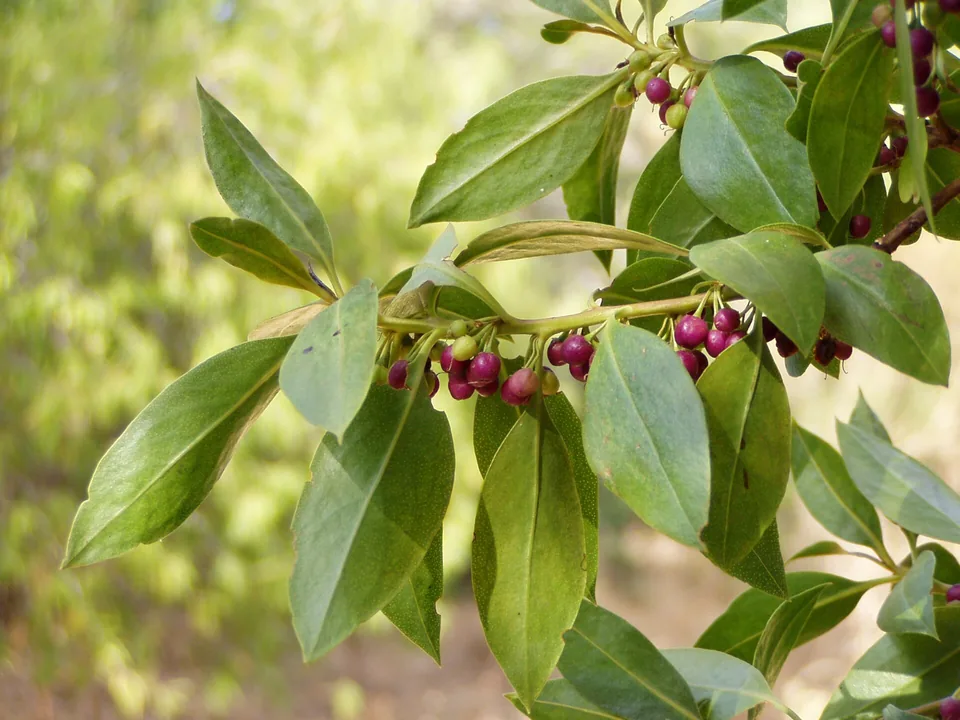
Myoporum laetum (ngaio) is an evergreen shrub or small tree native to New Zealand, grown as a landscape ornamental with white, purple-spotted flowers. [7] It is mainly a coastal plant, useful for seaside plantings, screens and hedges, and it has become invasive in California. [5][1] Its leaves and fruits are toxic to livestock and can be fatal. [1]
This record is incomplete: the sources we read do not cover every field yet.
Not yet covered by our sources: Pruning
Ngaio care
How to water Ngaio
Watering
Drought tolerant
What the sources say (1)
In areas with water available, it grows rapidly into large, dense stands. It is surprisingly drought tolerant.Watering notes
Requires well-drained soil
What the sources say (1)
medium (loamy) and heavy (clay)
soils, requires well-drained soil and can grow in nutritionally poor soil.How much light Ngaio needs
Full sun
What the sources say (1)
(1) Sun Exposure: Full Sun (2) It cannot grow in the shade.How much cold Ngaio can take
Hardiness, coldest zone
The sources give different values depending on region, zone or growing conditions.
What each source says
According to Trees and Shrubs Online: 9-10 [winter low −6.7 to 4.4 °C (20 to 40 °F)]
According to PIER risk assessment: 11 [winter low 4.4 to 10 °C (40 to 50 °F)]
What the sources say (2)
According to Trees and Shrubs Online: Habitat  Coastal regions down to the high-tide line USDA Hardiness Zone  9-10According to PIER risk assessment: (1) Hardiness: USDA Zone 11: above 4.5 �C (40 Hardiness, warmest zone
The sources give different values depending on region, zone or growing conditions.
What each source says
According to Trees and Shrubs Online: 9-10 [winter low −6.7 to 4.4 °C (20 to 40 °F)]
According to PIER risk assessment: 11 [winter low 4.4 to 10 °C (40 to 50 °F)]
What the sources say (2)
According to Trees and Shrubs Online: Habitat  Coastal regions down to the high-tide line USDA Hardiness Zone  9-10According to PIER risk assessment: (1) Hardiness: USDA Zone 11: above 4.5 �C (40 How to propagate Ngaio
Seed; semi-hardwood cuttings
What the sources say (2)
Propagation technique
Easily grown from fresh seed and semi-hardwood cuttingsIt will grow best in good soil, but also copes with drier sites. Propagation is from seed or by cuttings.How to grow Ngaio
The plant
Family
Myoporaceae
What the sources say (1)
Família: MYOPORACEAE Género: Myoporum Sinònims: Myoporum tenuifolium G. Forst.Mature height
up to 800 cm (8 m)
What the sources say (1)
Arbusto o pequeño árbol de hasta 8 m. de altura que se mantiene verde todo el año.Pests and diseases
Pests
myoporum thrips (Klambothrips myopori)
What the sources say (1)
In California, myoporum thrips has only been observed on two species of Myoporum: M. laetum, which is a shrub or small treeHeat and drought
Drought
Myoporum is drought hardy, which makes the genus desirable for ornamental planting.
What the sources say (1)
The drought hardiness of Myoporum , and the fact that the plants are generally so pest free, has made members of this genus desirable for ornamental planting.Pruning
Hard pruning
Avoid excessive pruning: it can stress or even kill Myoporum trees and shrubs.
What the sources say (1)
Be aware that excessive pruning can stress, or even kill, both large and small Myoporum trees and shrubs.Ngaio pests and problems
Myoporum thrips (Klambothrips myopori)
Symptom: Gall-like distortion of new leaves, leaf curling and severely stunted terminal growth; persistent damage can kill established plants.
What to do: Avoid planting susceptible species; prune, bag and dispose of infested shoots; systemic insecticides where infestations are severe.
What the sources say (2)
Myoporum plants damaged by this thrips are characterized by gall-like distortion of new leaves. Terminal growth can be severely stunted
— Myoporum Thrips / Home and Landscape / UC Statewide IPM Program (UC IPM) [4] On affected plants, infested terminal shoots may be pruned, bagged, and disposed of.
— Myoporum Thrips / Home and Landscape / UC Statewide IPM Program (UC IPM) [4]
Remedies
Each remedy shows what official sources say about it; traditional remedies without an official source are marked as such. Harmful ones are listed so you know to avoid them.
Treating the plant
myoporum thrips
prune and bag infested shoots Works
Be aware that excessive pruning can stress, or even kill, both large and small Myoporum trees and shrubs.
— ipm.ucanr.edu [9] How: Infested terminal shoots are pruned, bagged and disposed of; dying or dead plants are disposed of in the same way to prevent spread to other plants.
On affected plants, infested terminal shoots may be pruned, bagged, and disposed of.
— ipm.ucanr.edu [9] What the evidence says On affected plants, infested terminal shoots may be pruned, bagged, and disposed of. Dying or dead plants should be disposed of in the same manner to prevent spread of the pest to other plants.
— ipm.ucanr.edu [9] insecticidal soap or horticultural oil spray Not proven
How: Contact sprays of oils and soaps, which control other thrips, do not reach this thrips protected inside twisted terminal growth.
it cannot be successfully managed with the reduced-risk and organic contact insecticides such as oils, soaps, and spinosad that control other species of thrips
— ipm.ucanr.edu [9] What the evidence says Because this thrips mostly lives protected within twisted terminal growth, it cannot be successfully managed with the reduced-risk and organic contact insecticides such as oils, soaps, and spinosad that control other species of thrips.
— ipm.ucanr.edu [9]
Getting rid of it
myoporum laetum
pull seedlings Works
If the root remains in the ground the plant will resprout with vigor.
— IPCW Plant Report – California Invasive Plant Council [1] How: Pull seedlings when the soil is moist and the plant is small; seedlings have long, strong taproots. Annual seedling removal is needed where seed sources are plentiful.
Seedlings can be pulled, but they have long, strong taproots, and pulling must be done when the soil is moist and the plant is small.
— IPCW Plant Report – California Invasive Plant Council [1] What the evidence says To control weeds without using manufactured herbicides, the best option is to pull, remove or interfere with weed growth.
— extension.usu.edu [10]
Is Ngaio toxic to pets?
Reported by the source, quoted verbatim. This is not medical or veterinary advice: if a person or an animal may have eaten this plant, contact a poison control centre or a veterinarian.
Animals
myoporum is removed. Leaves and fruits are toxic and may be fatal to livestock.
[1]- Poisonous parts
fruit is less toxic than the leaves, and toxin is released with leaf fall
[1]- Toxic principle
The toxin (ngaione) is a furanoid sesquiterpene ketone that constitutes 70 to 80
[1]- Symptoms
Ngaio tree foliage contains toxic chemical compounds that can cause fatal liver damage in livestock
[7]
Ngaio deaths are most common in cattle (in 1945, 73 cattle died on Banks Peninsula)
[8]
People
Plant needs to be ingested to manifest toxicity. No evidence of poisoning in humans.
[8]
Calendar
Pruning
Not stated in the sources we read.
Months as given by the sources, which are mostly from the United States (northern hemisphere). In the southern hemisphere they shift by about six months.
Edibility
Reported by the source, quoted verbatim. Do not eat a plant on the basis of this page alone: identification mistakes can be dangerous.
The reddish-purple fruits are recorded as being eaten but caution should be taken as all parts of this plant are now known to contain a liver toxin.
[8]
Similar plants
- Myoporum insulare Myoporum insulare
- Abies grandis Abies grandis
- Abraham Trachystemon orientalis
- Abyssinian banana Ensete ventricosum
- Acacia longifolia Acacia longifolia
- Acanthus hungaricus Acanthus hungaricus
- Aconite Aconitum napellus
- Adam's Needle Yucca flaccida
Sources
Every value above is quoted from these documents. Links lead to the original publisher.
- IPCW Plant Report – California Invasive Plant Council · cal-ipc.org, consulted
- Myoporum Thrips | Center for Invasive Species Research · cisr.ucr.edu, consulted
- Myoporum laetum • New Zealand Plant Conservation Network · nzpcn.org.nz, consulted
- Myoporum Thrips / Home and Landscape / UC Statewide IPM Program (UC IPM) · ipm.ucanr.edu, consulted
- Myoporum laetum - Trees and Shrubs Online · treesandshrubsonline.org, consulted
- Myoporum laetum G. Forst. - Herbari Virtual del Mediterrani Occidental · herbarivirtual.uib.es, consulted
- Myoporum laetum Profile – California Invasive Plant Council · cal-ipc.org, consulted
- Myoporum laetum risk assessment · hear.org, consulted
- ipm.ucanr.edu · ipm.ucanr.edu
- extension.usu.edu · extension.usu.edu
Written by Emilio Marruso · last checked