
How to Grow and Care for Nosegaytree
Plumeria alba
Written by Emilio Marruso · last checked
Toxic to: People · Why
At a glance
Plumeria alba loves full sun, also accepts partial shade, and grows happily in a container. Give it well-drained soil and feed it often during the growing season with a high-phosphorus fertilizer to encourage flowering. It can reach up to 40 ft tall, and you can start new plants yourself from stem cuttings, a fun project even for a beginner.
- Sun
Full sun to partial shade
- Soil
Well-drained soil: in soggy soil the roots rot
What the sources say (2)
- Feeding
Feed often in the growing season with a high-phosphorus fertilizer; never outside that season
What the sources say (4)
When: During the growing season only
Fertilize frequently during the growing season with a high phosphorus (blossom-booster) fertilizer to encourage flowering, and do not fertilize at other times of the year.
— Plumeria – Wisconsin Horticulture [6] How often: Frequently during the growing season
Fertilize frequently during the growing season with a high phosphorus (blossom-booster) fertilizer to encourage flowering, and do not fertilize at other times of the year.
— Plumeria – Wisconsin Horticulture [6] Mineral fertilizers: High-phosphorus (blossom-booster) fertilizer, to encourage flowering
Fertilize frequently during the growing season with a high phosphorus (blossom-booster) fertilizer to encourage flowering, and do not fertilize at other times of the year.
— Plumeria – Wisconsin Horticulture [6] Avoid: Fertilizing outside the growing season
Fertilize frequently during the growing season with a high phosphorus (blossom-booster) fertilizer to encourage flowering, and do not fertilize at other times of the year.
— Plumeria – Wisconsin Horticulture [6] - Pests
Whiteflies, mealybugs and spider mites; also root rot, sooty mold and rust
What the sources say (1)
Pests: white flies, mealybugs, spider mites
Plumeria have few problems, but can be infested with common greenhouse pests such as white flies and mealybugs, and are very susceptible to spider mites. Insecticidal soap can be used to control these pests.
— Plumeria – Wisconsin Horticulture [6] - Size
Up to 40 ft tall
What the sources say (1)
Mature height: up to 1219.2 cm (40 ft)
In its native Puerto Rico this plant can grow up to 40 feet tall.
— Plumeria – Wisconsin Horticulture [6] - Propagation
From stem cuttings, grafting or air layering
What the sources say (1)
Propagation: Stem cutting, grafting, marcotting
Propagation Method | Stem Cutting, Grafting, Marcotting
— NParks | Plumeria alba [2] - Containers
Grows in containers too
What the sources say (1)
In containers: Yes
Parks & Gardens, Small Gardens, Container Planting, General
— NParks | Plumeria alba [2] - Safety
Its sap is irritating to people: handle it with care
Overview
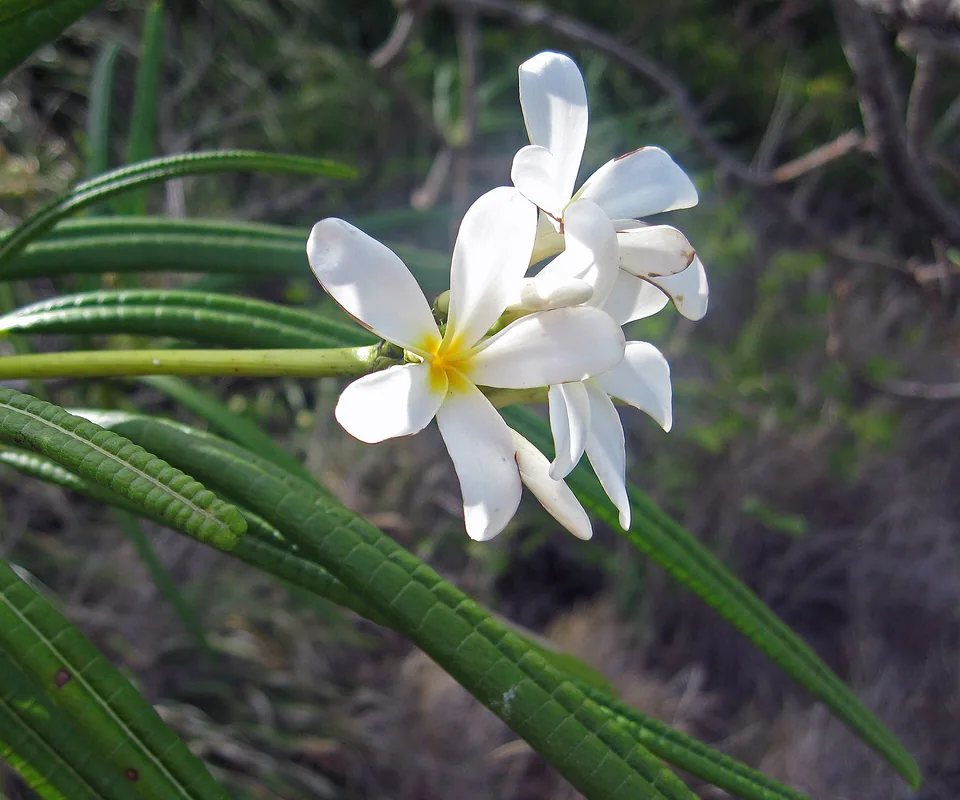
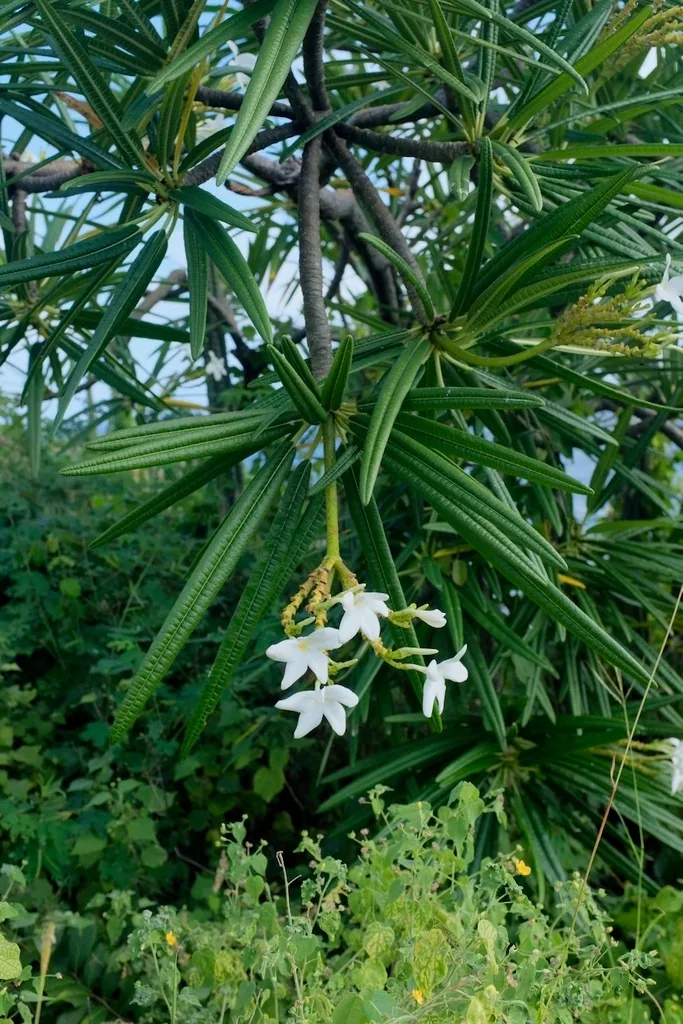
Plumeria alba is a small tree native to Puerto Rico and the Windward Islands, widely cultivated for its ornamental and scented flowers. [2] It is susceptible to freezing and prefers full sun and well-drained soil. [1][2]
This record is incomplete: the sources we read do not cover every field yet.
Not yet covered by our sources: Hardiness, coldest zone, Hardiness, warmest zone, Pruning
Nosegaytree care
How to water Nosegaytree
Watering
The sources give different values depending on region, zone or growing conditions.
What each source says
According to NParks: Moderate water
According to Useful Tropical Plants: Established plants are very drought tolerant
Watering notes
Well-drained soils; root rot can infect plants in poorly-drained soils
How much light Nosegaytree needs
How much cold Nosegaytree can take
Hardiness, coldest zone
Not stated in the sources we read.
Hardiness, warmest zone
Not stated in the sources we read.
Where to grow Nosegaytree
Yes
What the sources say (1)
Parks & Gardens, Small Gardens, Container Planting, GeneralHow to propagate Nosegaytree
Stem cutting, grafting, marcotting
What the sources say (1)
Propagation Method
| Stem Cutting, Grafting, MarcottingHow to grow Nosegaytree
The plant
Family
Apocynaceae
What the sources say (1)
Plumeria is a genus of eleven species of shrubs and small trees in the dogbane family (Apocynaceae) native to tropical America from Brazil to Mexico and the Caribbean.Mature height
up to 1219.2 cm (40 ft)
What the sources say (1)
In its native Puerto Rico this plant can grow up to 40 feet tall.Pests and diseases
Pests
white flies, mealybugs, spider mites
What the sources say (1)
Plumeria have few problems, but can be infested with common greenhouse pests such as white flies and mealybugs, and are very susceptible to spider mites. Insecticidal soap can be used to control these pests.Fertilizing
When
During the growing season only
What the sources say (1)
Fertilize frequently during the growing season with a high phosphorus (blossom-booster) fertilizer to encourage flowering, and do not fertilize at other times of the year.How often
Frequently during the growing season
What the sources say (1)
Fertilize frequently during the growing season with a high phosphorus (blossom-booster) fertilizer to encourage flowering, and do not fertilize at other times of the year.Mineral fertilizers
High-phosphorus (blossom-booster) fertilizer, to encourage flowering
What the sources say (1)
Fertilize frequently during the growing season with a high phosphorus (blossom-booster) fertilizer to encourage flowering, and do not fertilize at other times of the year.Avoid
Fertilizing outside the growing season
What the sources say (1)
Fertilize frequently during the growing season with a high phosphorus (blossom-booster) fertilizer to encourage flowering, and do not fertilize at other times of the year.Nosegaytree pests and problems
Root rot, mealybugs, sooty mold and rust
Symptom: Root rot in poorly-drained soils; mealybug infestations followed by black sooty mold; rust fungus on leaves
What the sources say (1)
Root rot can infect plants planted in poorly-drained soils. It is susceptible to mealy bug infestations and secondary infection of black sooty mold.
— NParks | Plumeria alba [2]
Remedies
Each remedy shows what official sources say about it; traditional remedies without an official source are marked as such. Harmful ones are listed so you know to avoid them.
First aid
First aid: not a substitute for a doctor
skin contact with irritant sap
washing with running water and soap Official source, not independently tested
Swallowed a possibly poisonous plant? Use the web POISON CONTROL online tool to get help, or call your poison center at 1-800-222-1222
— poison.org [7] How: Wash the area thoroughly with plenty of running water and soap.
- Wash the area thoroughly with plenty of running water and soap.
— poison.org [7]
Treating the plant
spider mites
light horticultural oil spray Works
When using soaps or oils, plants should be well-watered to avoid stress, and caution must be taken not to expose the plants to excessive heat and/or direct sunlight prior to or after treatment.
— ipm.ucanr.edu [8] How: A light horticultural oil spray (1% solution), covering all plant surfaces.
A light horticultural oil spray (1% solution) can effectively control mites if care is taken to cover all plant surfaces.
— ipm.ucanr.edu [8] What the evidence says A light horticultural oil spray (1% solution) can effectively control mites if care is taken to cover all plant surfaces.
— ipm.ucanr.edu [8] insecticidal soap Partly works
When using soaps or oils, plants should be well-watered to avoid stress, and caution must be taken not to expose the plants to excessive heat and/or direct sunlight prior to or after treatment.
— ipm.ucanr.edu [8] How: Insecticidal soaps can be utilized as an alternative to oil.
Insecticidal soaps can be utilized as an alternative to oil but it’s more likely that repeat applications may be necessary.
— ipm.ucanr.edu [8] What the evidence says Insecticidal soaps can be utilized as an alternative to oil but it’s more likely that repeat applications may be necessary.
— ipm.ucanr.edu [8] sticky tape on the stem Partly works
How: Double-sided sticky tape wrapped around the plant stem.
Double-sided sticky tape wrapped around the plant stem may help prevent overwintering mites from crawling up the stem.
— ipm.ucanr.edu [8] What the evidence says Double-sided sticky tape wrapped around the plant stem may help prevent overwintering mites from crawling up the stem.
— ipm.ucanr.edu [8]
whiteflies and mealybugs
insecticidal soap Works
How: Insecticidal soap can be used to control these pests.
Plumeria have few problems, but can be infested with common greenhouse pests such as white flies and mealybugs, and are very susceptible to spider mites. Insecticidal soap can be used to control these pests.
— Plumeria – Wisconsin Horticulture [6] What the evidence says Plumeria have few problems, but can be infested with common greenhouse pests such as white flies and mealybugs, and are very susceptible to spider mites. Insecticidal soap can be used to control these pests.
— Plumeria – Wisconsin Horticulture [6]
Is Nosegaytree poisonous?
Reported by the source, quoted verbatim. This is not medical or veterinary advice: if a person or an animal may have eaten this plant, contact a poison control centre or a veterinarian.
Calendar
Pruning
Not stated in the sources we read.
Months as given by the sources, which are mostly from the United States (northern hemisphere). In the southern hemisphere they shift by about six months.
Indicative values
Values from a secondary source, not checked word for word like the rest of this page. Use them as a starting point.
- Life cycle
- PerennialIndicative value, adapt it to your climate · Secondary source
- Hours of sun
- 4-6 hoursIndicative value, adapt it to your climate · Secondary source
- Drought tolerant
- yesIndicative value, adapt it to your climate · Secondary source
- Soil pH
- 6-7Indicative value, adapt it to your climate · Secondary source
- USDA hardiness zones
- 10-12 [winter low −1.1 to 15.6 °C (30 to 60 °F)]Indicative value, adapt it to your climate · Secondary source
- Growth rate
- HighIndicative value, adapt it to your climate · Secondary source
- Pruning
- December, January, February, MayIndicative value, adapt it to your climate · Secondary source
Similar plants
- Plumeria Plumeria rubra
- Singapore graveyard flower Plumeria obtusa
- Allamanda Allamanda cathartica
- Asiatic Jasmine Trachelospermum asiaticum
- Bladderflower Araujia sericifera
- Blue Star Amsonia ciliata
- Blue Star Amsonia hubrichtii
- Bush allamanda Allamanda schottii
Sources
Every value above is quoted from these documents. Links lead to the original publisher.
- Plumeria alba - Plant Detail - Tropical Plants Database - NTBG Database · ntbg.org, consulted
- NParks | Plumeria alba · nparks.gov.sg, consulted
- Plumeria alba - Useful Tropical Plants · tropical.theferns.info, consulted
- Acokanthera, Adenium, Allamanda, Alstonia, Ambelania, Araujia, Asclepias, Aspidosperma, Calotropis, Cameraria, Carissa, Catharanthus, Cerbera, Chloropetalum, Cosmostigma, Cryptolepis, Cryptostegia, Dischidia, Dyera, Ervatamia, Fischeria, Geissospermum, Gonioma, Hancornia, Heinsia, Hemidesmus, Holarrhena, Hoya, Lacmellea, Macoubea, Malouetia, Mandevilla, Marsdenia, Metaplexis, Nerium, Oxystelma, Pachypodium, Parameria, Pergularia, Periploca, Plumeria, Rauvolfia, Rejoua, Rhabdadenia, Sarcostemma, Tabernaemontana, Tanghinia, Thevetia, Tylophora, Vinca, Vincetoxicum, Wrightia | APOCYNACEAE: BoDD · botanical-dermatology-database.info, consulted
- Plumeria (Frangipani) | San Diego Zoo Animals & Plants · animals.sandiegozoo.org, consulted
- Plumeria – Wisconsin Horticulture · hort.extension.wisc.edu, consulted
- poison.org · poison.org
- ipm.ucanr.edu · ipm.ucanr.edu
Written by Emilio Marruso · last checked